HISTORY
Mioko Island community in East New Britain is gearing up for a commemoration ceremony to honour the crew of the sunken World War submarine AE1,
OFF the shores of Mioko Island in East New Britan lies a forgotten piece of history, hidden beneath the vast mighty Bismarck Sea for over a century.
And for over a century the crushing depts of the St George Channel hid the sunken submarine HMAS AE1, since Sept 14, 1914.
AE1 was Australia’s first submarine. However, the restless ghost of the 35 drowned sailors didn’t give up fighting against the downward pressure of the depths to stay back in the submarine. They struggled to swim up against the ocean’s eternal cruel tight fist to return to their loved ones and they finally surfaced in 2017.
And now the sailors’ loved ones in Australia and their adopted families on Mioko are preparing to mourn them during the first commemoration ceremony in September. The commemoration ceremony will include an Australian Navy farewell ceremony and Mioko’s traditional mourning ceremony.
The submarine was on patrol during World War I, when it tragically sank about 1km off Mioko in the Duke of York Group of Islands. It sank mysteriously during the war between the British Empire and German Empire.
At the time, the German Empire colonised the New Guinea region, while the British Empire colonised the Papuan region. And East New Britain was a base for German New Guinea.
This incident predates the iconic battles of Kokoda and Milne Bay, and while those WWII events have brought Papua New Guineans and Australians together through commemoration ceremonies, the AE1’s story remains a powerful, lesser-known link between our nations. And now the commemoration ceremony will bring the islanders and relatives of the deceased Australian submariners together. It will also further bond the historical relationship between Australia and PNG.
The sinking of the AE-1 was in Mioko’s traditional waters. And, due to the strong cultural protocol of the Mioko people, the sailors are buried in their traditional waters. And so, the Islanders have adopted the 35 sailors and will host a fitting traditional mourning ceremony for them during the commemoration ceremony.
It’s historical because Australian Navy only had two submarines during WW1. The AE-1 and AE-2. The A E-1 sank here and AE-2 sank in Turkey. also during WW1.
The islanders are now working with the Australian Government and relatives of the deceased servicemen to commemorate the sailors’ deaths. The relatives have formed what is now the Australian E Class Submarine Foundation Limited. The AE1 family Descendant Association to worked together with AE-1 Duke of York Association.
The AE-1Duke of York Association is made up of the deceased adopted families on Mioko and so the islanders will hold a traditional funeral ceremony during the commemoration in September, while the Australian Navy will also conduct a farewell ceremony.
“It’s an initiative of the Mioko Islanders and the commemoration ceremony is structured to combine all the clans of the Island,” AE1 Duke of York Association executive officer Walter Litur says.
“So far, we have identified 17 major clans. Since there were 35 navy personnel on board AE1, our chiefs came up with an initiative to adopt the 35 submariners to capture them into their own clan to commemorate them. The Australians had already formed AE-1 Class Association. That was the association that had worked over the century to find this submarine. And they finally found it in 2017.”
Litur said that AE-1 is very precious to the Australian Naval history.
“It’s historical because Australian Navy only had two submarines during WW1. The AE-1 and AE-2. The A E-1 sank here and AE-2 sank in Turkey also during WW1.
“Here there is a monument being built which is an initiative by Australian AE class association and we are link to them. Currently we are doing preparations for the event on Sept 14. The Australian High Commission in PNG with the PNG Department of Foreign Affairs and Australian Department of Foreign Affairs and Trade are working closely to decide on the dedication event since it is two days away from the national event day of PNG independence.
“But this is a concern as invited political leaders from PNG will stay at their respective provinces for independence celebration and might not attend. And so we are working together to come up with a favorable date so that all the invited politicians will attend”.
Litur said Mioko people have now become custodians of the AE-1 submarine. According to Litur almost 13 expeditions were conducted since 1970 by late John Foster, a retired Australian Navy commander. Sadly, the late Foster passed away in 2010 after 12 unsuccessful expeditions that were conducted at the same location. But his effort was not wasted. His successor Jim Miles obtained all his reports and with the latest cutting edge marine navigational technology finally found AE-1 in 2017 at the same location on the 13th expedition.

“Miles came on a fully equipped latest marine survey ship Fugro Equator, and they found AE-1 at the same location that late Foster had been searching for between 1970 and 2010. This time Miles used a remotely operated under water vehicle (ROV) and deployed it down at the same location identified by his late predecessor. Finally, the ROV detected a metal 300 meters deep.”
Further detailed verification of the detected metal indicated that it was the AE-1. And that’s how AE-1 was found. Its final resting place is 300 meters deep and about 1km off shore of Mioko Island.
That A E 1 site at Mioko Island is now a shared heritage site for PNG and Australia. Conservation and Environment Protection Authority is the mandated government agency in PNG to manage the heritage site together with underwater cultural heritage division of Australia.
Litur said that since the discovery of AE-1, they have been advised by the National Museum and Art Gallery to incorporate an association to represent Mioko Islanders to commemorate AE-1.
“Now we have an association called Duke of York AE- 1 Submarine Development Foundation. Currently we are liaising with the East New Britain Provincial Government. At the same time, we are liaising with the Australian government through Australian Underwater Cultural Heritage to host the commemoration ceremony.
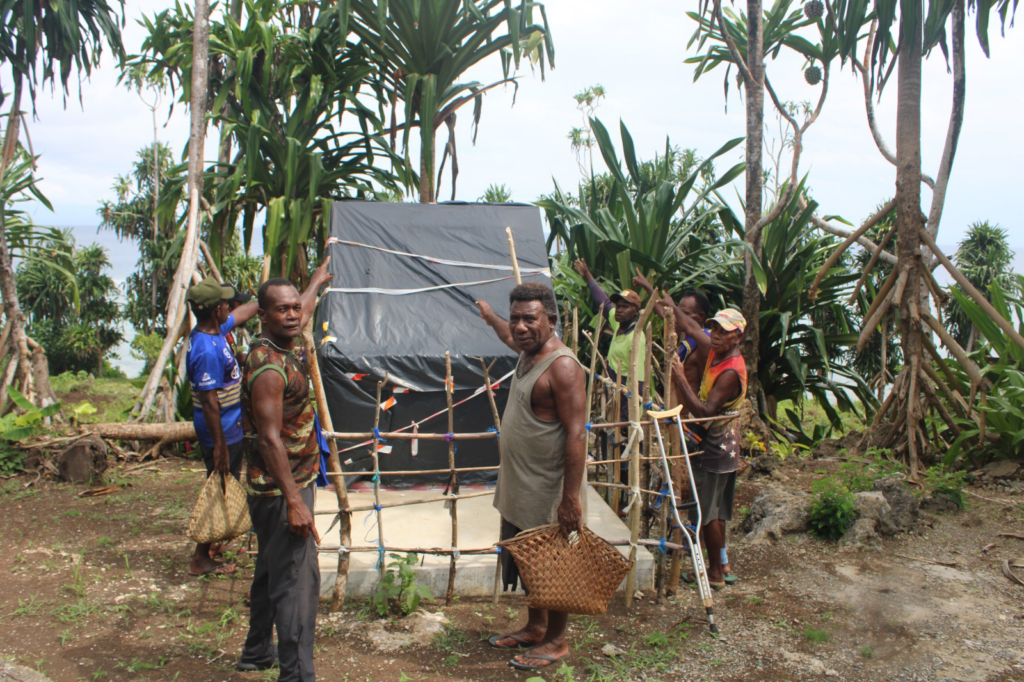
“And we have constructed the plaque and prepared the commemoration ceremony area. We are now looking forward for the event. There is still much more preparation work to be done and we are in consultation with the Australian government to ensure that we have a fitting event to commemorate these 35 under water warriors. Also the late Foster can be acknowledged for his efforts to find AE-1.
This is the only plaque that commemorates the sinking of the AE-1 in PNG after it was discovered. But prior to the discovery of the sunken AE-1, there were monuments to commemorate its loss. A Google search revealed that a stained-glass window commemorating the losses of AE1 was added to the naval chapel at Garden Island in Sydney Australia in 1933.
In September 2015, a floating sculpture to commemorate AE1 was unveiled outside the Australian National Maritime Museum and In 2008 a memorial plaque was dedicated to HMAS AE1 at the Tasmanian Seafarers’ Memorial at Triabunna on the east coast of Tasmania.
p.s: More detail on the sunken submarine can be obtained from online sources.
- Clifford Faiparik is the media officer at the Climate Change and Development Authority.