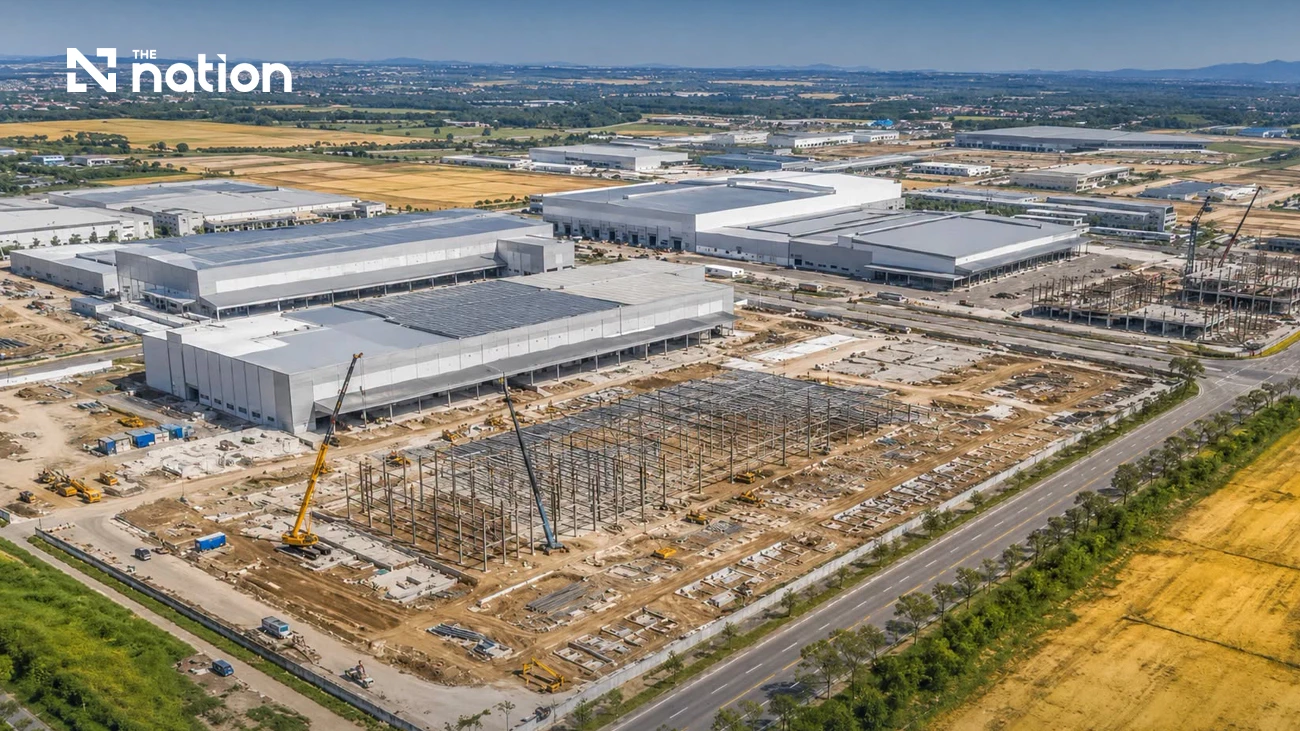
Large land holding raises questions
In practice, the source said, a large land bank may have been assembled, potentially reaching 5,000 rai. Initial land filling, development work and infrastructure preparation have already begun, while an electricity request of up to 300 megawatts has reportedly been submitted.
That level of power demand is comparable to a large industrial estate. The project has also reportedly contacted industrial raw-water suppliers, although some companies declined because of concerns about Chinese-backed land accumulation.
The area in Bo Thong, Chonburi, is subject to the land-use and infrastructure development plan for the Eastern Economic Corridor issued in 2019.
Under that plan, land classified as light-yellow zone, is designated as rural community land. Its purpose is to support communities, social service centres, rural economic activity and agriculture.
The rules for light-yellow land prohibit industrial projects that may cause severe environmental or health impacts as defined by the Industry Ministry. They also prohibit land allocation for industrial purposes under the land allocation law.
Authorities find no industrial estate application
A source from the Industry Ministry said no application had been found from Hengtu Industrial Park Co Ltd to establish an industrial zone.
The Industrial Estate Authority of Thailand also found no record of an application to establish an industrial estate under the same project name.
Checks with the Department of Business Development show that Hengtu Industrial Park Co Ltd has registered capital of 5 million baht, with its main business objective listed as real-estate agency and brokerage.
“There has been large-scale land collection and accumulation, with the first phase of development beginning at around 1,000 rai to support future industrial development. This pattern raises questions about whether an intermediary model is being used to hold land in preparation for future foreign investment,” the source said.
The company’s shareholding structure is reported as 60% Thai and 40% Chinese. This does not breach restrictions under the Foreign Business Act. However, in practice, the source said state agencies would still need to monitor closely whether Thai shareholders were being used as nominees to hold assets on behalf of foreign investors.
Yellow zoning becomes a key issue
Another concern is that the project site is located in a light-yellow planning zone, which is legally intended for rural community use.
In principle, such land is not designated to support large-scale industrial development and is subject to limits on activities that could affect the environment and residents’ quality of life.
However, available information indicates that land filling and some construction have already begun. The site may eventually be divided into areas for factories, the source said.
Large projects would normally have to go through detailed planning checks. If the land has not been designated as an industrial zone, the project would need to enter a zoning adjustment process, including impact studies, public hearings and consultations with local residents.
“Proceeding with the project before these processes are completed could become a major loophole that requires comprehensive scrutiny,” the source said.
Power demand matches a major estate
The reported request for up to 300 megawatts of electricity has become another major point of concern.
The figure is at the same level as an industrial estate and is much higher than the power demand of a typical real-estate development.
The source said the case raised several questions. It remained unclear whether the project’s power investment plan had already been coordinated with the Provincial Electricity Authority, whether the application was being submitted in phases or as a single full-project request, and whether the project should come under a special state-supervision framework.
“Developing land to support industrial investment requires a full infrastructure plan, including electricity, water supply, drainage and wastewater treatment systems. If this is truly industrial development, a 300-megawatt power request may reflect planning for large-scale industry,” the source said.
Water supply could affect communities
Water use is another issue requiring scrutiny.
Initial information indicates that companies have been contacted to help secure water sources for investment in the EEC. This has raised questions about the volume of water required and the possible impact on local communities.
The EEC is already a strategic area with high water demand from industry, agriculture and the public.
If water is not managed properly, the source said, long-term water security could be affected.
Although Hengtu Industrial Park Co Ltd is legally registered as a real-estate brokerage business, its operational pattern appears closer to industrial-estate-style development, including large land holdings, utility preparation, major electricity planning and land preparation for investors.
Foreign capital oversight faces new test
The project is now being seen as a test of Thailand’s ability to regulate land and infrastructure development linked to foreign investment.
The infrastructure work and 300-megawatt power request have raised questions over whether the case could expose gaps in oversight of land development intended to serve industrial investment.
Security agencies have previously coordinated inspections into expanding foreign investment and nominee practices, including cases in Rayong and Chonburi. In one major case, a Chinese investment group allegedly used Thai employees, including drivers and sales staff, to hold 51% of shares in companies used to acquire 72 rai of land worth about 2 billion baht.
Violations under Sections 111-113 of the Land Code carry penalties of up to two years in prison and fines. The Land Department also has authority to order land to be sold within 180 days to one year if nominee ownership is found.
The Land Department now links data with the Department of Business Development to examine financial trails and shareholder structures in greater detail before allowing registrations.
The Hengtu Industrial Park case therefore reflects a new challenge for Thailand as it manages a rapid inflow of foreign investment. If regulatory gaps are allowed to open in the strategic EEC area, the model could become a new investment pattern that the government will have to address.
Concerns over Chinese end-to-end investment model
A source from the Thai industrial sector said Chinese investment should be watched closely because some groups were moving into multiple parts of the supply chain, from upstream to downstream operations.
As more Chinese companies enter Thailand and industrial-estate land in the EEC becomes increasingly expensive, some Chinese investors are buying land themselves to develop and sell to other Chinese companies.
Some investment structures reportedly involve Thai accounting or legal firms helping set up companies to acquire land inside and outside EEC industrial estates, as well as in commercial districts such as Yaowarat and Huai Khwang.
This pattern has helped push land prices up by 20-30%, while rents for commercial buildings in some districts have risen threefold to tenfold. Local Thai operators have struggled to compete with the higher costs, with some forced to close.
Chinese investors have also been acquiring land outside industrial estates in EEC areas such as Pluak Daeng district in Rayong and Bo Win subdistrict in Si Racha district, Chonburi.
In some cases, the source said, Chinese capital has been invested through nominee structures, pushing land prices higher and making it harder for Thai businesses to expand. In some locations, land and rental costs have nearly tripled, preventing local operators from renting space for livelihoods or factory expansion and causing some local businesses to disappear.