Think before you print this page! We know such reminders of climate awareness from emails. Raising awareness of sustainable behavior is called “green nudges”. “People who get an Amazon delivery every day sometimes tell me that they live totally sustainably anyway,” says Margaretha Gansterer from the Institute of Economics and Analytics at the University of Klagenfurt, shaking her head. “Many people are not even aware of the emissions caused by the delivery of online shopping.”
Gansterer specializes in “last mile” calculations: what costs and CO2-Emissions occur in the last section of the supply chain? The journey from the warehouse to the end customer is time-consuming; it involves finding a parking space, taking double routes, traffic jams, etc. The fewer goods are transported per delivery car or moped, the more harmful it is for the environment. “You cannot decouple the costs for a company from the environmental consequences,” emphasizes Gansterer. Because the more fuel is consumed, the more exhaust gases are released into the atmosphere. The world is currently experiencing a major green nudging due to the rise in oil prices: suddenly people who used to race along motorways at 150 km/h are now driving a petrol-saving 100, turning off the air conditioning in their car or removing the roof rack that causes air resistance.
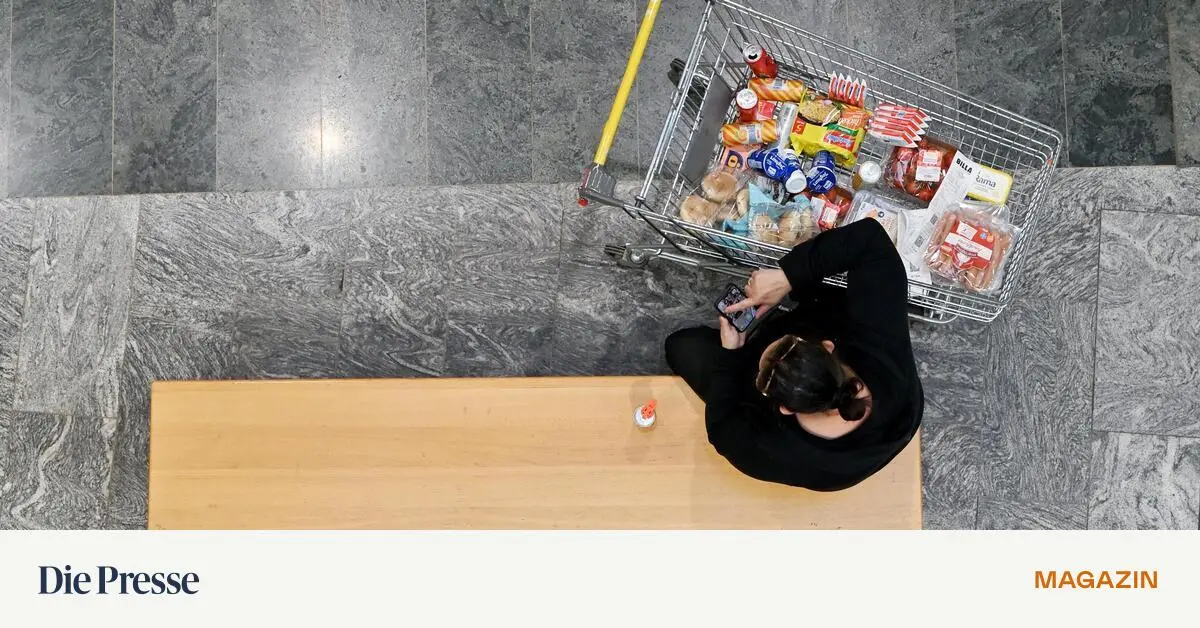
A team from Carinthia and Italy looked at how people can be nudged towards more sustainability when shopping online at supermarkets. The data collection took place in Palermo, where the researchers were given anonymous access to a large customer base at a food retailer. Delivering perishable goods is challenging for companies, especially in the last mile. Offers also flourished in Austria during the pandemic, but today the large chains in this country have stopped their supermarket deliveries again.
“When it comes to shelf life and cold chains, there are narrow time windows. You can hardly cover your costs,” says Gansterer, who has never ordered online from a supermarket herself. “In surveys and experiments, we offered customers the choice of a more flexible delivery schedule.” The question was, what attracts online shoppers more in a green direction, to a delivery option that has the least CO22emissions caused?
It has been well-tested with airlines that you can make your contribution to climate protection for a fee of miles or a small surcharge. Likewise, large online mail order companies have e.g. B. Buttons installed during the payment process, which lead to a lower ecological footprint with just one click.
“It could say something like, ‘Think about whether you really need this tomorrow at 2 p.m.,’” says Gansterer. In the current study, the team was able to combine real empirical data with optimization calculations for companies. “You often expect simulated conditions, but we used the answers from online customers,” says Gansterer. If you incorporate this knowledge into route planning, the company can optimize: What does customer behavior really mean in numbers, how much emissions can you reduce or how much costs can you save?
In the experiments, participants either received financial incentives for a climate-friendly delivery option or were encouraged to have a sense of community and environmental awareness. “We offered the option of using a shared kart. This is a shared shopping cart for the neighborhood,” says Gansterer. In this way you can bundle the delivery and save an enormous amount of fuel.
The results varied greatly depending on the order in which online customers were presented with the incentives. Those who first decided on a green option for financial reasons were then more willing to choose the most ecologically sensible option of shared kart or maximum time flexibility. But if someone showed “green behavior” first, an additional financial incentive presented later would no longer help. “It was more the case that these people refused to act more sustainably if there was a discount for it,” says Gansterer.
With the shared shopping basket, which is only delivered to the neighborhood if there are four customers or more, it became clear that peer pressure works: if three neighbors are already taking part, you would rather click on this option than if you are the first who might have to wait two days for the delivery truck to come to your alley.
The evaluation based on the age, gender or income of the participants showed hardly any differences, except that in principle women responded more to green nudges. It has a particularly strong effect on everyone when CO figures are present2-Reduction can be called: “People click on it more often if it is clear that the shared shopping cart saves 60 percent of emissions or 90 percent of delivery costs,” says Ganstererwho would never drive to the supermarket herself just for a little something.