At the beginning of the United States and Israel’s war against Iran, I dared to predict in this column that the biggest winner of this conflict would be the interim dictator of Venezuela, Delcy Rodríguez. A new economic study that predicts huge growth for the Venezuelan economy this year (2026) further convinces me that I was right.
The study by the well-known economist Asdrúbal Oliveros projects that Venezuela’s economy will grow by 12%, thanks to the lifting of US oil sanctions and by the increase in oil prices since the start of the war with Iran.
“Venezuela’s economy is showing signs of remarkable progress,” Oliveros wrote on AmericasQuarterly.org. “Production has increased to more than 1 million barrels per day and is expected to continue growing in the coming months.”
Although the growth projected by Oliveros would only begin to reverse an economic collapse of more than 20 years, Venezuela would be one of the fastest growing economies in Latin America. The region as a whole will grow just 2.3% this year, according to the World Bank.
The Venezuelan economy began to recover after the US attack on January 3 that captured former dictator Nicolás Maduro and replaced him with Rodríguez, his former vice president. The new president had been a participant and accomplice in the brutal repression of the Maduro regime.
However, since Maduro’s capture, Trump has not stopped praising Rodríguez. He has described her as a “fantastic person” and a “friend and partner.”
Although Secretary of State Marco Rubio has called for free elections once the country stabilizes and the economy begins to recover, Trump — the ultimate decision-maker — shows no rush to restore democratic freedoms.
When Trump talks about Venezuela, he talks about oil and, occasionally, drugs. He almost never mentions the word “democracy.”
What’s more, Trump cites the current situation in Venezuela as a major achievement of his foreign policy, without mentioning that the Venezuelan regime still bans opposition leaders and detains some 500 political prisoners, according to the human rights group Foro Penal.
Polls show that most Venezuelans — both inside and outside the country — applaud the United States’ capture of Maduro.
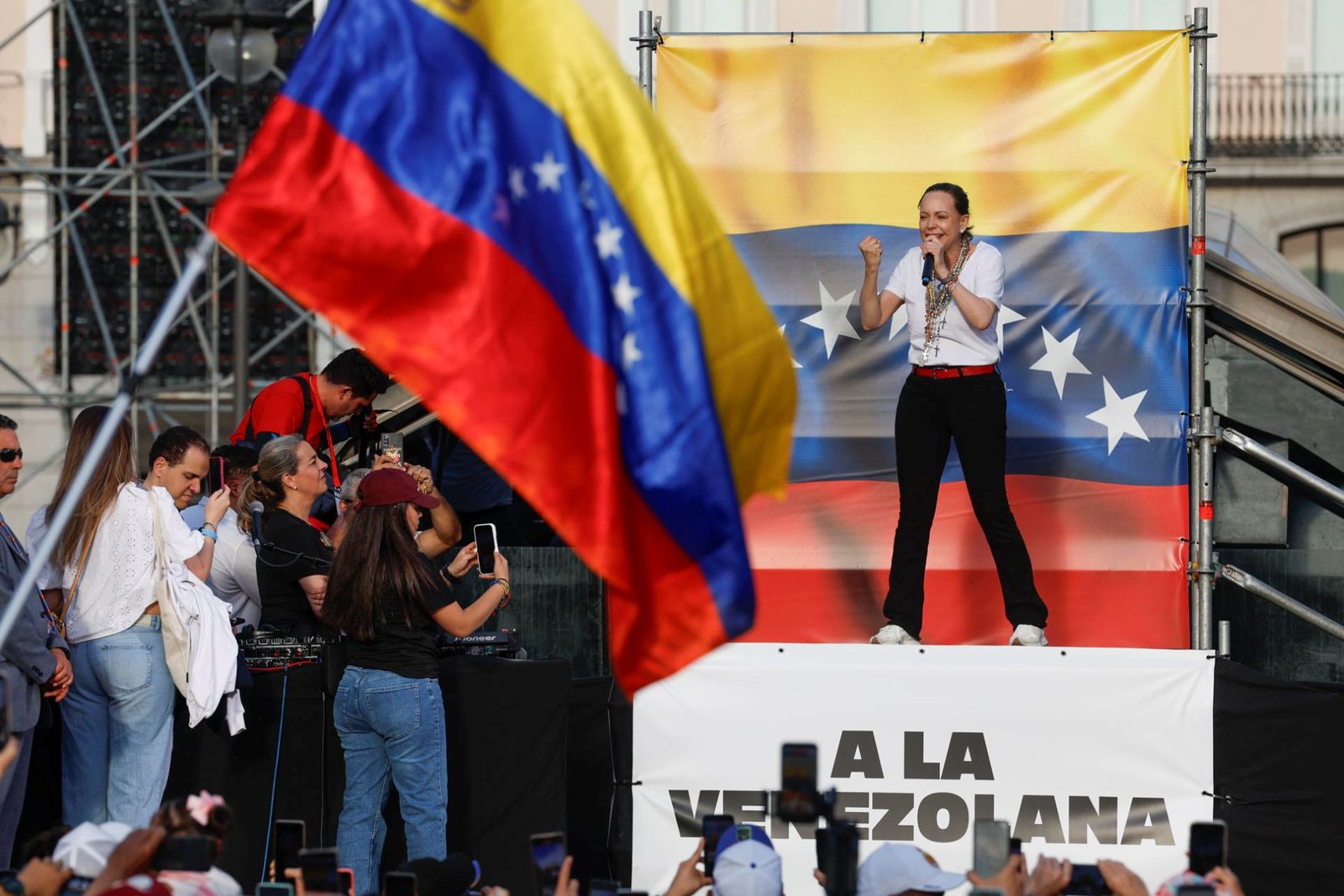
At the same time, polls reveal that opposition leader and Nobel Peace Prize winner María Corina Machado remains much more popular than Rodríguez.
However, according to several former US diplomats, time is working against the Venezuelan opposition leader.
Although many rate the forecast of 12% economic growth as excessively optimistic, most agree that there will be a partial economic recovery that will clearly benefit Rodríguez.
Brian Naranjo, a former State Department official who worked in Venezuela, told me that Rodríguez is running “a de facto presidential campaign” with no rivals in Venezuela.
“Every day that María Corina Machado is outside the country is a day in which Delcy can consolidate and strengthen her position to remain in power,” Naranjo told me. “That’s why I think it’s really imperative that Machado returns to Venezuela as soon as possible.”
John Polga-Hecimovich, a professor at the United States Naval Academy and a specialist in Latin American politics, told me that Venezuela’s economic growth may also reduce pressure from Washington to announce an electoral calendar.
“Delcy Rodríguez will not leave power unless she is forced,” Polga-Hecimovich told me. “She’s not a democrat. She never believed in elections. She never believed in democracy. Why would she suddenly believe in all that now?”
Machado did well to shower Trump with praise so as not to be left out of the game.
But to avoid becoming irrelevant in her own country, the opposition leader should ignore Trump’s advice to postpone her return to Caracas.
I should return as soon as possible. If she is arrested, she will force Trump to publicly take the side of democracy and demand an electoral calendar. And if she is not stopped, she will be able to put herself back on center stage, and possibly become the next president of Venezuela.