Loading Text-to-Speech…
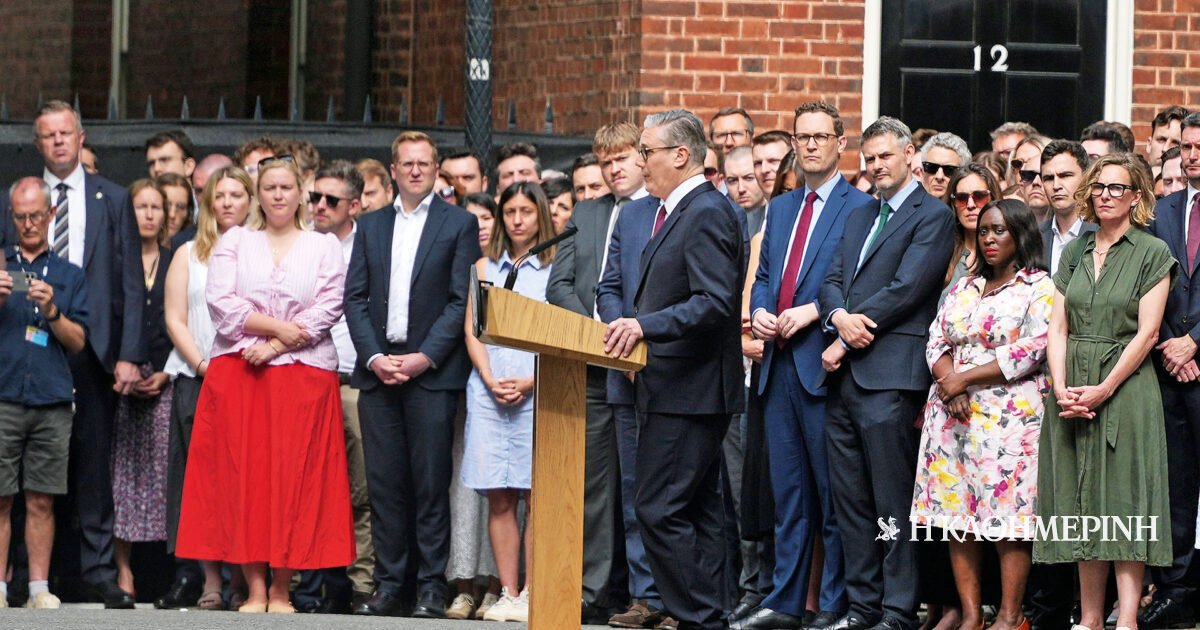
Seven prime ministers in ten years or six in just seven years, depending on where you start counting. She will have changed so many Britain before the end of this summer. THE Keir Starmer announced yesterday that he is stepping down as the leadership of the ruling Labor party and as prime minister, paving the way for a succession process expected to be completed before the end of August or – possibly – even before the end of July.
The citizens of the United Kingdom now recognize in their majority that the exit of the country from the E.U. led to failures and losses.
The elephant in the room of the Prime Minister’s office in Downing Street he is, however, another. Today marks exactly ten years since the referendum that opened its gates Brexit. It was June 23, 2016, when UK voters said yes (51.9% to 48.1%) to leaving the EU. European Union. Since then, of course, many other things have happened: the election of Trump to the presidency of the USA, the coronavirus pandemic, the Russian invasion of Ukraine, the war in Gaza, the re-election of Trump in the USA, the war in Iran, etc.

Especially for Britain though (and not just for Britain), the Brexit constitutes a pivotal development of historical proportions. In the environment created by this decision, Geria Albion changed six prime ministers (Cameron, May, Johnson, Truss, Sunak, Starmer) and is now heading for the seventh, which will most likely be o Anti Burnham. The British are not satisfied with what has followed in their country since that referendum in 2016. Especially on the economic front, the course has been disappointing. If Brexit had not intervened, the country’s exports, productivity, employment, fiscal revenue, investment and overall GDP would be higher than they have been in years past. Almost everyone agrees on this (indicatively, one can refer to the relevant studies by the Stanford Institute for Economic Policy Research, UK Office for Budget Responsibility, US National Bureau of Economic Research, Center for European Reform, etc.).

Even on his forehead immigranthowever, which was supposed to be “solved” by leaving the EU. by bringing British borders and immigration policy back under national/British control – as the Brexiteers argued – things did not fare any better. Immigration from the E.U. declined, but flows from outside the European bloc increased, pushing immigration levels to record highs in 2023 (although these numbers have since declined). At the same time, many tens of thousands of people (about 46,000 in 2022, over 41,500 in 2025) continued to arrive illegally in British coasts in inflatable boats, sailing the English Channel. “The number of arrivals by small craft increased significantly after 2018. From 2018 to 2025, around 193,000 people were identified as arriving in the UK by small craft,” notes the Oxford University Migration Observatory in a report.
The polls
Against this backdrop, exactly ten years after the 2016 referendum, UK citizens overwhelmingly admit that Brexit has led to setbacks and losses. “Two-thirds of Britons (66%) think Brexit has been ‘negative’ for the UK and has made things worse on every issue they care about – including opportunities on youth, trade, cost of living, economic development and managing illegal immigration“, observes the European Council on Foreign Relations (ECFR) in a recent report, underlining at the same time that “three quarters of the British electorate, including voters of the Reform UK faction of Nigel Faragenow they want closer ties with the EU”. Farage himself has, after all, admitted that Brexit has not turned out in practice as he envisioned when he campaigned for Britain to leave the EU. in 2016. But at the same time and despite admitting a series of failures, Farage insists on not being self-critical. Instead, he blames all these failures on them Tory who also ruled him Starmer who succeeded them – and now calls for the country to go to early elections.

The background to Starmer’s resignation and the selection of Burnham
When he became Prime Minister of Britain in the summer of 2024, he obviously imagined a better political future for himself and his party. And not without reason. The Workers they had just come off an electoral triumph – a battle that had ended in ‘Waterloo’ for the Conservatives– electing more than 410 MPs out of a total of 650. However, before completing two years in office, Keir Starmer announced his resignation yesterday and is now heading for the exit. Commenting on the developments, the American president Donald Trump argued that Starmer had “failed miserably” on two issues: on immigration and on North Sea oil drilling.
The prime minister buckled under the weight of the scandal of the appointment of Peter Mandelson (a friend of Jeffrey Epstein) as ambassador to the US, immigration and the economy.
The outgoing Prime Minister was indeed much greener on energy policy than Farage and Trump or Kemi Bandeho would like.

On the other hand, however, the numbers on the immigration front have decreased in the last two years, without of course this means that the problem has been eliminated. The scandal of the appointment of (Jeffrey Epstein’s friend) Peter Mandelson as ambassador to the US, the little inflatables with them immigrants which continued to reach British shores, the course of the economy and the “absence of vision» are now presented as some of the main causes that led to Starmer’s downfall. Much to Trump’s dismay, however, Mr Anti Burnhamwho is tipped to be the new Labor leader and prime minister, is positioned politically to the left of the outgoing Starmer.

The nationalist populist Nigel Faragefor his part, has called for the UK to go to early elections, apparently in an attempt to capitalize on the momentum in his own party, Reform UK, which did very well in May’s local elections and has risen significantly in polls. However, this is not expected. The next election is normally scheduled for 2029 and Labor still holds an absolute majority in parliament: more than 400 seats out of a total of 650. By comparison, Farage’s Reform UK has fewer than ten MPs.
Ball to Labor
In other words, the ball is currently in Labour’s court, where it is expected to remain for some time at least, with 56-year-old Andy Burnham as the reference point, who stands out as the favorite to succeed Starmer in the leadership of the ruling party. MP between 2001 and 2017, mayor of Manchester from 2017 to 2026 and MP again from 18 June onwards, the so-called ‘King of the North’ (due to his successful multi-year stint as Manchester mayor) is now seen as the politician who can revitalize the ruling party. It is also worth noting that he had once again contested for the leadership of the Labor Party in 2010 and 2015, but without success.