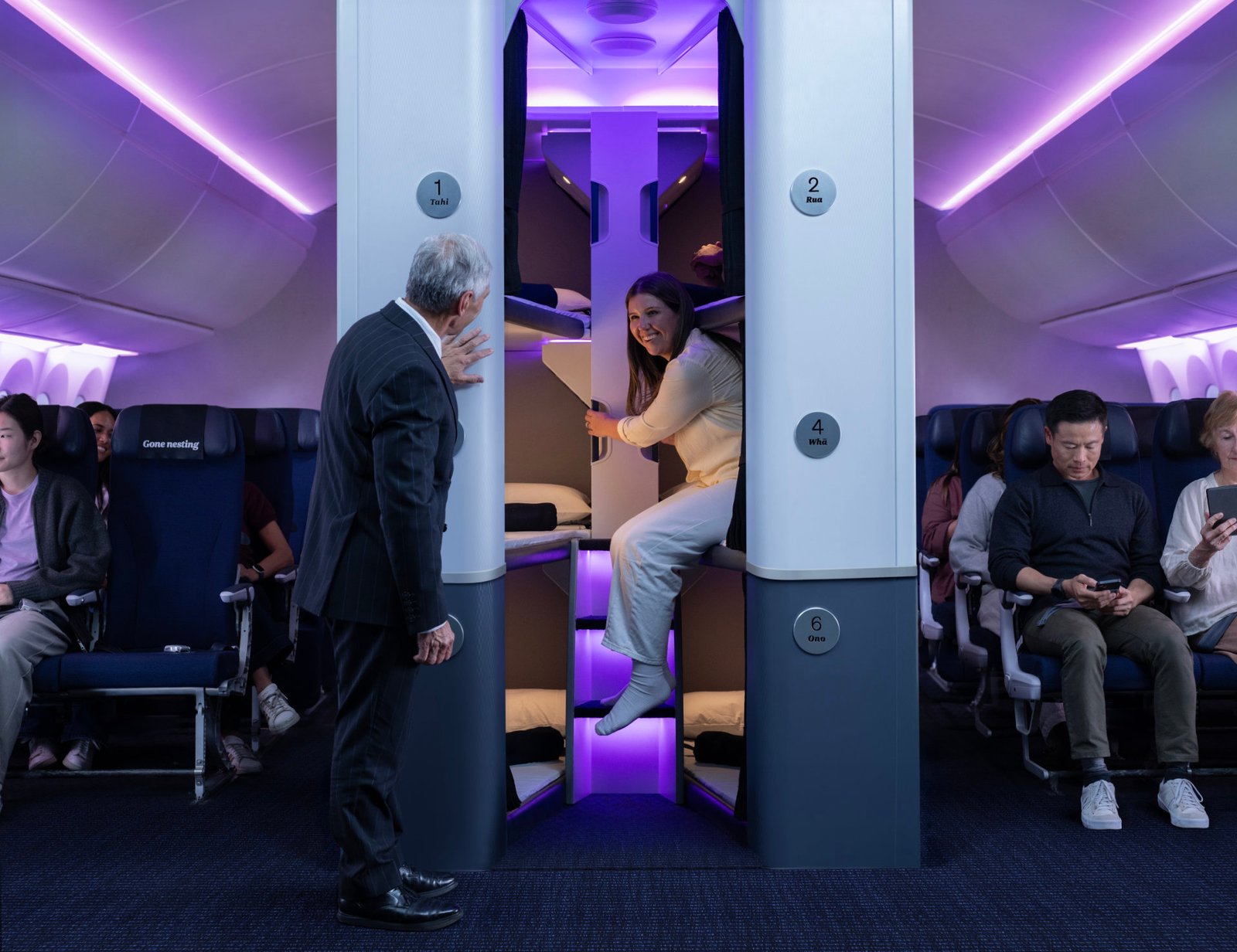
Air New Zealand is ushering in a new era in economy travel: From May 2026, passengers will be able to book the so-called “Economy Skynest” – six flat sleeping pods that are designed to enable a real night’s sleep in the air on long-haul flights.
The pods are located between the economy and premium economy cabins on the New Zealand airline’s new Boeing 787-9 Dreamliner aircraft. The start of bookings is planned for May 18, 2026, and operational use begins in November 2026.
Anyone who has booked an economy or premium economy seat can book a four-hour Skynest slot – at a starting price of 495 New Zealand dollars (the equivalent of around 270 francs). Each session is tailored to the natural sleep rhythm: time to settle in, sleep and wake up gently. Two sessions are initially available per flight.
Each pod offers a full mattress with fresh linens, a privacy curtain, ambient lighting, personal storage compartments, USB-A and USB-C charging ports, a reading light, ventilation, as well as a cabin call button and an integrated seat belt.
Air New Zealand boss Nikhil Ravishankar justifies the development with New Zealand’s geographical location and the importance of tourism for the country. “For a country as remote as New Zealand, the journey itself plays a crucial role. The tourism industry is a 46 billion New Zealand dollar industry – but growth depends on whether travelers are willing to spend long hours in the air to get here.”
The Skynest is not a luxury product, but a pragmatic answer to a real challenge: those who arrive rested prefer to travel again. “It’s about giving more people the opportunity to travel in a way that suits them better,” says Ravishankar.
The system was developed over several years and tested with more than 200 test subjects. Air New Zealand sees the Skynest as a further development of its own “Skycouch” – a bench that can be converted into a lying surface and which had already made the airline internationally known.
The concept has the potential to shape the industry: For the first time, economy class travelers on ultra-long-haul routes will have access to lie-flat pods – a standard that was previously reserved for business and first class passengers.