Portugal’s role
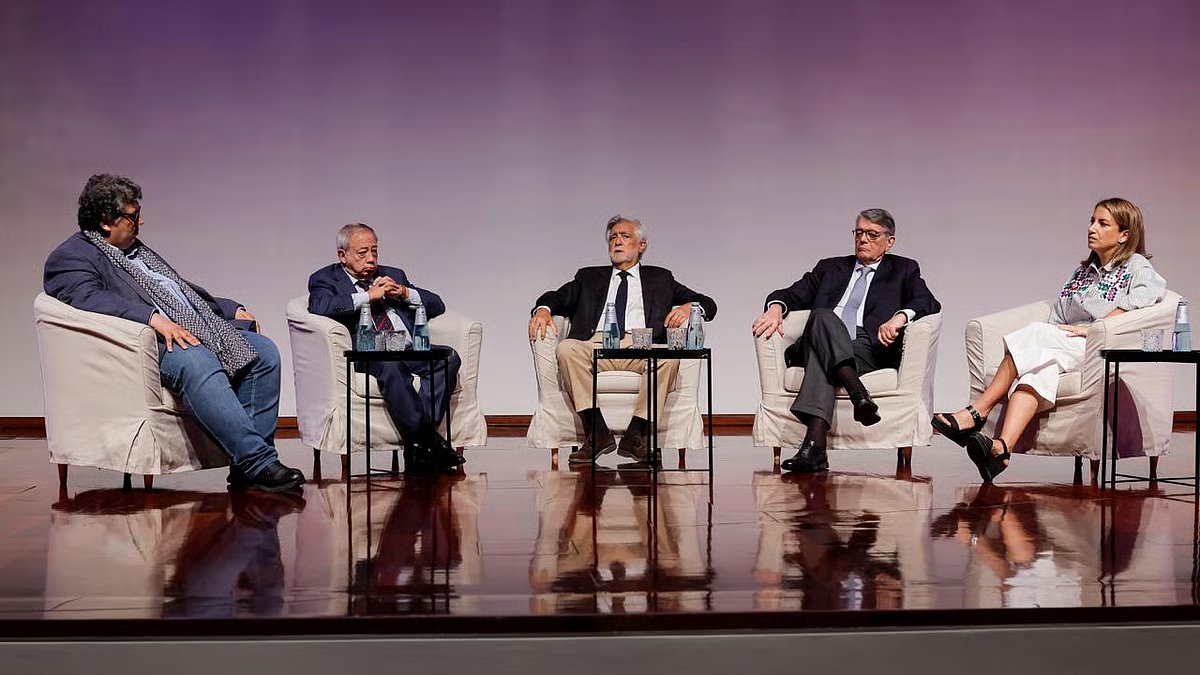
Historian Jaime Nogueira Pinto sees Portugal as “a peripheral country in the European Union”, but former Minister of Foreign Affairs Luis Amado sees the international political context as a “situation of exceptional opportunity” for our country.
An added value of Portugal, in a context of global security crisis, is precisely the security it offers. And security, argued the former minister, has become “the reference value of society’s opportunities”.
“Whoever offers security has a competitive capacity in attracting resources, in attracting capital, in attracting investment”, he concludes.
Regarding Portugal’s role, Jaime Nogueira Pinto recalls that the country “from a political and economic point of view, it is a European country. From a geostrategic point of view, it is an Atlantic country. And from a historical point of view, it is a country that is part of the Portuguese language space. And it is these three conditions that mark Portuguese foreign policy and Portugal’s position in the world”.
The former minister mentioned the importance of Portugal’s election to the United Nations Security Council, but “from a foreign policy point of view, a country the size of Portugal reacts much more than it acts in today’s world”. The last time he acted was during the independence of Timor-Leste, he said, referring to “to the last great cause of foreign policy” Portuguese.
Ana Miguel dos Santos argues, however, that Portugal “always has a place” where it can make “a difference”, even if it often feels that it does not have that place or the size of other countries. “Africa is one of those stages where Portugal can be a decisive moment and which Europe has forgotten”, mentioned.
Returning to the issue of security, addressed by Luis Amado, the expert recalled that Portugal is not a “security producer”, this being the great challenge for Europe in the coming years. But he argued that we need to stop being naive in relation to a European army, an idea that he argues is far away. “I’m optimistic about NATO, Portugal has a role, it is a founding country”, he said, remembering that at the moment “we have more Europe in NATO”.
“In the era of systemic vulnerability we have to be more prepared for the unpredictable and we are only prepared for the unpredictable if we are very trained”, he added, defending the need to maintain “the ability to question” and “develop critical capabilities”.
Europe and China
Martins da Cruz says that four issues that will arise in the coming years in the European Union that could be decisive for Portugal’s position. The first is the enlargementwith nine countries in the pipeline (the ambassador says that Türkiye is outside this group) all from central and eastern Europe. “The political axis moves to the east and makes Portugal more peripheral”and it remains to be seen whether or not this means a loss of influence in decision-making processes in Brussels.
The second question concerns the European budget for 2028-2034, which is being discussed. “Bringing the Common Agricultural Policy and Cohesion Policies together in the same chapter, as the European Commission wants, harms Portuguese interests,” he stated.
The third problem seemed to be initially beneficial, but will have a cost in the future: “the mutualization of Europe’s debt“, in the aftermath of the Covid-19 pandemic, of loans to Ukraine. “This debt mutualization could harm the Stability and Growth Pact or, if you want, the so-called Maastricht criteria which, as we all know, are not scientific, they are purely political”, he indicated.
And finally, the fourth issue cited by Martins da Cruz is the relationship with China. “Europe, at the moment, doesn’t know what it wants with China. Europe started by defending the decoupling that is, cut off with China. Then he went to de-risking that is, avoid risks with China”he recalled, to quote a number that makes this impossible: trade between Europe and China represents two million euros per minute.