
- Horacio Ochoa, the photographer who captured Cusco like few others and whose legacy (for so long ignored) is reborn again
- Sarah Bernhardt, the diva who charged a fortune in silver soles to appear in Peru and paralyzed the capital after the war with Chile
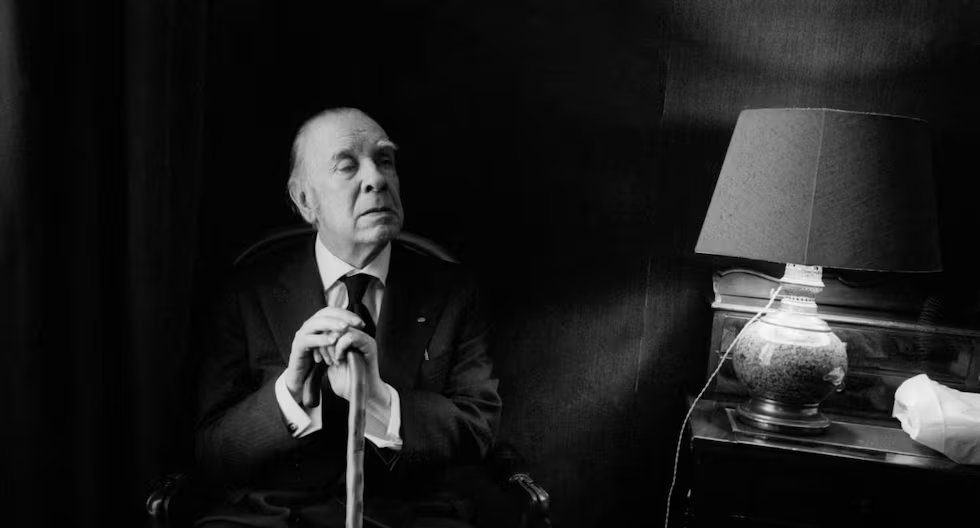
He had entered the meeting with a lost smile, directed from his blindness to all of us who received him in that house. We were in Austin, it was 1983 and Borges, holding the arm of Maria KodamaI was immensely happy. By then, he had been modestly dedicated to fame for some time. On that trip he had returned to the University of Texas, which in 1961 had welcomed him as a professor. As we sat down at the table to eat a paella that Professor Arocena had prepared for us, Borges expressed his liking for the dish: “I have waited eighty-four years to eat this paella.” At the end of that night, full of anecdotes, he asked María Kodama to recite the Lord’s Prayer in Anglo-Saxon. After listening to it, my friend Ángel Delgado recited the same prayer in Latin and when it was my turn, I repeated some lines from Eguren, one of his favorite poets. It was a night of improvised recitals.
LOOK: I read you like a book, by Irene Vallejo
The next day, we accompanied Borges and María Kodama on a walk through the city. My friend Ángel was at the helm of the car with María Kodama. Borges and I sat in the back seats. As the car left, Borges remembered the lyrics of a tango: “I want to be a canfinflero/ to have a mine/ and make my son an aviator/ so that he can beat the record/ of Argentine aviation.” He smiled and clarified: “I say it quietly so that Maria doesn’t hear me.” That morning, his first intention had been to visit the artificial moons (old towers from which Austin was illuminated at the beginning of the century). We then visited the statue of General Joseph Wheeler. Like Funes, Borges remembered every detail of his appearance.
As we walked away, Borges said to me: “Have you noticed how musical the beginning of Don Quixote is?” He immediately recited Cervantes’ first famous phrases. “It is a music that is not at all strident, he told me, but that imposes itself in secret.” Several other examples emerged in the conversation. He recalled out loud the famous lines of Ricardo Jaimes Freyre: “Pilgrim imaginary dove – you enkindle the last loves…”.
His arrival at the University of Texas was a great event, crowned by his massive conference. The night of his talk, while he was driving to the theater, he felt uneasy because of the size of the audience waiting for him, and he kept repeating the first two words of his talk: “Ladies and gentlemen.” As he told us, if he could say those two words, the rest would follow. Upon arriving at the building, as the elevator was taking a long time to arrive, he said that it would be better to take the stairs “which have already been invented.”
A few hours earlier we had been in the lobby of the building where he had lived with his mother for several months in 1961. Upon entering, Borges looked up and whispered with a smile: “Here I am, mother. Here I am again. Here we are with María.”
When I went to say goodbye to him at the airport, he told me that he was very excited to leave for New York. However, he added, for a man of his age the hope for the future had little meaning. I watched him walk away toward the plane, under the bright Austin noon. I thought you were right. The future had little meaning because eternity had reached him in life. He had created a universe for his readers to live in. He has been dead for forty years but he is beyond time.