The Ministry of Education Transformation is pressing ahead with phasing out the traditional common entrance examination from September, replacing the high-stakes, single-day test with a continuous assessment model designed to track student development over time, Minister of Education Transformation Chad Blackman confirmed on Monday.
As the ministry released the 2026 examination results, Blackman revealed that the shift forms the cornerstone of a broader, years-long education overhaul aimed at bringing equity, fairness, and a “purpose-driven” focus to the national curriculum.
“I understand the historical significance that a Common Entrance [Exam] has played in Barbados, and this is no different today,” Blackman said. “But it must not determine how people are viewed; it must not determine a person’s self-worth. It must determine, however, your ability to move forward and to help build and shape this nation.”
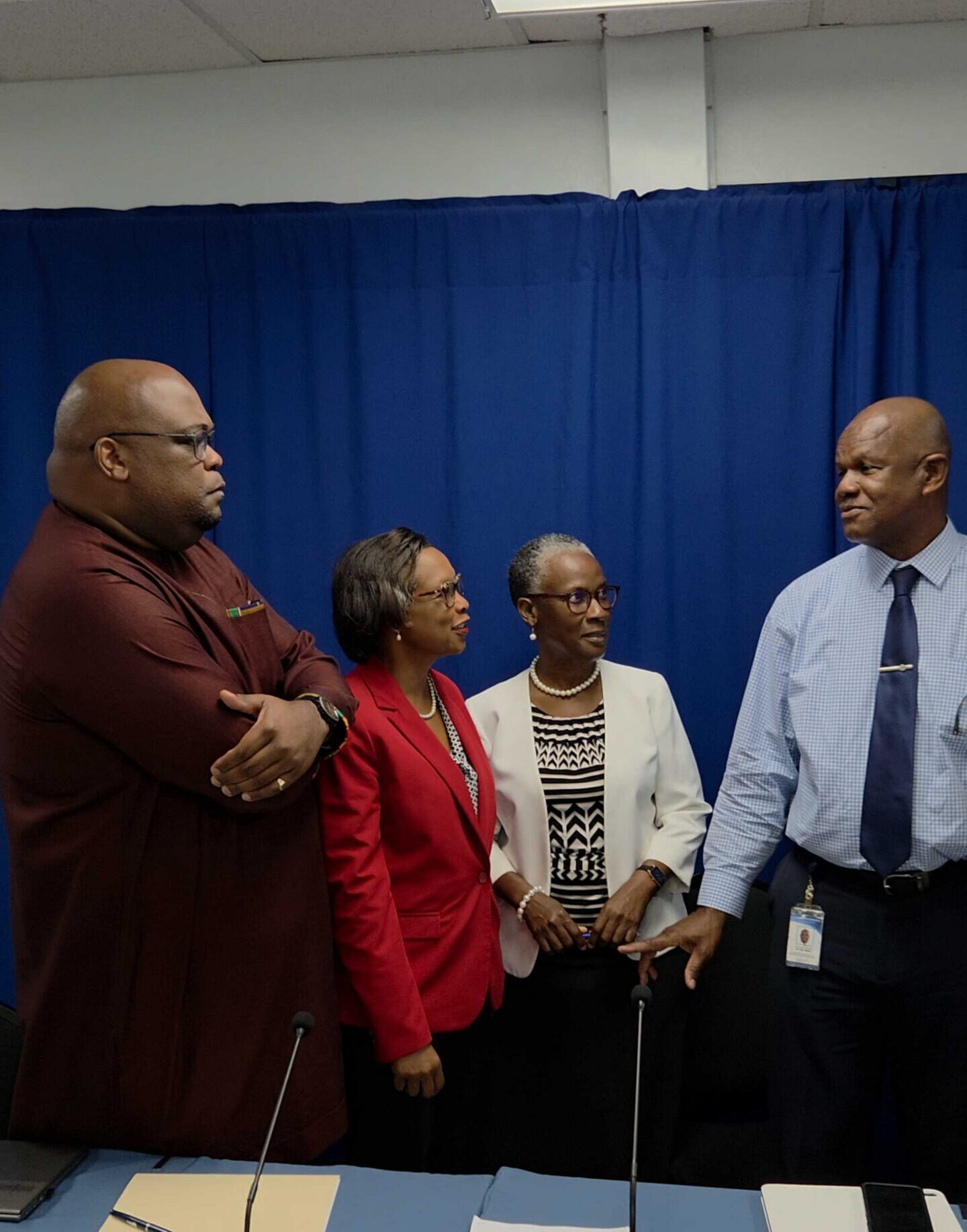
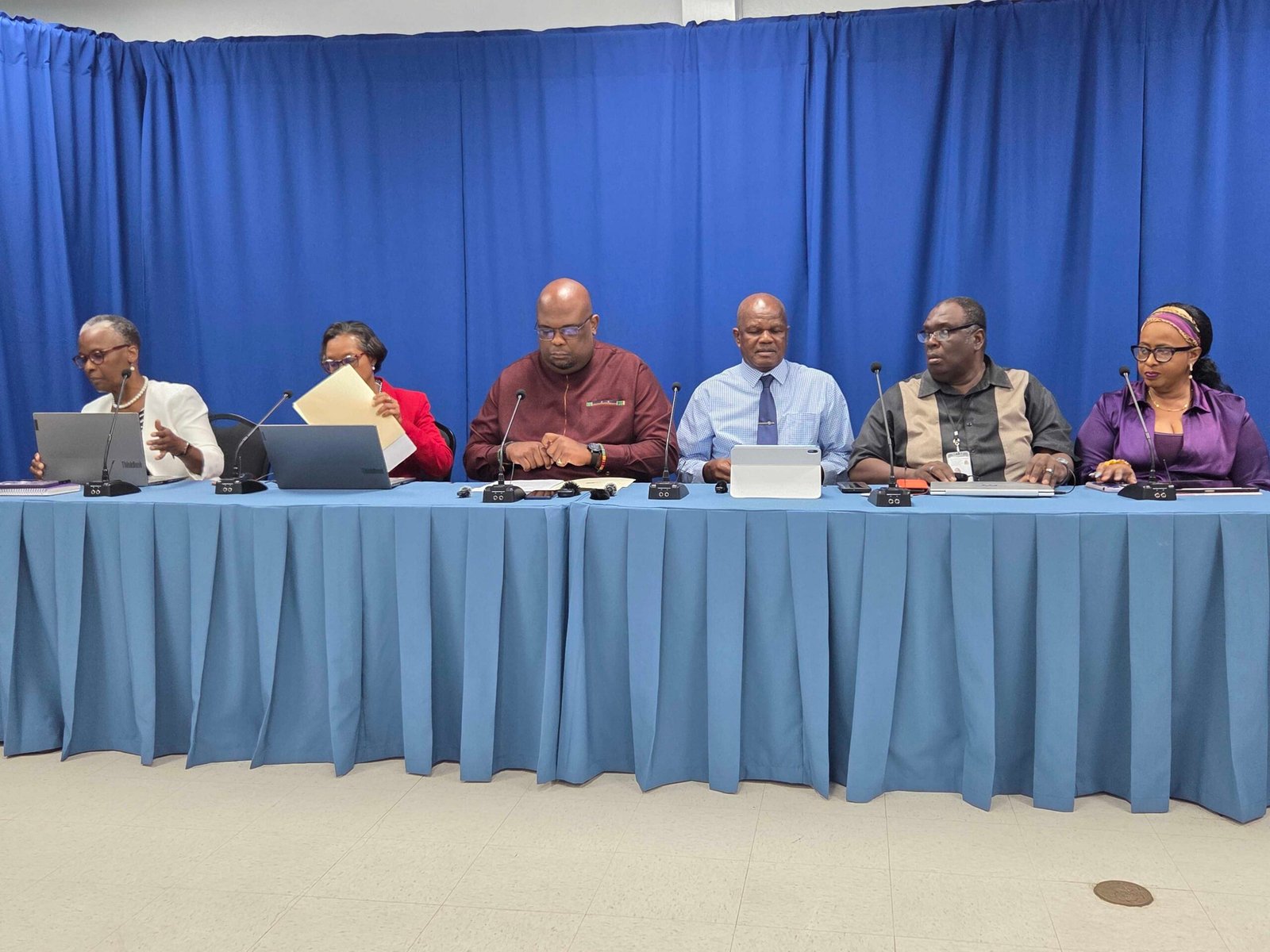
Minister of Education Transformation Chad Blackman; Deputy Chief Education Officer Julia Beckles, Acting Permanent Secretary Kathy Shepherd, Glyne Price Senior Education Officer. (Photo credit: Ricardo Roberts/Barbados TODAY)
Under the new model, the ministry intends to move away from the one-shot exam to a system that continuously assesses both traditional academic performance and non-traditional skill sets over a two-year course. The objective is to ensure that the transition from primary to secondary school focuses on a child’s long-term development rather than a single day’s performance.
The transition changes will take effect immediately for the upcoming academic year. The Ministry of Education Transformation has mandated that all secondary school principals and their management teams completely restructure their entry programmes for the incoming cohort.
“September 2026 is a major time in our transformation,” Blackman said, highlighting that the changes coincide with the eve of Barbados’ 60th year of independence and its fifth anniversary as a republic. “All secondary school principals and their teams must now reimagine what orientation should look like. Every child going into secondary school from September must feel that I am going to a school that understands my purpose, understands where I want to go in life.”
The education minister emphasised that the structural shifts are designed to standardise the quality of education across the island, ensuring that secondary schools maintain a high baseline of morale, atmosphere, and teaching capacity regardless of their historical prestige.
The announcement came alongside the statistical breakdown of this year’s primary school graduating class.
The 2026 examination, which was administered on May 5 across 21 public secondary schools, saw a total of 2 764 registered candidates. This cohort comprised students from 67 public primary schools, 28 private primary schools, and seven home-schooled children.
The latest registration data confirms a continuing contraction in student numbers. The total of 2 764 candidates represents a decrease of 60 students compared to 2025, and a more substantial drop of 169 students — or 6.1 per cent — from the 2 933 candidates recorded in 2024.
While overall student numbers declined, the ministry processed a record number of access accommodations. Authorities received 240 special requests this year, marking a steady increase from 194 requests in 2025 and 183 in 2024. These provisions included the distribution of large-print booklets and the assignment of official scribes and readers to assist students with specific learning or physical needs.
The ministry also approved 15 early sitters — 11 males and four females — to write the examination. Under the Education Act, early sitters must be under the age of 11 and maintain an academic average of at least 85 per cent in both mathematics and language arts across classes two and three. Blackman cited the approvals as “inclusion in practice”.
To support the phased transition model, the ministry has introduced a series of technological and physical upgrades across primary schools. Infants B and Class One student cohorts were recently outfitted with dedicated learning tablets, while teachers received targeted training and device allocations to better integrate digital tools into daily lessons.
Additionally, a major physical refurbishment drive led to the temporary closure of 13 primary schools on 12 June to facilitate structural extensions and upgrades.
Blackman defended the temporary disruptions as a prerequisite for modern learning.
“As we move forward, we must ensure that we have the ability not just to have training for our teachers, but the infrastructure is the place of course that serves to allow our children, our teachers, our principals to be in an environment where they can thrive.”
The ministry has paired these resource upgrades with external quality assurance measures. Following a pilot phase initiated last May, panels of education officers, principals, and trainers have been conducting structured school visits to formalise standard benchmarks for classroom instruction and institutional leadership.
At the same time, a national parent education programme was launched on 4 May to offer positive parenting workshops, communication strategies, and behavioural management techniques to families navigating the changing educational landscape.
Blackman congratulated the 2026 student cohort and sought to assure parents and educators that the ministry remains fully committed to establishing a modern system that recognises varied student achievements.
“The ministry is preparing to usher in a system which better recognises and facilitates the achievements and progress of all of our students,” he said. “I offer congratulations to all students who sat the examination this year, and this is, of course, only another leg in your life’s journey. You will have many other opportunities to achieve on this road of success.”
(RR)