Here’s what’s launching June 22–28: SpaceX debuts its uncrewed Starfall cargo return demonstrator from Florida while a Pegasus XL rocket carries a robotic spacecraft to rescue NASA’s sinking Swift Observatory.
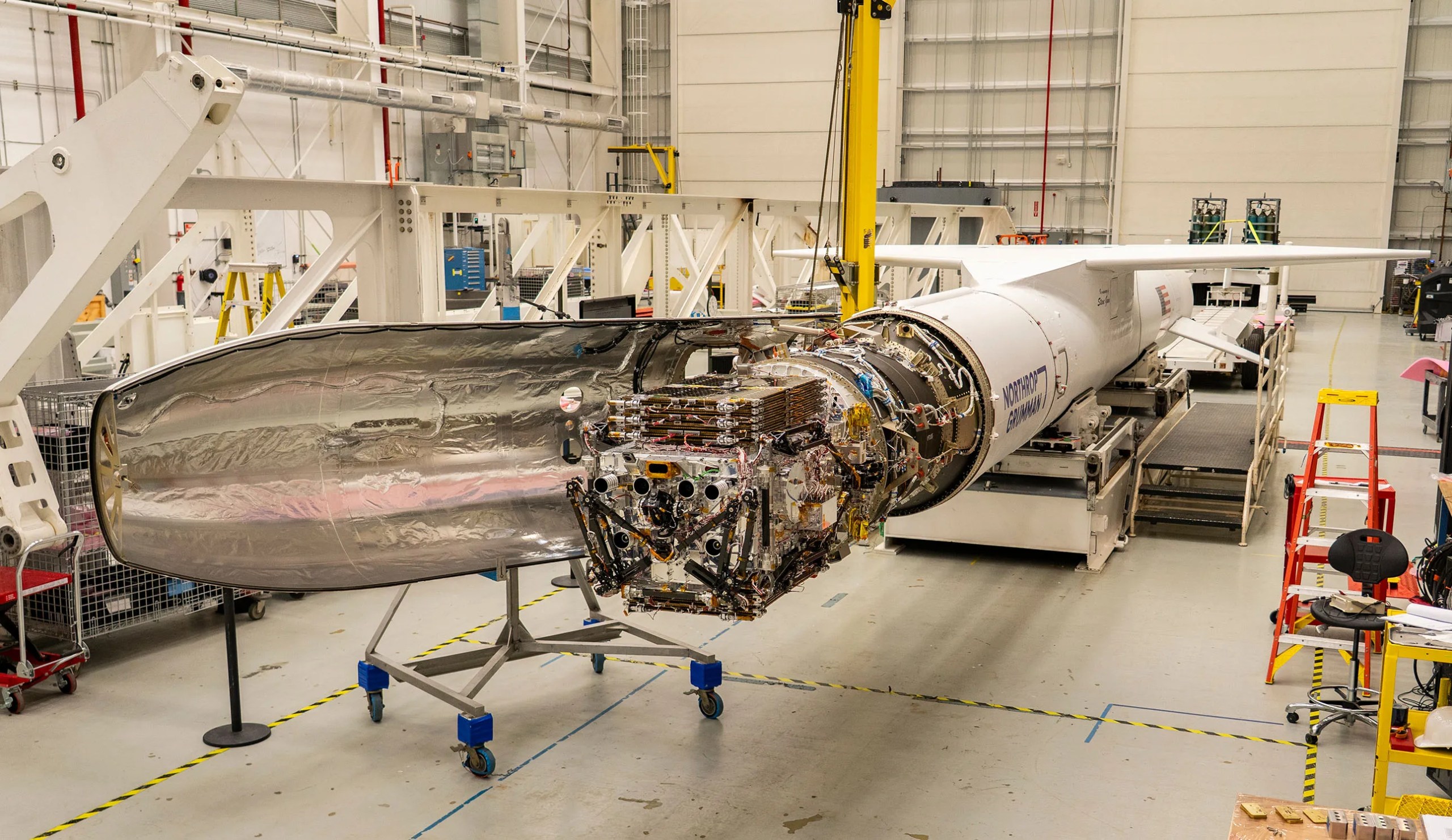
Katalyst Space’s LINK spacecraft sits inside the payload fairing of the Northrop Grumman Pegasus XL rocket at NASA’s Wallops Flight Facility in Virginia ahead of its launch to boost the orbit of NASA’s Neil Gehrels Swift Observatory. Credit: NASA/Ron Beard
Rocket launches this week
Tonight, Monday, June 22, according to tracking from Next Spaceflight, The China Aerospace Science and Technology Corporation (CASC) plans to launch a Long March 7A rocket from the Wenchang Space Launch Site located in the South China Sea on the island of Hainan at 10:10 p.m. EDT. The payload has not been publicly disclosed.
Tuesday, June 23, SpaceX is targeting a 6:43 a.m. EDT liftoff from Space Launch Complex 40 at Cape Canaveral Space Force Station for the Starfall Demo mission. SpaceX has kept the details quiet, but Starfall appears to be an uncrewed cargo return vehicle designed to bring materials back from low Earth orbit. The one-hour window carries a backup on Wednesday, June 24, at the same time. The Falcon 9 first stage — flying for the 29th time — will land on the droneship A Shortfall of Gravitas in the Atlantic.
Wednesday, June 24, SpaceX will launch Starlink Group 17-45 from Vandenberg Space Force Base in California at 10:48 p.m. EDT, adding another batch of internet-relay satellites to the growing megaconstellation. The booster will land on the droneship Of Course I Still Love You in the Pacific.
Saturday, June 27, a Northrop Grumman Pegasus XL rocket is scheduled to lift off from the Reagan Test Site in the Marshall Islands at 5:00 a.m. EDT carrying NASA’s Swift Boost Mission according to tracking from Next Spaceflight. Northrop Grumman’s modified L-1011 carrier aircraft, Stargazer, will carry the Pegasus XL to around 39,000 feet (12,000 meters) before releasing it to ignite and climb to orbit. The payload is Katalyst Space’s LINK spacecraft — a robotic servicer built to capture NASA’s Neil Gehrels Swift Observatory and push it into a higher orbit. Swift is a NASA astrophysics satellite capable of observing in visible, ultraviolet, X-ray, and gamma-ray light. It has been losing altitude faster than expected after a recent stretch of solar storms increased atmospheric drag on the spacecraft. Once in orbit, LINK will meet, capture, and boost Swift, extending the observatory’s scientific life.
Last week’s recap
Monday, June 15, SpaceX launched Starlink Group 17-54 from Vandenberg Space Force Base.
Tuesday, June 16, China put up three rockets in a single day. A Long March 3B/E carried the Shijian 31 satellite out of Xichang, a launch center in southwestern Sichuan province; a Long March 12 deployed SatNet LEO Group 22 from Wenchang; and a Kuaizhou 11 deployed navigation satellites from Jiuquan in the Gobi Desert of northwestern China.
Wednesday, June 17, Arianespace launched an Ariane 64 from the Guiana Space Centre in French Guiana carrying Amazon’s Leo broadband satellites — the latest batch in the company’s effort to build a broadband megaconstellation to rival SpaceX’s Starlink. SpaceX also launched BlueBird 8 through 10 — internet-relay satellites for Texas-based satellite manufacturer AST SpaceMobile — from Cape Canaveral.
Friday, June 19, Rocket Lab launched the VICTUS HAZE mission on an Electron rocket from the Māhia Peninsula in New Zealand for the U.S. Space Force’s Space Systems Command. The $32 million mission demonstrated rendezvous and proximity operations as part of the Space Force’s effort to respond to on-orbit threats on short notice. The spacecraft is designed to be ready for launch with only 24 hours’ notice. SpaceX also launched the classified NROL-179 payload for the National Reconnaissance Office from Vandenberg the same day.
Saturday, June 20, SpaceX closed out the week with Starlink Group 17-28 from Vandenberg.
Looking ahead
On July 2, United Launch Alliance (ULA) is targeting 12:24 a.m. EDT for the launch of an Atlas V 551 from Cape Canaveral carrying Amazon’s Leo satellites.
Brooks Mendenhall is a staff writer for Astronomy and is based in Chattanooga, Tennessee.