Loading Text-to-Speech…
The market is on a wait-and-see basis regarding the effectiveness – essentially the size of the deterrent power it will have on European consumers– of duty of 3 euros which will be imposed on small parcels with a value of less than 150 euros which are imported into European Union from third countries. The measure, which will take effect from July 1, 2026, is – or at least this is the aim and the motivation at the same time of its enactment – a first rampart in the mass purchases of cheap products from Asian – mainly Chinese – e-commerce platforms (marketplaces).
The next step will be the imposition of a customs duty until November 2026 at the latest and then the establishment of the EU Customs Authority. and the gradual start of its operation. In addition, the European Commission will start its construction Customs Data Hub of the EU for e-commerce, aiming for it to be operational from 1 July 2028. Online platforms and sellers will inform customs through the EU customs data hub. regarding their sales to Union consumers immediately after their implementation. This will allow customs to react before goods arrive at the border, supported by the EU Customs Authority’s risk analysis. at Union level. These platforms and sellers will become responsible for financial obligations (customs duties and other fees) and for ensuring compliance of their products with EU legislation.

“We want to see how it will be implemented and then judge its effectiveness,” the president of the Hellenic E-Commerce Association (GRECA) recently emphasized. Katerina Frydakireferring to the imposition of the temporary duty of 3 euros. Much will be judged, as the representatives of e-commerce in Greece add, firstly, by the way the measure is implemented and, secondly, by the increase in the competitiveness of domestic online stores. A particularly important element for the effectiveness of the measure is the fact that the duty of 3 euros is not imposed per parcel, but per piece of a separate tariff category contained in a parcel. If, for example, someone has ordered a phone charger, a cable and a case, which come in a package with a total value of less than 150 euros, the price will be charged 9 euros, not 3 euros.
The Chinese platforms, to avoid the burden, create large warehouses in various EU countries.
How will they react? Chinese platforms; First, by creating large warehouses or cooperating with third parties for warehouses in various countries of the European Union, so that consumer orders are not burdened with the fixed duty of 3 euros. Temu has started from December 2024 to maintain warehouses within the EU. and now has such spaces in Hungary, Germany, France, Italy, Spain, Sweden. Its goal is in the future 80% of the orders made by E.U. to be served by warehouses within the EU Corresponding practices are applied by Sheinhaving a large storage center in Warsaw, but also smaller warehouses in Germany, France, Belgium, Spain. On its website, in fact, it has a special category for orders marked “EU Warehouse”.
The other way of reaction is expected to be, according to market analysts, the absorption of the cost of this €3 by the sellers working with the said platforms, in order to remain competitive against their European colleagues.

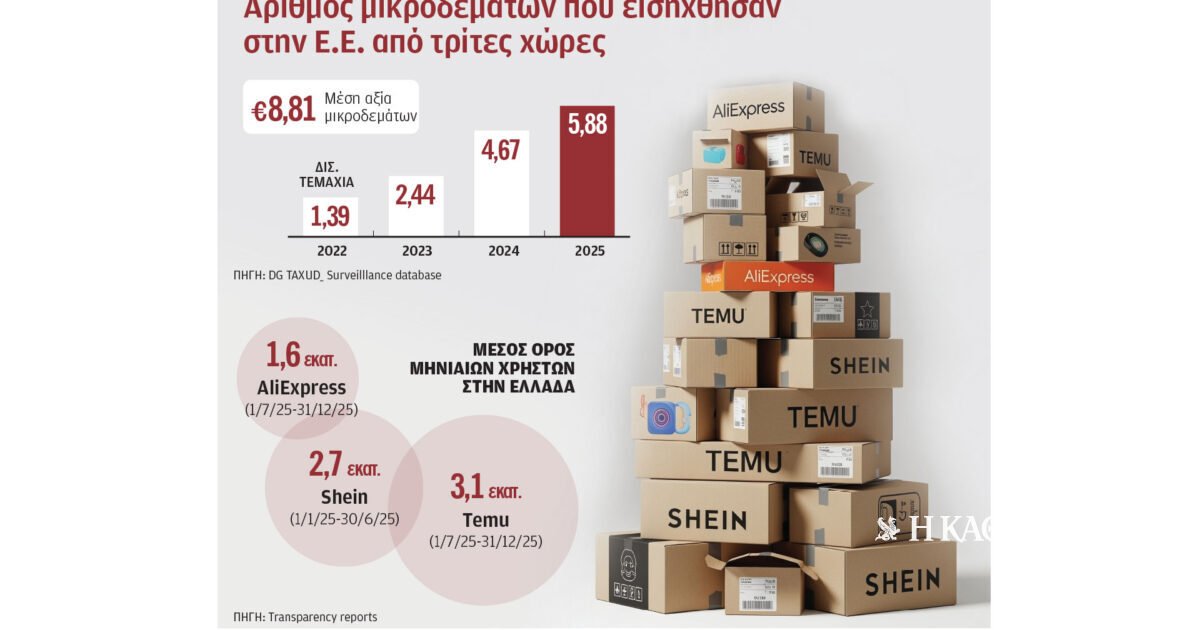
The omnipotence of of Chinese e-commerce platformsnot only in Europe but also in other continents, is confirmed by the following data: according to the specialized e-commerce database website ECDB, China is the leading e-commerce exporter in 88% of countries worldwide. In 2025, according to the data of the European Commission, were introduced into the E.U. 5.88 billion microparcels (value under 150 euros) compared to 4.67 billion in 2024. Their average value is 8.82 euros, while China is the main country of origin. According to official data, 93% of the volume and 78% of the value of these parcels originate from China.
The popularity of Asian platforms is reflected in the data included in the transparency reports, which are required to be compiled by the major platforms in the category. Temu’s average monthly users in Greece increased to 3.1 million in the second half of 2025, from 2.7 million in the first half of 2025. Shein’s average monthly users is 2.7 million, while Aliexpress’s is 1.64 million.