▶ Listen on Spotify, Apple Music or YouTube
Whitney Houston, ‘Saving All My Love for You’ (Arista, 1985)
“Why did she only meet with me to pick out every song for her album? It was she and I, no one else,” Davis said in a 2021 Rolling Stone interview, emphasizing his role in Whitney Houston’s success. Other labels had wanted to sign her too, but Davis had an advantage: He’d worked successfully with Warwick and Franklin, Houston’s cousin and godmother. Houston had been singing “Saving All My Love for You” in her nightclub act, so Davis brought in Michael Masser, who wrote it with Gerry Goffin, to produce. It would “take an act of Congress to keep this woman from becoming a megastar,” a People magazine critic predicted when her debut came out.
▶ Listen on Spotify, Apple Music or YouTube
Kenny G, ‘Songbird’ (Arista, 1986)
Kenny Gorelick’s breakthrough came because of a “Tonight Show” appearance where he’d promised to play his cover of a Junior Walker song but enraged TV producers by instead doing “Songbird,” a showcase for his mellow, highly reverbed playing, which the former New York Times critic Ben Ratliff has called “a corporate attempt to soothe my nerves.” (It wasn’t a compliment.) Davis wrote letters to pop radio programmers, imploring them to play it, and assembled what he later called “a military operation” to promote it. “Songbird” turns jazz into hold music, but as Davis would have pointed out, Kenny G has sold more than 75 million records, making him the most popular instrumentalist of all time.
▶ Listen on Spotify, Apple Music or YouTube
Milli Vanilli, ‘Blame It on the Rain’ (Arista, 1989)
Pop music grew more and more crass and manufactured as the 1980s advanced, and Davis’s keen ear turned Arista into a hit factory: Billy Ocean, Thompson Twins, Taylor Dayne, Lisa Stansfield and Exposé all made good to great hits, none of which sustained a career. It led inexorably to Milli Vanilli, the ne plus ultra of manufactured pop. Frank Farian, the group’s mastermind, had already recorded “Girl You Know It’s True,” and when Davis got involved, he directed Farian to “Blame It on the Rain” by Diane Warren, the Pavarotti of Hallmark sentiment. It became Milli Vanilli’s third No. 1 smash, but once it was revealed in 1989 that the group was a fraud, and their two handsome frontmen hadn’t sung on the album, their Grammy was revoked and Davis minimized his role in the music, insisting that he, too, had been deceived by Farian.
▶ Listen on Spotify, Apple Music or YouTube
Carlos Santana featuring Rob Thomas, ‘Smooth’ (Arista, 1999)
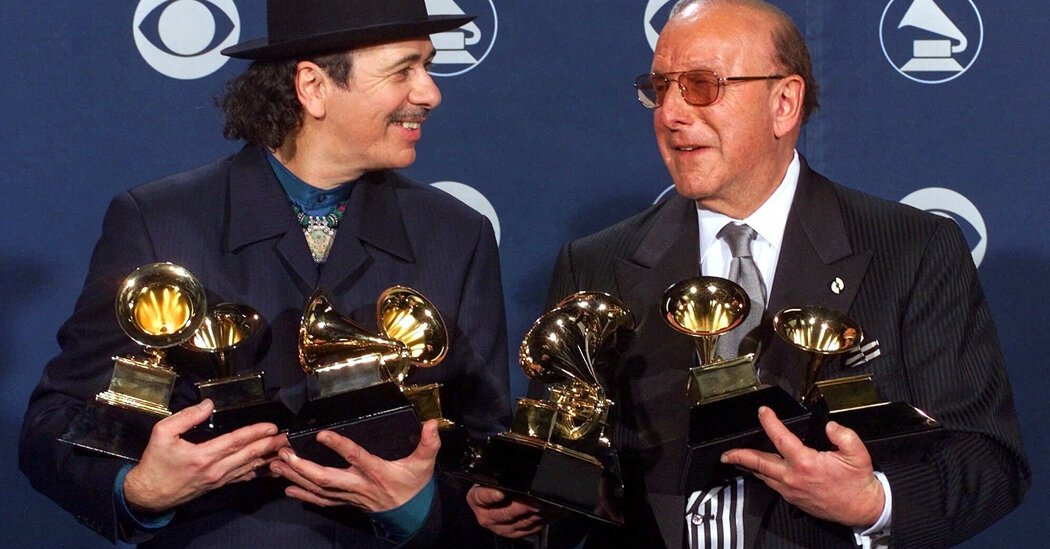
When Carlos Santana was signed to Columbia with his band, Santana, he chafed at the pressure Davis put on him to make hits. Years later, Santana’s profile had declined, and he was eager for input. There are lots of guests on his Arista debut, including Lauryn Hill and Dave Matthews, but what drove the album to dazzling sales of 15 million in the United States was “Smooth,” which Rob Thomas of Matchbox Twenty sang and helped write. Santana hated it and turned it down, until Davis assured him it would be the most important song on the album. “Smooth” spent three months at No. 1 and Santana later said it had “the frequency of joy” in it.
▶ Listen on Spotify, Apple Music or YouTube
Alicia Keys, ‘Fallin’’ (J, 2001)
The Arista executive Peter Edge spotted Alicia Keys, and Davis was so smitten that after he was bounced out, he made her the signature artist of his new label, J. Keys was an excellent writer, in addition to being a singer and piano player, so Davis didn’t have much of a role to play. But once this song was out, he used every bit of his influence to turn the young artist into a star, whether that meant making Keys the focus of his legendary pre-Grammy party or writing a letter to Oprah Winfrey, successfully lobbying her to book “music’s great new star.” Her debut album won five Grammys.
▶ Listen on Spotify, Apple Music or YouTube
Rod Stewart, ‘These Foolish Things’ (J, 2002)
Rod Stewart was 57 when he signed to J. He hadn’t found a middle-age rendition of his youthful-playboy image and hadn’t had a million-selling album in 10 years. Davis liked the fact that Stewart wanted to record standards, but he had some conditions for the singer: He had to use only the best-known songs, focus on up-tempo numbers and ditch the jazz and blues tracks he’d been considering. It worked: “It Had to Be You: The Great American Songbook” sold more than three million copies and was nominated for a Grammy. Stewart settled into his niche, releasing four more albums of standards.