Legal experts to “Gulf News”: The Kingdom’s selection in the first stage reflects its digital and legislative readiness
Written by: Yasmine Al-Aqeedat
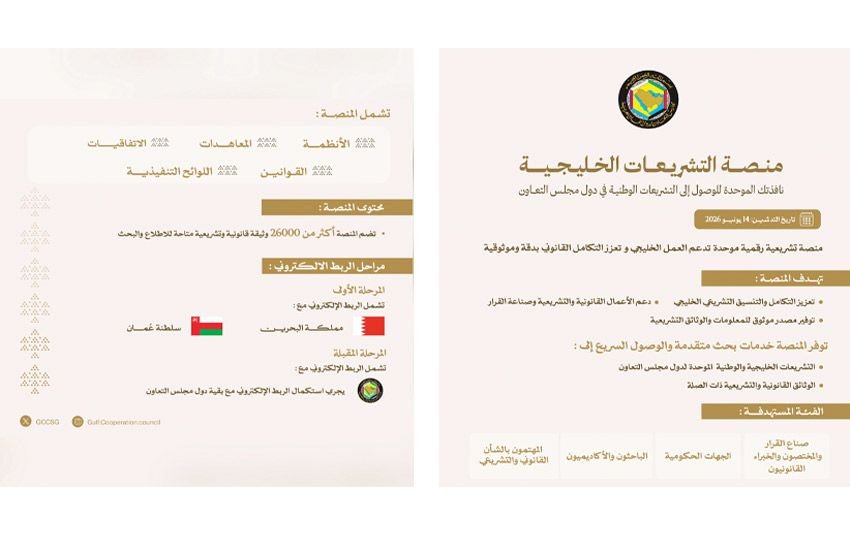
The General Secretariat of the Cooperation Council for the Arab States of the Gulf launched the Gulf Legislation Platform, as a unified digital legislative platform that supports Gulf work and enhances legal integration with accuracy and reliability. It aims to enhance legislative integration and coordination between the countries of the Gulf Cooperation Council, and support legal and legislative work and decision-making, in addition to providing a reliable source of information and legislative documents.
The first phase of the platform’s electronic connectivity includes the Kingdom of Bahrain and the Sultanate of Oman, while the electronic connectivity with the rest of the GCC countries is being completed during the next phase.
The platform provides advanced search services that allow quick access to unified Gulf and national legislation of the Gulf Cooperation Council countries, in addition to relevant legal and legislative documents, which contributes to facilitating access to legislative content and accessing it efficiently.
The platform targets decision-makers, specialists, legal experts, government agencies, researchers and academics, as well as those interested in legal and legislative affairs.
The platform includes a wide range of legislative and legal content, including regulations, treaties, agreements, laws and executive regulations. It also contains more than 26,000 legal and legislative documents available for viewing and research.
The platform comes as a unified window to access national legislation in the Gulf Cooperation Council countries, in a way that supports joint Gulf action and enhances legal and legislative integration among member states.
An easy and reliable qualitative shift
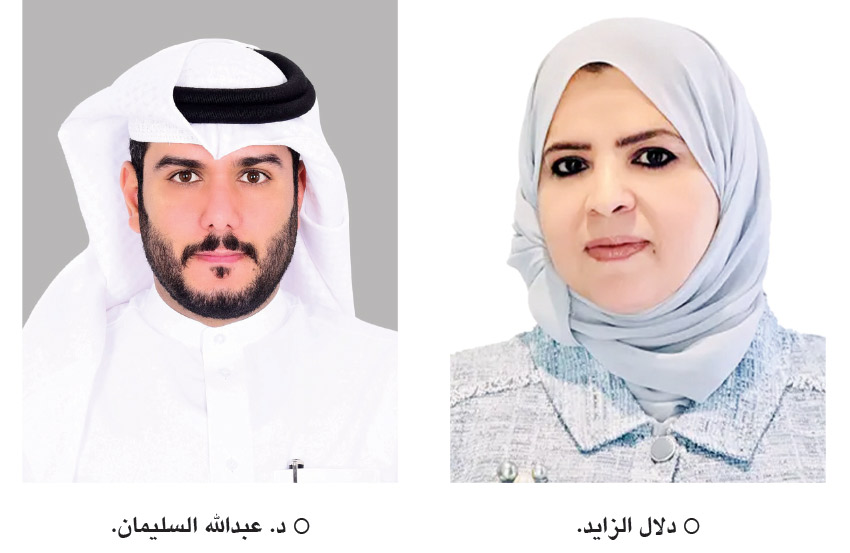
In this context, Lawyer Dalal Al-Zayed, Chair of the Legal and Legislative Affairs Committee of the Shura Council, confirmed that the launch of the Gulf Electronic Legislation Platform coincides with a phase witnessing a significant acceleration in the pace of digital transformation, and an increasing need to develop cooperation tools and exchange experiences in legislative and legal work, in keeping with the changes and economic and development requirements witnessed by the Gulf Cooperation Council countries. She added that this platform represents an easy and reliable qualitative leap in facilitating access to and review of Gulf and national legislation and treaties. And the agreements, and the large amount of data they contain, through a unified framework that reduces time and effort for legislators, government agencies, legal experts, experts and researchers.
She pointed out that this platform reflects the keenness of the GCC countries to enhance cooperation, integration and joint Gulf action, by creating an integrated electronic legislative knowledge base that contributes to providing information from a reliable source and accurate data that supports legislation and decision-making. She pointed out that in light of the great convergence between the Gulf legal systems and economic and social environments, the existence of a unified platform represents an essential mechanism for enhancing coordination, exchanging experiences, and benefiting from successful legislative experiences among member states.
Regarding the role of the platform in the path of legislative integration between the GCC countries, Dalal Al-Zayed confirmed that it represents one of the tools supporting the process of Gulf legislative integration, as it provides a unified reference that allows the target groups to view unified Gulf legislation and national legislation in the various GCC countries through a single electronic window, which contributes to enhancing mutual knowledge between legislative and legal bodies, and supports efforts at harmonization and rapprochement between national legislation.
She added that the platform will practically contribute to enabling members of legislative councils, especially Gulf ones, and legal committees, researchers and specialists, to conduct legislative comparisons easily and quickly, and to view the best practices, experiences and legal amendments adopted by member states in addressing common issues, in a way that raises the quality of legislation and enhances the opportunities for reaching legal visions more consistent with common Gulf goals.
Regarding the selection of the Kingdom of Bahrain and the Sultanate of Oman to be the first countries to launch the platform, she explained that this selection comes within the framework of the first phase of the legislative electronic connectivity project, as a practical step to start operating the platform according to gradual stages that guarantee the efficiency of implementation and the quality of technical and legal connectivity, before completing the connectivity with the rest of the member states in the subsequent stages.
She said that this choice reflects the level of cooperation and coordination existing between the legislative and legal authorities and relevant institutions in the two countries with the General Secretariat of the Gulf Cooperation Council, which contributed to the readiness of national data and legislation for electronic linkage, stressing that this stage represents the beginning of an integrated Gulf project that ultimately aims to bring together the national legislation of all member states within one system that serves the common Gulf interest.
Regarding the significance of choosing the Kingdom of Bahrain, she stressed that this reflects the Kingdom’s remarkable development in the areas of digital transformation and the development of the legislative and institutional structure, in addition to its advanced legislative system, as Bahrain has paid continuous attention to modernizing legislation, facilitating access to legal information, and employing modern technologies to support government and legislative work.
She added that Bahrain has advanced experience in developing the legislative system and parliamentary work, in light of the presence of a legislative authority based on cooperation and joint work between the two councils, which requires a high level of organization, documentation, and management of legislative knowledge. From this standpoint, Bahrain’s inclusion in the first phase of electronic connectivity confirms its readiness to participate in Gulf initiatives aimed at enhancing legislative integration, and reflects its active role in supporting the process of joint Gulf action and developing its institutional and legal tools.
Achieving integration
Gulf legislative
For his part, lawyer Dr. Abdullah Al-Sulaiman stressed that the launch of the Gulf legislation platform comes at a very important time in light of the quest to reach the highest levels of integration and coordination between the Gulf Cooperation Council countries and the increasing need to unify legal references in support of joint Gulf projects.
He explained that the digital transformation witnessed by governmental and judicial institutions in the GCC countries, especially after the recent crises, makes it necessary to provide a unified platform that facilitates access to laws, legislation, agreements and regulations in an updated manner and from reliable sources, indicating that this would enhance legal transparency and serve investors, researchers, legal practitioners and decision-makers.
He stated that the platform represents an important practical step towards achieving Gulf legislative integration, as it provides a unified database that allows access to unified Gulf legislation, as well as the national legislation of member states in one place, in a quick and easy way, which contributes to enhancing comparison between legal systems and legislation, exchanging legislative experiences, and identifying areas of convergence and difference between national and Gulf laws.
He added that the platform will help legislative bodies benefit from successful experiences in member states, supporting legislative harmonization efforts and creating a more harmonious legal environment among member states.
Regarding the selection of the Kingdom of Bahrain and the Sultanate of Oman in the first phase of electronic linkage, the lawyer said that this appears to be related to the readiness of the institutional and technical infrastructure necessary to link national legislation to the Gulf platform, as countries are usually selected that have completed the technical and legal requirements for the process of electronic linkage and continuous updating of legislative data, in preparation for disseminating the experience to the rest of the member states, indicating that Bahrain is one of the first Gulf countries to adopt the approach of electronic publishing of legislation and making it available to the public and professionals in an organized and continuous manner.
He explained that Bahrain has an advanced legislative and digital structure, as the Legislation and Legal Opinion Authority publishes laws and their amendments timely through its official electronic platforms, in addition to publishing the executive regulations and relevant regulatory decisions. It also provided the “Bahrain Legislation” application, which provides quick access to various national legislation, in addition to making the Official Gazette available electronically to ensure easy access to legislation and legislative amendments immediately upon their issuance.
He said that choosing Bahrain in the first stage can be seen as a reflection of its accumulated experience in the field of legal digitization and electronic legislative content management, which makes it a suitable model for starting the Gulf legislative linkage project and exchanging legal data at the level of the Gulf Cooperation Council countries.
He pointed out that the ease of integrating data is an important factor at this stage, as it is easier to start with countries that have ready-made, structured digital legal databases that can be linked electronically, in addition to Bahrain’s role in Gulf legal work as it is one of the countries active in the fields of legislation and government digital transformation and has invested for years in making legislation available to the public and researchers electronically.
He added that the real value of the platform does not lie only in collecting legislative texts in a unified database, but in building a joint Gulf legal knowledge system that will contribute in the future to raising the quality of legislation and reducing regulatory discrepancies, in a way that supports the Gulf integration process.