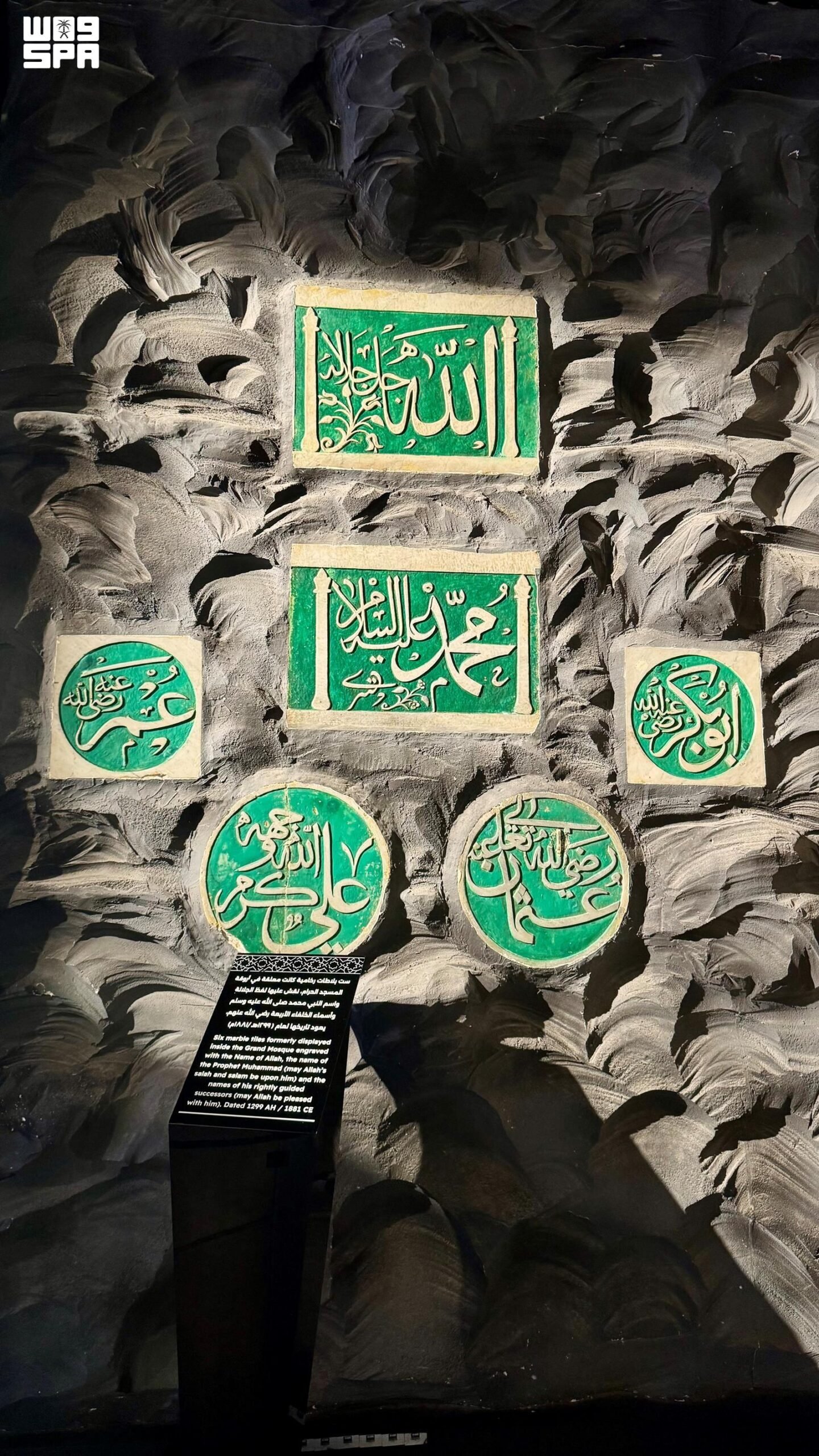
Six historical marble tiles in the Al-Haramain Architecture Exhibition document the names of the Rightly Guided Caliphs and date back to the thirteenth century AH.
The Architecture of the Two Holy Mosques exhibition in Mecca includes a group of rare historical pieces that document aspects of the architectural and artistic legacy of the Grand Mosque, the most prominent of which are six marble tiles that were hung in the corridors of the Grand Mosque, and bear prominent Islamic inscriptions that reflect the care of Muslims throughout the ages for the architecture of the Holy House of God and highlighting its religious symbols.
These tiles, dating back to the year (1299 AH – 1881 AD), stand out as one of the distinctive pieces of art that combine the beauty of Arabic calligraphy and precision of execution, as the word Majesty, the name of the Prophet Muhammad – may God bless him and grant him peace – were engraved on them, and the names of the four Rightly Guided Caliphs, may God be pleased with them: Abu Bakr Al-Siddiq, Omar bin Al-Khattab, Othman bin Affan, and Ali bin Abi Talib, in an artistic composition that reflects the decorative character prevailing in the architecture of the Grand Mosque. In that era.
These tiles are considered a historical witness to the stages of development that the Grand Mosque has witnessed over the centuries, as they used to decorate the corridors of the Grand Mosque in Mecca, before they were preserved within the collections of the Architecture of the Two Holy Mosques exhibition, which includes a number of archaeological and architectural treasures related to the history of the Grand Mosque and the Prophet’s Mosque, and contributes to introducing visitors to the urban and artistic development that the Two Holy Mosques witnessed throughout the ages.
The exhibition is of interest to visitors, researchers, and those interested in the history of Islamic architecture, as it contains rare original collectibles, including architectural elements, artifacts, manuscripts, and models documenting the historical stages through which the Two Holy Mosques passed, reflecting the care and attention that the Saudi state has given since its founding to the architecture of the Two Holy Mosques and the preservation of their cultural heritage.
These six marble tiles embody an aspect of the artistic beauty that adorned the corridors of the Grand Mosque in the late thirteenth century AH, and represent a historical document that preserves the features of Islamic architecture and calligraphic decoration that were associated with the holiest parts of the earth, and highlights the continuity of interest in preserving this legacy and making it available to successive generations through exhibitions and specialized centers.