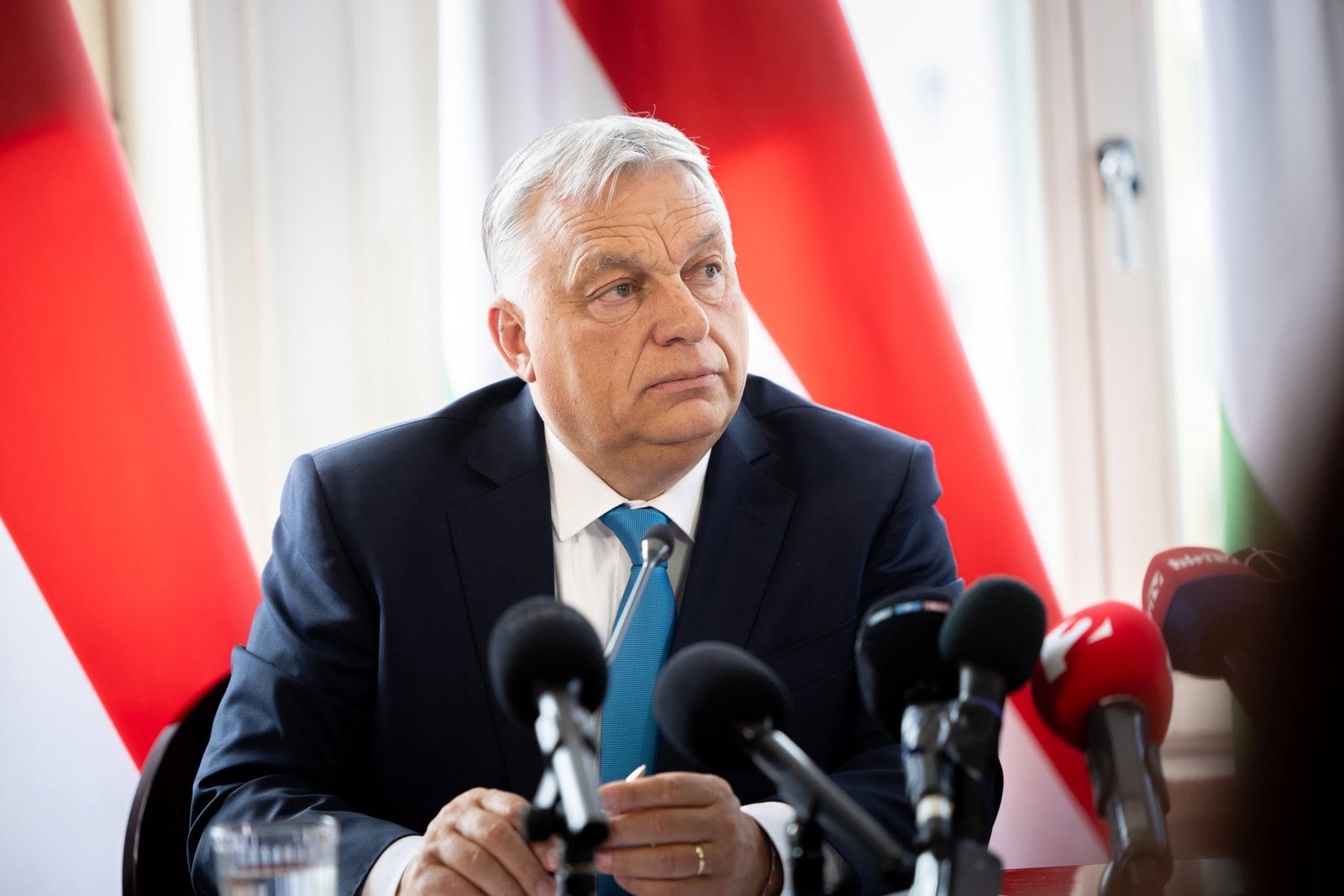

“FIDESZ’s foreign policy will continue to be a committed supporter of the patriotic European movement, and its objective remains unchanged: Brussels must be reformed,” Viktor Orbán, president of FIDESZ, said at an international press conference held in the Belgian capital on Wednesday.
Viktor Orbán, who took part in the Patriots for Europe party family’s meeting on Thursday, pointed out that FIDESZ’s electoral defeat does not alter what he considers the historically decisive fact that patriotic political organizations, communities, and parties continue to gain ground across Europe.
No single election or electoral defeat can override this historical process,”
he stated, adding that throughout Europe there is an expectation that this trend will continue and that anti-immigration and sovereigntist political forces will become even stronger in the months and years ahead.
The former prime minister said he is convinced that this advance could only be halted if the leadership of the European Union were able to demonstrate successful results. “However, for years now we have lived in times when the EU leadership has been able to show not successes but failures, or has been forced to present failures, whether in matters of security, the Russia–Ukraine war, and the issues of peace, competitiveness, or migration,” the politician listed.
Responding to a question about the recent decision to limit how long someone may serve as prime minister to a maximum of eight years, he emphasized that Hungary is an 1,100-year-old state and “has enormous experience in how to remove leaders from governing the country.” He added that he himself had “gotten off relatively cheaply.”

In Orbán’s view, “things are going badly in every respect” in Europe. European politics is unable to provide security for the continent or effectively handle the war taking place in its neighborhood. He added that the migration problem is gradually turning into an integration problem and that Europe is also facing competitiveness challenges.
He added that after 2022, an economic policy should have been found that would enable the Hungarian economy to succeed even while developments within the EU were unfavorable. In his opinion, the major dilemma across Europe is how to create a growth-generating economic policy when the EU itself is unable to grow.
Regarding EU funds, he said that Hungary has now changed tactics. He explained that
while he was in office, his government regarded the European Commission’s actions as political blackmail and responded by threatening to use its veto power.
He added that he had expected the funds to be received in December.
As he noted, the strategy was based on the fact that the EU’s next seven-year budget requires unanimous approval by the member states. “If they do not give us the money, then there will be no next seven-year budget,” he said, adding that he had expected all of Hungary’s withheld funds to be released by December under this approach.
He argued that the current government has adopted a different strategy by complying with Brussels’ demands in an effort to secure the release of the funds. At the same time, he urged it not to leave “a single penny” behind, including the €2 billion that Brussels says is no longer available because the relevant deadlines have expired. Orbán suggested that Hungary should again use its veto power over the next seven-year EU budget if necessary.
In my opinion, it is important that Hungary not simply let those two billion euros go to waste,”
said the politician.
He also criticized the inclusion of conditionality mechanisms that tie EU payments to political or legal requirements, saying that Hungary’s previous position had been that such provisions should be removed from the next budget because they create opportunities for future political pressure and blackmail.
He noted, however, that in European politics, the patriots and conservatives are gaining increasing influence, and
the policy of center-right parties to constantly form coalitions with the left will not be sustainable in the long run.
The center-right parties must either join the left in the opposition or establish unity on the right, explained the former prime minister.

Via MTI, Világgazdaság; Featured image: Facebook/Orbán Viktor