The agreement in principle between the United States and Iran, which should put an end to the war that started at the end of February, has been received rather mixed. After an intense phase of bombings and shelling, a shaky ceasefire and many announcements of an agreement, signatures will be signed on Friday under a settlement that still contains many open endings.
In one camp there is relief, in the other there is talk of capitulation. This is the profit and loss account for the parties involved.
United StatesHumiliation
:format(webp)/s3/static.nrc.nl/wp-content/uploads/2026/06/17124321/170626BUI_2034500821_trump.jpg)
President Donald Trump.
Photo AFP
The agreement in principle with Iran is widely seen as a huge defeat for President Donald Trump, and therefore for the United States as a whole. And ‘defeat’ is a weak word: commentators also speak of ‘humiliation’ and even ‘capitulation’.
Trump, columnist wrote Gideon Rachman of the Financial Timeshas a “long history of presenting failures as successes – whether it’s a bankrupt casino or a lost election.” Sunday evening the president called The New York Times to explain why the agreement in principle was “great news”: the Strait of Hormuz would be “toll-free forever,” Iran would refrain from pursuing highly enriched uranium “forever” and the war had reshaped the Middle East in favor of the US.
Even in his own party, few agree with Trump on this. And certainly not neutral commentators. For example, Ali Vaez, Iran director at the International Crisis Group think tank, calls it “nothing short of astonishing” that the world’s most powerful military force, in collaboration with the world’s most powerful intelligence agency – Israel’s – has failed to achieve any of its strategic goals against the “third-rate regional power” Iran.
Trump’s claim that the agreement in principle also includes nuclear restrictions is simply not true: it has been agreed that the two countries will continue to discuss that theme for another sixty days. No one applauds this agreement in principle because of the nuclear agreements it contains.
The reopening of the Strait of Hormuz is also hardly seen as an achievement. “Let’s not forget,” said journalist David E. Sanger The New York Times that Sunday it phone call from Trump was told, “that the closure of the strait was not the cause of the war, but a consequence of it. So this just takes us back to where we were.”
Another sore point is that this agreement does not help the Iranian people. Despite all Trump’s promises, the agreement in principle actually perpetuates the power position of the Iranian regime.
After news agency Bloomberg News on Tuesday evening leaked version of the text of the agreement had published, criticism of Trump did not diminish. According to critics, the text is vague, the timeline is unclear and it is not clear what requirements Iran must meet.
The president and his team are diligently trying to interpret the text in their favor. The text, according to the Americans, is deliberately vague: this way the Iranians can better sell the agreement at home. In the meantime, that is exactly what Trump and associates are failing to do.
Also read
The US and Iran both interpret the agreement in principle to their own advantage. Do they actually agree with each other?
:format(webp)/s3/static.nrc.nl/wp-content/uploads/2026/06/15135932/150626BUI_2034469208_1-1.jpg)
IranTriumph
:format(webp)/s3/static.nrc.nl/wp-content/uploads/2026/06/17124307/170626BUI_2034500821_tehran2.jpg)
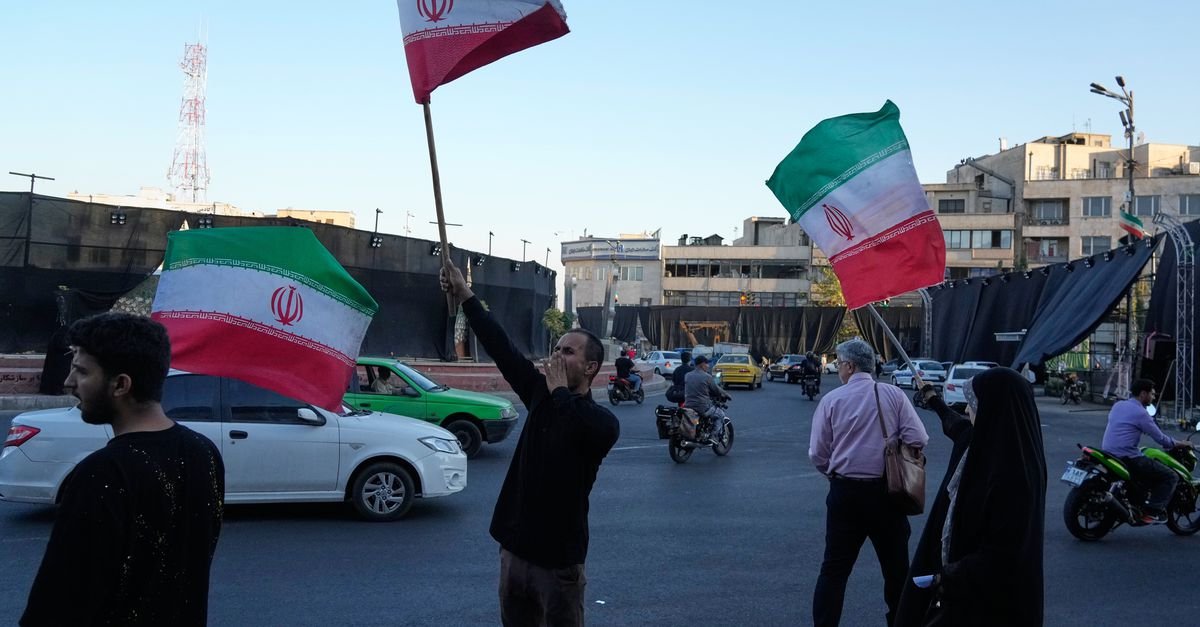
A woman with an Iranian flag demonstrates against the talks between Iran and the US in the Islamic Revolution Square in Tehran.
Photo Vahid Salemi/AP
The Iranian regime is generally regarded as the winner. Not only did it withstand the American and Israeli bombs, it also paralyzed the world economy. Blocking the Strait of Hormuz has proven to be an effective deterrent that the Iranians can continue to threaten in future conflicts.
Iran gained a few clear gains from the negotiations. For example, it can keep its drone and missile program and does not have to withdraw its support for the Lebanese fighting group Hezbollah.
Moreover, the regime can benefit significantly financially from this agreement. The agreement sets out a plan for Iran’s recovery and economic development, with “guaranteed financing of at least $300 billion” (almost 260 billion euros). However, the Iranians will only receive that money when the war has finally ended, including a nuclear deal. It is not yet clear who will pay for this. Some skepticism is appropriate: the reconstruction fund for Gaza promised by Trump is empty.
Financial issues surrounding Iran are sensitive to the American president. One of the reasons he once blew up the Obama deal was because his predecessor would send “piles of cash” to Tehran. Trump absolutely does not want to give the impression that he is rewarding the Iranian regime. But critics say the Iranians are now much better off than under that previous deal.
Yet there is also criticism of the agreement in Tehran, especially from ultraconservatives. They believe that Iran is giving up the blockade of the Strait of Hormuz too quickly and is trading it in for an American promise of sanctions relief that has yet to be fulfilled. Sanctions relief must be approved by Congress.
IsraelCapitulation
:format(webp)/s3/static.nrc.nl/wp-content/uploads/2026/06/17124332/170626BUI_2034500821_netanyahu.jpg)
Israeli Prime Minister Benjamin Netanyahu during a press conference in Jerusalem after announcing an agreement between the US and Iran.
Photo Ronen Zvulin/ANP
That Israel should be regarded as the loser of the agreement in principle is a position that is expressed loudly and clearly in that country by commentators and politicians on all sides of the spectrum. The agreement is seen, among other things, as a capitulation to radical Islam. Moreover, it feels like a great humiliation that Israel has to stop its attacks in Lebanon before it can achieve its war goals.
Even though he was not at the table during the talks with Iran, it is clear who is to blame: Benjamin Netanyahu. The Israeli prime minister has been called, among other things, Trump’s “errand boy”.
Netanyahu has continually made attempts to present his struggle in Lebanon as a separate war from the one against Iran. With this agreement in principle, Iran has achieved exactly the opposite: Lebanon and Iran are two inseparable theaters of one war, and what happens on one stage undeniably influences the other.
Also read
The US and Iran both interpret the agreement in principle to their own advantage. Do they actually agree with each other?
Netanyahu lost that battle; for the time being he will have to keep quiet in Lebanon. But anyone who has followed recent developments in Gaza knows that the prime minister has a knack for doing something completely different from what he says in public. He openly supported Trump’s plan to turn the coastal strip into a kind of Singapore. Six months later he deploys the Israeli army to take over more and more of Gaza.
This fall it will become clear at the polling stations whether Israeli voters will punish the prime minister for his defeat. Like his ally in the White House, Netanyahu appears as if the Iran war was a success.
On one level he seems to be getting his way. According to Iran, the agreement in principle means that the Israeli army must withdraw from southern Lebanon. This is not apparent from the leaked text. Netanyahu had no intention of withdrawing his troops, and does not appear to be obliged to do so.
Lebanon:Discomfort
:format(webp)/s3/static.nrc.nl/wp-content/uploads/2026/06/17124348/170626BUI_2034500821_libanon.jpg)
A displaced man who fled his village in southern Lebanon lies next to his belongings on a sidewalk in the southern port city of Sidon, Lebanon, Wednesday, June 10, 2026.
Photo Mohammed Zaatari/AP
It will be a great relief for the Lebanese people that Israel must stop its attacks on the country. More than a million people have been driven from the south of the country.
The agreement also raises uncomfortable questions, especially about the country’s sovereignty. The Lebanese government has to deal with an armed group in its own country that does not listen to the central authority (Hezbollah) and a neighboring country that occupies territory (Israel). Lebanon was not allowed to participate in discussions with the US and Iran. Things are being decided about Lebanon. The government is sitting there and watching it.
A major loss for the Lebanese government is that Iran does not have to stop supporting Hezbollah. The government wanted to work on disarming the group. This has already proven to be extremely difficult and will now become even more complicated.
It will probably take some time before tourists and expats find their way to the Gulf States again
Gulf StatesRelief
:format(webp)/s3/static.nrc.nl/wp-content/uploads/2026/06/17124350/170626BUI_2034500821_dubai.jpg)
Sunset off the coast of Dubai.
Photo Fadel Senna/AFP
In the Gulf there is initial relief that, if the agreement in principle holds, Iran will not shoot drones and missiles over the Persian Gulf for the time being and that the Strait of Hormuz will open. Oil from the Gulf States will reach the world market again. However, it will probably take some time before tourists and expats find their way to countries such as Saudi Arabia, Qatar and the United Arab Emirates.
These countries, which benefit from stability, are worse off than before the war. Their oil and gas exports appear to be vulnerable, and the Americans do not appear to be an ally that has saved them from malaise. On the contrary: it was Trump who disrupted stability in the region with his rash attack on Tehran.
Is it worth keeping that alliance? The Emirates seemed to be preparing for an alliance with Israel, which helped the country with air defense against Iranian projectiles. During the war, Qatar sought rapprochement with Tehran, something that is also being considered in the Saudi capital Riyadh. Iran has therefore succeeded in playing the Gulf states against each other.