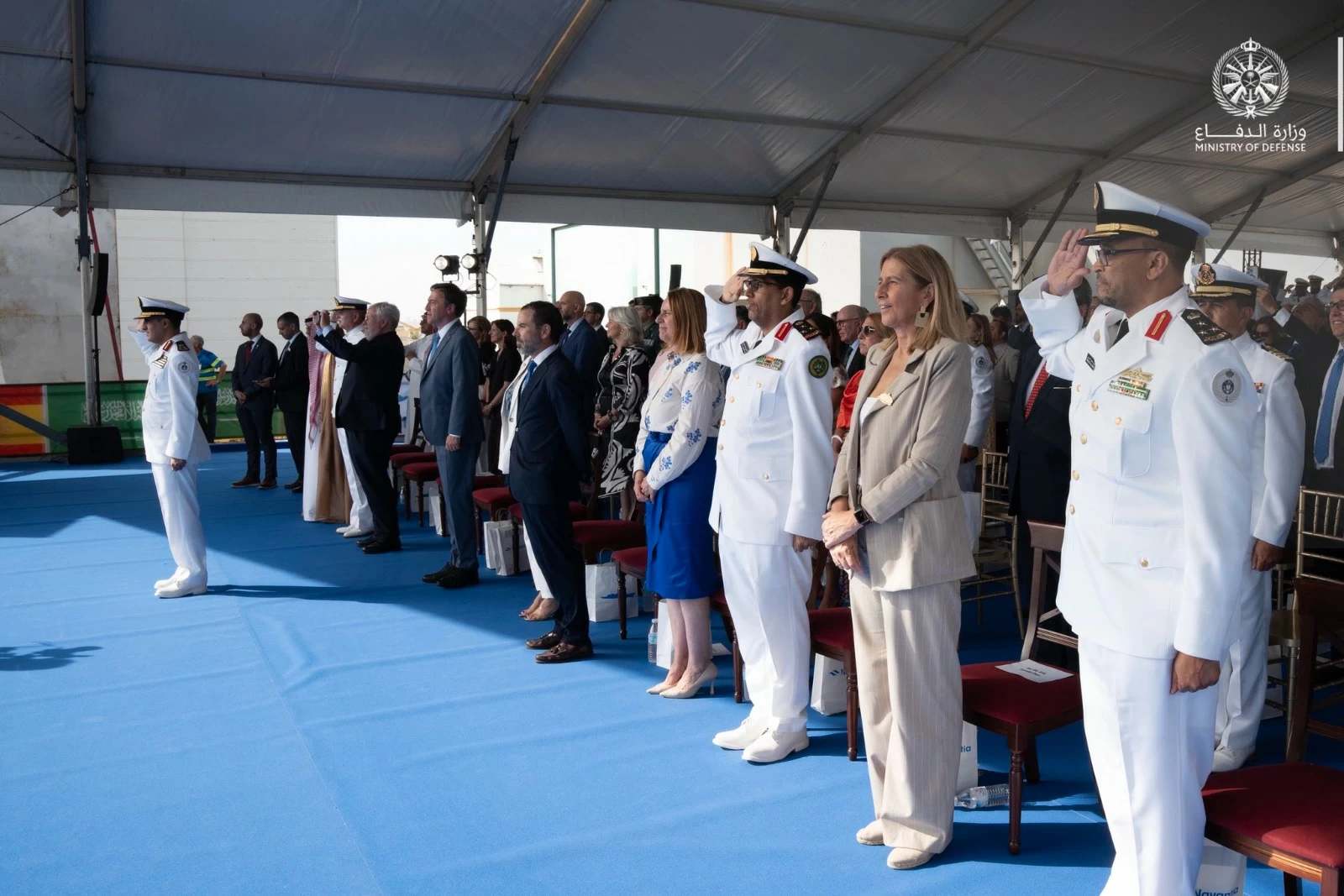
Today, the Royal Saudi Navy refloated “His Majesty the King’s Ship Medina,” the first ship of the second phase of the “Sarawat Project,” at the Navantia shipyard in the city of San Fernando, Kingdom of Spain.
The flotation step comes after the completion of the construction and assembly phase of the ship’s hull, moving to an advanced stage that includes installing and integrating the systems, followed by port acceptance tests and sea trials, in preparation for its entry into official service in the naval forces.
“His Majesty the King’s Ship Al-Madina” is the first of three multi-mission combat ships of the “Avanti 2200” corvette type, along with “His Majesty the King’s Ship NEOM” and “His Majesty the King’s Ship Al-Ula.”
In mid-December 2024, the Ministry of Defense signed a contract with the Spanish company “Navantia” to acquire and supply these ships, in continuation of the success of the first phase of the “Sarawat Project,” which was completed with the construction and delivery of five combat ships to the Navy.
The floating ceremony took place in the presence of the Director of Staff of the Naval Forces, Rear Admiral Saleh bin Ali Al Khathami, on behalf of the Chief of Staff of the Naval Forces, Lieutenant General Mohammed bin Abdul Rahman Al Gharibi, and the Chairman of the Board of Directors of Navantia, Ricardo Dominguez.
On this occasion, the Chief of Staff of the Naval Forces, Lieutenant General Mohammed bin Abdulrahman Al Gharibi, appreciated the unlimited support enjoyed by the Armed Forces in general and the Naval Forces in particular from the Custodian of the Two Holy Mosques King Salman bin Abdulaziz Al Saud – may God support him -, His Royal Highness Prince Mohammed bin Salman bin Abdulaziz Al Saud, Crown Prince and Prime Minister, and His Royal Highness Prince Khalid bin Salman bin Abdulaziz, Minister of Defense – may God protect them -, stressing that this support contributed to developing defense capabilities and raising the level of Readiness and operational efficiency.
He stressed that the project is proceeding according to the approved time plan, under the supervision and follow-up of a specialized team of Navy personnel. In order to achieve the highest levels of efficiency and readiness, he added that the project includes an integrated package of logistical support, qualification and training of ship crews, in addition to completing the work of the second and third ships within the Kingdom.
The “Sarawat Project” aims to transfer and localize the shipbuilding industry and military naval technology in the Kingdom, by training Saudi technical personnel and involving them in construction work, while the Saudi Military Industries Company “SAMI” plays a pivotal role in developing the naval battle management system “Hazm” and integrating it with armament systems, in a way that enhances the development of local capabilities and achieves the goals of the Kingdom’s Vision 2030.
The project’s ships enhance the capabilities of the naval forces, with their combat systems and advanced technologies, in dealing with various air, surface and subsurface threats, monitoring the maritime domain and protecting the vital interests and strategic assets of the Kingdom.
The Royal Saudi Naval Forces today launched the “King’s Ship Al-Madinah,” the first vessel of the second phase of the “Sarawat Project,” at the shipyard of Navantia in San Fernando, Spain.
This launch follows the completion of the construction and assembly phase of the ship’s hull, moving to an advanced stage that includes the installation and integration of systems, followed by port acceptance tests and sea trials, paving the way for its official entry into service with the Naval Forces.
The “King’s Ship Al-Madinah” is the first of three multi-mission combat vessels of the Avante 2200 corvette class, alongside the “King’s Ship Neom” and the “King’s Ship Al-Ula.”
The Ministry of Defense signed a contract with the Spanish company Navantia in mid-December 2024 to acquire and supply these ships, completing the successful first phase of the “Sarawat Project,” which involved the construction and delivery of five combat vessels to the naval forces.
The launch ceremony was attended by the Director of Naval Forces Staff, Rear Admiral Saleh bin Ali Al-Khathami, on behalf of the Chief of Naval Forces Staff, Lieutenant General Muhammad bin Abdulrahman Al-Ghareeb, and the Chairman of Navantia, Ricardo Dominguez.
On this occasion, the Chief of Naval Forces Staff, Lieutenant General Muhammad bin Abdulrahman Al-Ghareeb, praised the unlimited support received by the Armed Forces in general and the naval forces in particular from the Custodian of the Two Holy Mosques, King Salman bin Abdulaziz Al Saud – may God support him – and His Royal Highness Crown Prince Mohammed bin Salman bin Abdulaziz Al Saud, Prime Minister, and His Royal Highness Minister of Defense Prince Khalid bin Salman bin Abdulaziz – may God protect them – emphasizing that this support has contributed to the development of defensive capabilities and enhanced operational readiness and efficiency.
He confirmed that the project is proceeding according to the approved timeline, under the supervision and follow-up of a specialized team from the Naval Forces, achieving the highest levels of efficiency and readiness. He added that the project includes a comprehensive package of logistical support, crew qualification, and training, alongside the completion of the second and third vessels within the Kingdom.
The “Sarawat Project” aims to transfer and localize military shipbuilding and maritime technology in the Kingdom by training Saudi technical personnel and involving them in construction work, while the Saudi Military Industries Company (SAMI) plays a pivotal role in developing the “Hazm” naval combat management system and integrating it with weapon systems, enhancing local capabilities and achieving the objectives of Vision 2030.
The project’s vessels enhance the capabilities of the Naval Forces, equipped with combat systems and advanced technologies to address various aerial, surface, and subsurface threats, monitor the maritime domain, and protect the vital interests and strategic assets of the Kingdom.