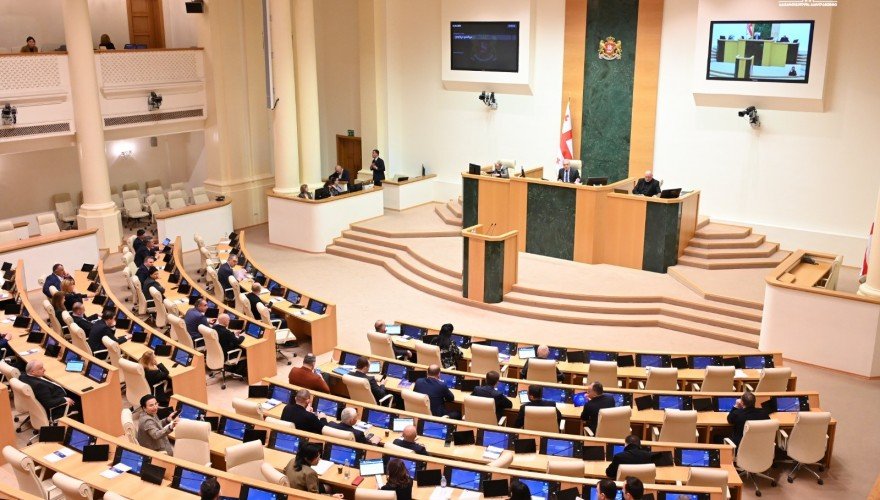
Georgia’s disputed parliament adopted amendments to the controversial Law on Grants, introducing new exemptions to apply to diplomatic and international organization missions, as well as the Georgian Red Cross Society and financial and credit institutions. The amendments were adopted in the third and final reading on April 15, after two days of deliberations under an accelerated procedure.
The amendments follow a restrictive package adopted by the disputed parliament on March 4, which, among other changes, significantly broadened the definition of a foreign “grant” requiring government approval to include any monetary or in-kind support from a foreign organization or individual to local entities.
Under the new version, funds disbursed by diplomatic missions, consular offices, and international organizations that are “used or may be used for activities arising from the political or public interests, approaches, or relations of a foreign government or a foreign political party” will not be considered grants requiring government approval.
Georgian Dream had earlier explained that the exception will apply to funds that such missions use for their “own activities.”
Chair of the disputed parliament’s legal issues committee, Archil Gorduladze, said when the changes were drafted in early April that “if a diplomatic mission, an embassy, receives funds from its country to carry out its objectives, specifically, activities in accordance with the Vienna Convention, such as hiring staff or promoting its country, none of this required agreement with the government under existing legislation, and it will not require it under the changes either.”
He then added, however, that “if an embassy provides funds to any natural or legal person, aimed at shaping policy in Georgia and influencing the public, this will be considered a grant and will require agreement with the government.”
While the ruling party said further amendments were necessary to ensure “uniform interpretation” of the law, critics pointed to broader problems with ambiguity in drafting restrictive legislation, suggesting the further amendments refer to commercial services contracted by diplomatic missions and predicting that more revisions may become necessary.
In addition, the new version of the law exempts the Georgian Red Cross Society and its grants, as well as grants issued by financial and credit institutions, from the requirement to obtain government consent. This amendment was approved during the second reading in the disputed parliament’s legal issues committee on April 15.
Gorduladze said during the April 15 committee hearing regarding the financial and credit institutions that grants issued by the World Bank, for example, would be deemed exempt, noting that they are “usually always accompanying grants linked to loan agreements” and therefore would not require government approval.
Exemptions already applied to grants issued by international sports organizations, individual funding for education and research received abroad, and programs such as the EU’s “Horizon Europe” and Erasmus+, as well as grants from the German Academic Exchange Service (DAAD) and the EU–Georgia “Creative Europe” program.
Also Read:
This post is also available in: