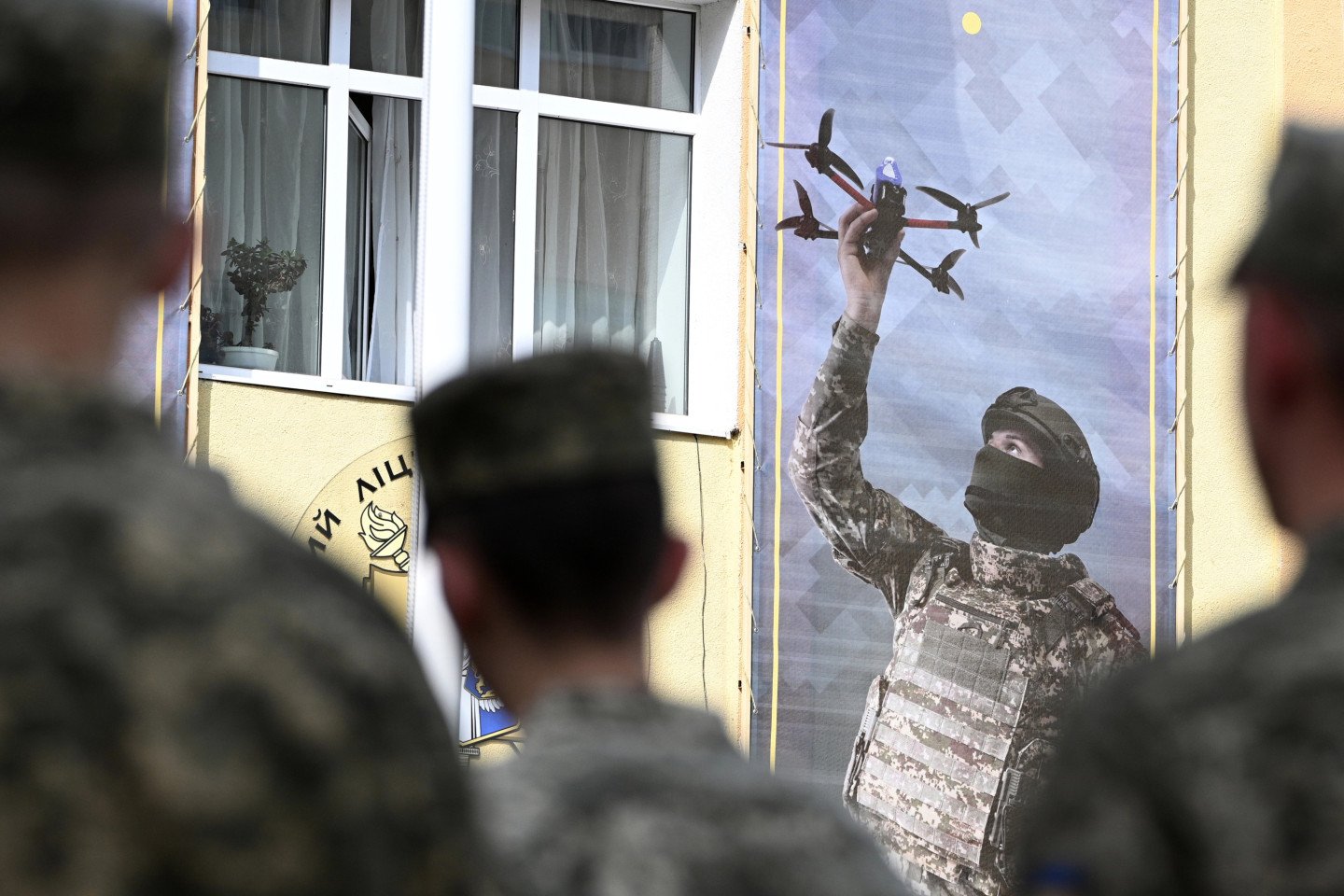
In the corridors of Ukrainian power, there are fierce battles over how to maintain state control over Ukraine’s military industry, especially over long-range drone technologies and anti-drone systems developed by Ukrainian companies – according to a publication on the website of the Polish state-funded Marek Karpa Center for Eastern Studies.
In the Latvian information space about ongoing processes related to Ukraine’s armaments field and cooperation with Latvia, as well as the latest news from Tallinn, where Latvian Prime Minister Andris Kulbergs and Ukrainian President Volodymyrs Zelenskis met and signed documents on June 9.
Scary news
The website of our Ministry of Defense published a scant message about the agreement with Ukraine on cooperation in the field of defense, which foresees comprehensive cooperation in the next 10 years. “The document expresses the commitment to further develop bilateral cooperation between Latvia and Ukraine, assuming that Latvia’s support will be provided by Latvian industry, through international or bilateral cooperation frameworks and by supporting Ukrainian industry. Ukraine is committed to providing support for the export of military products in order to expand the capabilities of the National Armed Forces. In cases where support will be provided to Ukrainian industry, the possibilities of co-production, localization and technology transfer will be considered. Ukraine has committed to providing support to the experts transfer, especially in the context of unmanned air defense, taking into account Ukraine’s unique military and civilian experience. The agreement provides that any budgetary commitments from the Latvian side will be ensured only with the clear approval of the Latvian Parliament. At the same time, the agreement provides that Latvia intends to allocate around 110 million euros to fulfill the provisions of the agreement within the framework of the available state budget The most important elements of the agreement on military support are Latvia’s continued cooperation with Ukraine in the research and development of new military technologies, the provision of support to Ukraine in the following 10-year period, the specific type and amount of which is decided each year, as well as the provision of export licenses for procurement for the needs of the National Armed Forces, including the exchange of experience and cooperation in the reconstruction of Ukraine’s defense-related infrastructure. such as communication networks, logistics infrastructure and military industrial facilities.”
On the website of the Ukrainian Embassy in Latvia, an even more meager message can be read: “After the meeting, the President of Ukraine and the Prime Minister of Latvia signed the Drone Agreement – an agreement on cooperation in the field of unmanned technologies. The purpose of the document is to improve the defense capabilities of Ukraine and Latvia, develop joint production, exchange technology, experience and knowledge, as well as deepen cooperation in the field of anti-aircraft and missile defense. Special attention was paid to the air defense needs of Ukraine and Latvia’s future support in this field.”
But what really lies behind this sparsely described arrangement?
Produces more than the country can buy
This is partially revealed by the publication of the Center for Eastern Studies “Exports under special supervision. Ukraine liberalizes arms exports” prepared by the researcher Krzysztof Nechipor.
It states that in recent months, Kyiv has significantly accelerated the process of liberalization of the export of arms and military equipment produced in Ukraine. Until now, it was subject to an informal ban by the higher authorities, which was determined by the need to meet the needs of the Armed Forces of Ukraine only. The publication says that “Kyiv plans to allow exports only to those companies that, in cooperation with foreign partners, on the basis of intergovernmental agreements, receive special permits for the production of weapons. This will allow strict control of trade, which will be determined by political agreements at the international level. Kyiv also expects that this selective liberalization of sales will significantly increase state revenues and accelerate the development of the domestic arms industry, which will become one of the pillars of the post-war economy.”
The publication reveals that Ukraine’s desire to sell military products is not the result of pressure from the Ukrainian state, but from local defense companies. “The rapid growth of defense production has led to the fact that production capacity this year far exceeds the financial capabilities of the Defense Acquisition Agency (the agency responsible for contracting, procurement and monitoring the execution of military orders). According to estimates by the Ministry of Defense, the production potential of the defense industry will reach about $50 billion this year, while national orders for the military will not exceed $13 billion. This overproduction threatens to hamper domestic industrial development in key defense sectors (primarily drones and electronic warfare). As a result, companies have redoubled their pressure on authorities to allow exports. According to October 2025, 51% of drone manufacturers expressed a desire to move their factories abroad (52% of them to Poland). The main reasons cited were security concerns (89%). to export manufactured products (61%).”
According to K. Nechipor, the granting of export permits in Ukraine is subject to special conditions, the sale of products abroad refers to certain types of weapons and military equipment, and it takes place only in accordance with international agreements within the framework of the “Build with Ukraine” program and the drone program “Drone Transactions”. “Joint production with foreign partners will continue to focus on the needs of the armed forces, and exports will cover only products whose supply exceeds domestic demand. This will allow Ukrainian arms companies to increase production using Western capital and production infrastructure, while retaining personnel and technological know-how for the armed forces (ASU).
Kyiv aims to create a fully monitored arms export mechanism, the proceeds of which will be reinvested in arms production. According to the Secretary of the National Security and Defense Council, Rustem Umerov, the first arms sales contracts will be implemented in the second half of this year, and the profits are estimated at several billion dollars a year. Zelensky believes that the success of Ukraine’s defense industry in foreign markets will make it a pillar of the future economy, equal to agriculture. The Persian Gulf War, which has increased interest in Ukraine’s anti-drone defense solutions, is an important context for the opening of arms exports. This strengthened Kiev’s confidence in its ability to play a political game and make the choice of partners a condition that they support Ukraine in the war with Russia,” the publication explained.
Red tape
Although A. Kulbergs and V. Zelenskis signed the agreement in Tallinn, it looks like there is still a long way to go before its implementation, full of bureaucratic loopholes. The publication of the Center for Eastern Studies reads: “Weapons sales abroad will be hindered by the complex and bureaucratic process of obtaining permits. They are issued by the Cabinet of Ministers to selected companies after a process lasting several months, while the sale of a specific type of weapon is possible after the approval of the Inter-Ministerial Commission, based on an application submitted by the State Export Control Service. In addition, allowing the sale of weapons only to companies included in international agreements on cooperation in the field of weapons could give advantages to selected companies. Consequently, it could lead to a decrease in the market share of weapons concentration in the hands of government-linked entities and to change the current shape of the arms industry, whose main advantage was its dispersion among many different manufacturers, which promoted creativity and innovation. Ensuring the full cooperation of domestic companies in the field of armaments could pose a challenge to the Ukrainian authorities with countries trying to attract the Ukrainian arms industry without consulting the government in Kyiv.”
The desire to control companies also in foreign countries
The publication states that Kyiv not only plans to bring companies operating in Ukraine under full control, but also to systematize the activities of Ukrainian companies that have moved their production facilities to Western countries: “Kyiv’s attitude to the foreign operations of Ukrainian companies that have already established cooperation with Western partners is still unclear. This mainly concerns companies that have moved their production from the territory of Ukraine after 2022, mainly to EU/NATO countries In Central Europe, these companies will not be subject to Kiev’s control, if only because their foreign partners will refuse to accept additional restrictions. The fact that they are important suppliers of weapons and military equipment used by the Ukrainian army (including so-called long-range drones that allow attacks deep into Russian territory) is hindered.
It should be reminded that the core activities of the Marek Karpa Center for Eastern Studies are fully financed from state funds in accordance with the annual decision of the Seimas of the Republic of Poland. The center employs more than 40 full-time analysts. The director of the center is appointed by the Prime Minister of Poland from the candidates nominated by the seven members of the center’s council.