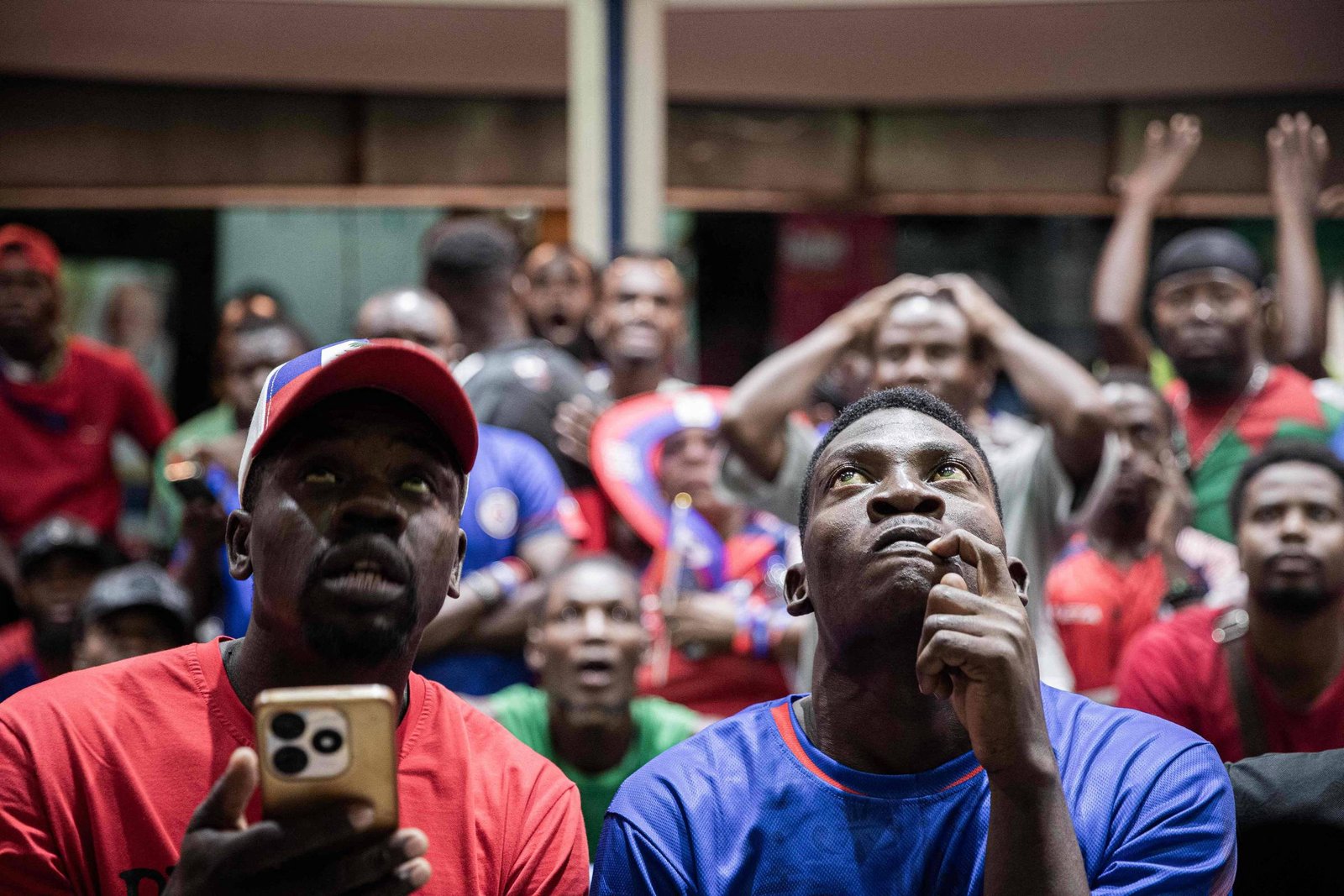
Brazil’s opponent this Friday (19), the Haiti and a broken countrypoor and violent, dominated by gangsan ordeal that has been minimally alleviated by the joy of participating in the World cup.
Haitians are passionate about soccerbut above all by Brazilian stars, which makes the confrontation in Philadelphia, unprecedented in World Cups, even more historic for the population.
“Football continues to be one of the few things capable of providing a collective emotional outlet in the midst of so much tiredness and frustration. In a country like ours, football is not just entertainment, it is almost a question of emotional survival,” he told Sheet journalist Patrick Saint-Pré, founder of the portal Haiti Climatespecialized in environment, and contributor to the newspaper “Le Nouvelliste” – the most influential and oldest in the country, at 128 years old.
“For decades, Brazil has been the second team for many Haitians. Pelé, Ronaldo, Ronaldinho, Neymar… entire generations here have grown up loving Brazilian football. Of course, people will support Haiti with pride, but many hearts will also beat for Brazil. It will be deeply symbolic. More than a football match, it will be a rare moment of national unity and joy, something that Haiti desperately needs right now,” said Saint-Pré.
Brazilian with a Haitian heart, the teacher Werner GarbersNeno, who has lived in Port-au-Prince, the country’s capital, for 14 years, took this two fans literally, creating a split shirt, on one side yellow with the Brazilian flag; on the other blue with the flag of Haiti.
“I did this because that’s how I feel, and so do many Haitians. They’ve always been very passionate about Brazil and now they’re expressing how passionate they are about Haiti. It’s very beautiful to see, and it’s very new. It’s a historic moment, we really feel like we’re participating in history,” said Neno, who teaches Portuguese language and Brazilian culture at the Brazil-Haiti Cultural Center.
In 2019, during a nine-day period in Port-au-Prince that resulted in a report for Piauí magazine about the outcome of Minustah – the peace mission led militarily by Brazil that lasted 13 years, from 2004 to 2017 – from the Haitian perspective, this reporter was able to see the effects of this passion.
Although Minustah left a negative image among the vast majority of the local population, the burden did not fall on Brazil – whose Army led the mission throughout the period and whose Armed Forces sent the largest contingent of soldiers, 37.5 thousand –, but on the UN.
“For the Haitian, it wasn’t Brazil that was here, it was the UN. In the Haitian’s mind, Brazil is Skinis Ronaldois Ronaldinho“, summarized Nouvelliste’s editor-in-chief at the time, Frantz Duval.
When Brazil was eliminated by Belgium in the quarterfinals of 2018 World Cupin Russia, violent protests erupted on the streets of the capital. Victories of the Canary Islands team in World Cups are celebrated with parties.
Haitians’ admiration for the team increased after the legendary “peace game” 2004 (Minustah’s first year), a friendly in which Ronaldo and Ronaldinho’s Brazil thrashed the home team 6-0 in front of a fanatical crowd.
The first country in the world to permanently abolish slavery – not by the colonizer, but in a revolution in which power was taken by former slaves, a unique case in history –, Haiti is rarely remembered for this immense featbut more because of his ailments, partly resulting from his insubordination.
France charged billions of dollars in compensation to recognize independence and maintain business with the country – the payment of which was one of the causes of historical debt Haitian. It took decades for the US to recognize the autonomy of its Caribbean neighbor.
The history of poverty and violence in recent decades – fueled by major natural tragedies, such as the earthquakes of 2010 and 2021 – has worsened since the assassination of president Jovenel Moïsein July 2021. Gangs dominate most of the country, including 80% of the capital’s territory.
As a sign that even with the World Cup the situation remains turbulent, last Saturday (13) it was reported that the chief of staff of the Haitian Ministry of Defense, James Boyard, also inspector general of the National Police, was kidnapped together with his wife and young daughter, in one of the most serious recent episodes of this sport that has been plaguing the country for decades.
News of the kidnapping came to light three days before the visit of the UN Secretary GeneralAntónio Guterres, to Haiti, this Tuesday (16). The Portuguese stated that the country is experiencing the most serious humanitarian crisis in the Western Hemisphere and the one that is worsening most quickly.
The executive director of the human rights NGO Je Klere Foundation, Marie Yolene Gilles, spoke to the reporter shortly after participating in a meeting with Guterres, and expressed dismay.
“He said that the mission (an international gang repression force with logistical support from the UN) is in action. But this force has been here since April, and so far nothing new has happened. We can’t go south, we can’t go north, the gangs are gaining territory, 80% of the capital is under their control.”
She sees some relief with the World Cup. “Because, after 52 years without participating in the World Cup (the only time was in 1974), Haiti had its back to the world, now it is in front of everyone. Everyone sees the Haitian flag, and that is very important for us. So there is hope.”
Yolene Gilles remembers, however, that only one of the 26 called up from Haiti (midfielder Woodensky Pierre) plays in local football – whose league is active, in fits and starts. All the rest work between Europe (mainly France), the Americas (mainly the USA) and even in Iran. And the majority (16) were not even born in the country.
“They don’t really know the situation in Haiti. They hear it on the radio or read it in the newspaper and on social media, but in terms of reality, they don’t know. They don’t understand Creole (one of the official languages, alongside French) well,” said the activist.
“They wanted to represent Haiti. That’s fine, and it’s very good for us. But I don’t know if they take the responsibility of talking to gang members to ask them to give the population a chance. I don’t know, because they’ve never come to Haiti. They would like to come, but due to lack of security, they can’t.”