Northern Ireland is on fire again, while it appears to be a contemporary version of the “Troubles” that this region of the United Kingdom knew in the past.
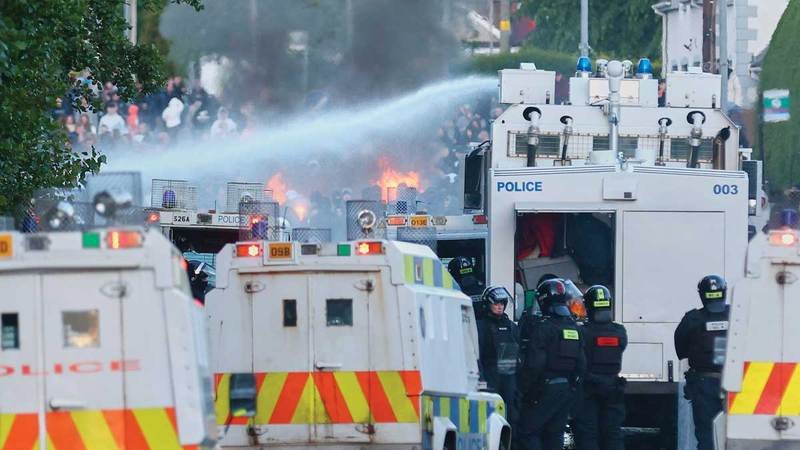
In several neighborhoods of Belfast, police and firefighters struggled, until the early hours of Wednesday morning, to contain crowds of anti-immigrant militants who targeted ethnic minority homes, restaurants and shops.
Police said dozens of homes were burned, along with several migrant cars and at least one bus, while authorities focused on transporting threatened people to safe places, rather than confronting and arresting the attackers.
In London, Prime Minister Keir Starmer pledged that hundreds of rioters, most of whom were teenagers and young people in their twenties who were covering their faces, would be identified and charged in the coming weeks and months.
Starmer said: “It is clear that people were targeted last night because of their background, I will not tolerate that, and those responsible will face the full force of the law.”
This wave of destruction and intimidation was widely expected, in response to the alleged knife attack that took place last Monday night, carried out by a Sudanese asylum seeker against a local resident on a street in north Belfast, a horrific event that was filmed and circulated internationally through social media accounts run by far-right agitators.
The alleged attacker, 30, appeared before a Belfast court after being charged with the attempted murder of Stephen Ogilvie, who lost an eye in the attack.
In return, the Ogilvie family issued a statement in which they appealed to the public not to take out their anger on innocent immigrants.
The family said: “We have many immigrants who make a very valuable contribution to our country, including in the healthcare system and the hospitality sector, and we depend on them to keep our country running.” She added: “We do not want this horrific tragedy to be exploited to divide people or inflame hostility.”
The extreme reactions mirror what happened in parts of Northern Ireland over the past two summers: in August 2024, authorities had to call in police reinforcements from Scotland to deal with a week of anti-Muslim violence, and in June 2025, when two young Romanian men were accused of sexually assaulting a teenage girl.
Looting and theft
In both cases, anti-immigrant groups organized protests mainly via Facebook and WhatsApp, which turned into attacks on immigrants’ homes and businesses, including looting and theft.
Analysts say that social media posts promoted by instigators from abroad could easily inspire and inflame this locally organized violence, but that is not happening because the lines of conflict here are already deeply rooted in a city characterized by sharp divisions and paramilitary traditions, especially in the poorer Protestant areas.
There, most of the violence broke out on Tuesday night, in areas still under the influence of one of the two main banned pro-British groups, the Ulster Defense Association and the Ulster Volunteer Force.
Both groups had previously killed Catholics in retaliation for violence committed by the Irish Republican Army, a horrific era that faded with the 1998 Good Friday peace agreement.
But since then, the rival Ulster Defense Association and the Ulster Volunteer Force have turned into full-time criminal organizations, with thousands of members who share the same values as far-right agitators in England and beyond.
These groups began as popular organizations committed to preventing Catholics from settling in Protestant areas, but today, when a triggering event occurs, their main targets become Asian and African immigrants, who, despite the rise in immigration rates in recent years, still constitute only about 3% of the population of Northern Ireland, which remains – by a clear margin – the least accommodating of immigrants in the United Kingdom.
Is history repeating?
This focus on defending Protestant lands against outsiders goes back to the first chapter of the conflict in Northern Ireland. The “Troubles” broke out in Belfast in August 1969, with loyalist attacks on the homes of Irish nationalists, which led to the displacement of thousands of Catholics and the creation of purely Protestant areas, a sectarian map that is still clearly defined today.
Near the places from which Catholics were expelled two generations ago, 40-foot-high walls, known as “peace lines,” separate working-class neighborhoods. On one side of these fortifications are the green, white and orange of the Irish flag, while on the other side Protestant areas bear the red, white and blue of the Union Jack.
In the era following the 1998 peace agreement, which made Northern Ireland a more attractive place to live, low-rent properties on either side of those security barriers became home to increasing numbers of new arrivals from Eastern Europe, Asia and Africa.
Contact areas
Given the increasing numbers of Irish nationalists and the decline of the Unionist Protestant community in the so-called “seam zones,” non-white asylum seekers find greater opportunities to obtain housing on the Protestant side of the barrier.
As for the knife attack that occurred last Monday night, it happened near one of those “seam zones,” but on the Catholic side of the separation line, where migrants often say they feel relatively safer.
Paul Doherty, the councilor who represents Catholic west Belfast, does not miss the feeling that history is repeating itself, as old tensions collide with new demographic shifts.
“I grew up hearing stories about members of my community in west Belfast whose homes were burned down on Bombay Street during the 1960s,” Doherty said, pointing to the place where the first “peace line” was held. “People are still suffering from the trauma of those days,” he added. “We know where this road leads, and we cannot allow reckless gangs in 2026 to repeat some of the darkest chapters of our past. That is what I felt last night.” About “Politico”
• Asian and African immigrants still constitute only 3% of the population of Northern Ireland, which remains, by a clear margin, the least accommodating of immigrants in the United Kingdom.
• This wave of destruction and intimidation was widely expected, in response to the alleged knife attack, which occurred last Monday night, carried out by a Sudanese asylum seeker against a local resident on a street in north Belfast.
• Due to the increasing numbers of Irish nationalists and the decline in the numbers of the Unionist Protestant community in what are known as “seam areas,” non-white asylum seekers find greater opportunities to obtain housing on the Protestant side of the security barriers.