Monday, May 25, 2026, 06:48
172132 readings

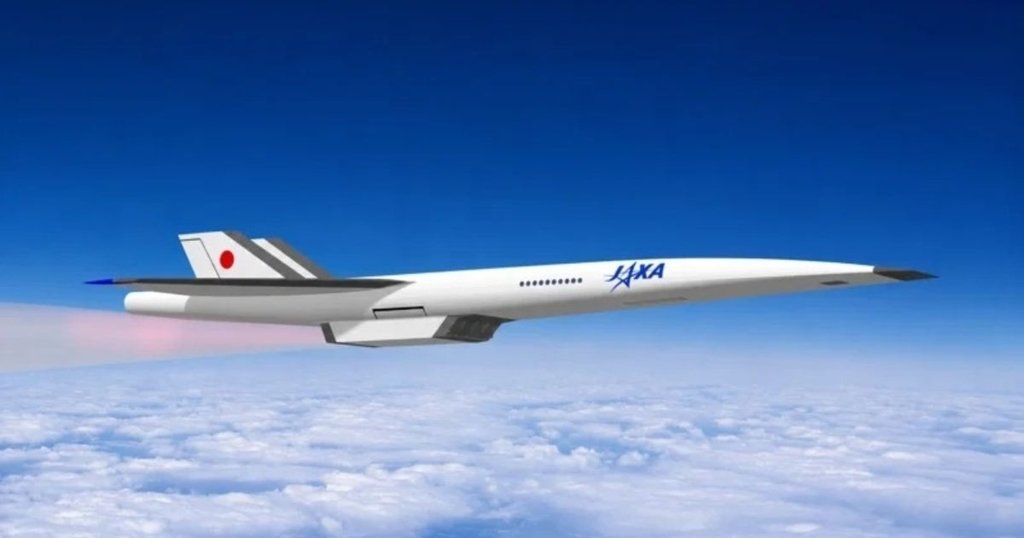
Japanese hypersonic aircraft/PHOTO:X@JTDH
A Japanese aerospace research agency is working on developing a hypersonic passenger plane that could reach speeds about two and a half times faster than the famous Concorde.
The Japan Space Agency (JAXA) has announced that it has recently carried out an important test within its experimental program dedicated to hypersonic air transport.
Tests at speeds five times the speed of sound
During the experiment, the researchers installed a model aircraft in a specialized facility for testing ramjet engines at the Kakuda Space Center in Miyagi Prefecture.
Engineers simulated flight conditions at Mach 5 — the equivalent of about five times the speed of sound and considerably above the performance ever achieved by Concorde.
According to the researchers, the test validated several essential systems of the aircraft, including thermal protection, control surfaces and engine operation in extreme conditions.
At such speeds, temperatures outside the aircraft can reach nearly 1,000 degrees Celsius, which is one of the main technological challenges for the development of hypersonic aircraft.
Possible flights Tokyo–US in just two hours
The next stage of the program could include an actual flight test at Mach 5, using an experimental rocket or similar launch vehicle.
If the project becomes operational, the travel time between Tokyo and United States it could be reduced to about two hours. Currently, the same route takes around 12 hours by conventional commercial aircraft.
The aircraft would fly at altitudes of about 27 kilometers, more than twice as high as regular commercial aircraft.
At Mach 5, a hypersonic jet could reach speeds of about 5,300 km/h, nearly six times faster than current commercial aircraft.
Concorde remains the benchmark of supersonic aviation
The Concorde supersonic aircraft, withdrawn from service in 2003, reached maximum speeds of about Mach 2, i.e. around 2,250 km/h.
Although the new Japanese project is considered promising, experts warn that the development of a hypersonic commercial aircraft will still require many years of research and testing.
Professor Hideyuki Taguchi, from Tokyo University of Science, said that developing a conventional aircraft normally takes about a decade, and for hypersonic aircraft the process could take about 20 years.
For his part, Professor Tetsuya Sato, from Waseda University, described the current results as “just a first step” towards a future full demonstration flight.
A global competition for the air transport of the future
JAXA is not the only organization involved in the race to develop ultra-fast aircraft.
In recent years, projects such as the X-59 experimental aircraft developed by NASA or the XB-1 model of the company Boom Supersonic have carried out important tests in an attempt to overcome problems related to noise, consumption and efficiency.
Researchers believe that hypersonic aviation could radically transform international transport in the coming decades, although technical hurdles and costs remain considerable.