Turki Al-Faisal: There is no alternative to a just and comprehensive international system that respects the law and does justice to the oppressed
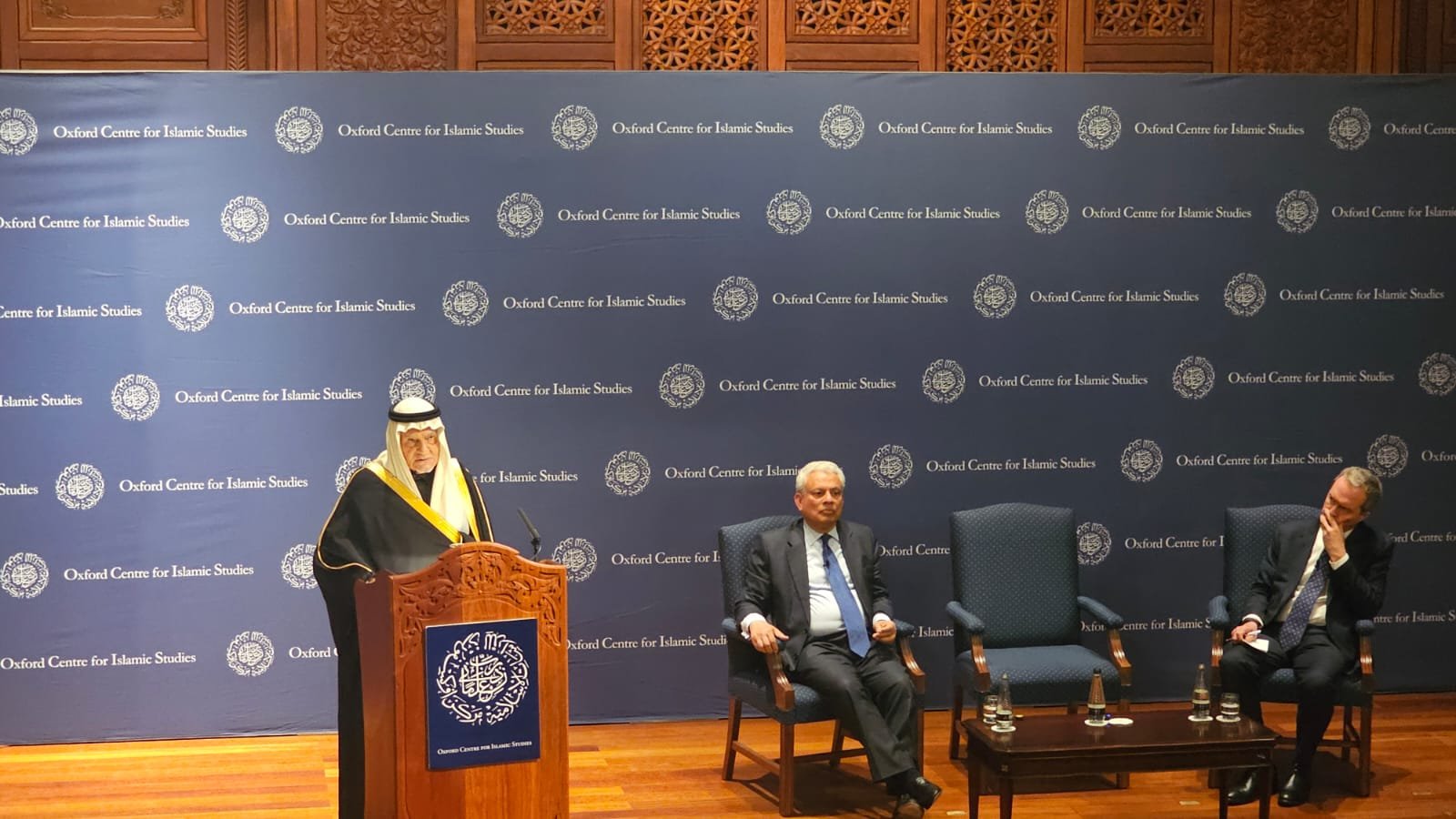
His Royal Highness Prince Turki Al-Faisal, Chairman of the Board of Directors of the King Faisal Center for Research and Islamic Studies, confirmed that the global system that was established after World War II is today going through a stage of fracture and collapse, warning that returning to the logic of the balance of power and the struggle of the elders is no longer an option, and that the only alternative is to restructure the international system to be fair, comprehensive, and expressive of international reality, so that power is distributed among multiple centers and not on one pole. His Highness stressed that the Arab and Islamic region was the most affected by the injustice of this regime, and that global peace and stability can only be achieved by respecting international law and resorting to reason, morals, and fairness.
This came in a speech delivered by His Highness entitled “The World Order Today: An Islamic Vision” at the Oxford Center for Islamic Studies on June 10, 2026 AD, at the invitation of the Center’s Director, Dr. Farhan Nizami, whose Highness praised his role over four decades in making the Center one of the most prominent institutions in the field of Islamic studies in the world. His Highness recalled the speech of His Majesty King Charles III at the Center in 1993 AD when he was Crown Prince, in which he stressed that the ties between the Islamic and Western worlds have become more important than ever in an increasingly interconnected world.
His Highness described the current strategic environment as turbulent and unstable, dominated by conflicts and wars and a disregard for international law and its institutions, recalling the British philosopher Thomas Hobbes’s depiction of the “state of nature” as a “war of all against all.” His Highness referred to what was said by the Secretary-General of the United Nations, Antonio Guterres, who warned that replacing the “force of law” with the “law of force” undermines the credibility of the rules-based international system and doubles human suffering.
His Highness noted what Canadian Prime Minister Mark Carney said in his speech at the World Economic Forum in Davos this year, when he described the current moment not as a phase of transition but rather as a “rupture” of the rules-based international order.
His Highness reviewed the stages that the international system has passed through since 1945 AD, which has succeeded in sparing the world from major power wars, contributed to the liberation of many peoples – including Islamic countries – from the yoke of colonialism, and established the principles of equality between countries, the right to self-determination, and the rule of international law. However, this system transformed from bipolarity to unipolarity, and then to what His Highness described as “unilateralism” that ignores the rules of belonging to an international system.
His Highness pointed out that the world hoped that this would lead to a more equitable system that embodied the principles preached by the United States during the Cold War, namely the rule of law, the right to self-determination, human rights, freedom, and equality, a dream that Winston Churchill always aspired to when he called for “a global order in which the principles of justice and fairness protect the weak from the strong.” However, this hope was dashed on the ground with the rise of nationalist tendencies and global terrorism, and then with the events of September 11 and the wars on Afghanistan and Iraq, where unipolarity turned into an unilateralism that ignored the requirements of the international system.
His Highness explained that the wars on Iraq and Afghanistan, and then on Gaza, Lebanon and Iran, had buried unipolarity without burying unilateralism in issues of war and peace, stressing that returning to the logic of force and the major wars it entails is not a solution, and that the world does not need a new world war to give birth to a new world order. His Highness stressed that the only viable alternative is to restructure the existing international system to be fair, comprehensive, and expressive of international reality, wondering how it is possible to accept the absence of effective representation of one and a half billion Muslims, more than a billion Indians, nearly a billion Africans, and more than half a billion Latin Americans at the head of this system.
His Highness stressed that the Islamic region, with the Arab world at its heart, was the most affected by the injustice of the international system in all its stages, indicating that it remained the altar on whose threshold the principles of this system were sacrificed, and that the Palestinians were deprived – by the same principles – of their homeland and their basic right to self-determination and the establishment of their state. He pointed out that the use of the veto has always been an obstacle to any Palestinian effort to gain state recognition in the Security Council, and His Highness stressed that the continued European and American support for the monster in Tel Aviv is the reason behind all evils in the Middle East.
His Highness recalled the words of the Custodian of the Two Holy Mosques King Abdullah bin Abdulaziz – may God have mercy on him – regarding the inability of the international community to stop the bloodshed in Syria: Confidence in the United Nations has been shaken, and that no country, no matter how powerful it is, can control the world except with reason, morals and fairness. Granting the General Assembly international legislative authority that is not subject to veto is an urgent necessity, proposing to begin reforming the veto system so that executive decisions emanating from a previously approved decision may not be vetoed, as is the case in Resolutions 242 and 338 related to the Israeli occupation.
His Highness addressed the current outbreak of armed conflict between the United States, Israel and Iran, describing it as a dangerous manifestation of the uncontrolled use of military means, and a reflection of three apocalyptic visions of the world: the doctrine of waiting for the Hidden Imam according to Iran, the establishment of a Greater Israel from the Nile to the Euphrates according to the Israelis, and the rebuilding of the Temple in Jerusalem according to Christian Zionism. His Highness explained that His Royal Highness Crown Prince Mohammed bin Salman had advised avoiding the military option from the beginning, like other leaders of the Gulf states. However, the Gulf states became the target of Iranian retaliatory strikes despite their refusal to respond in kind, stressing that this situation could not continue.
At the conclusion of his speech, His Highness stressed that the existence of an effective, rules-based international system was sufficient to prevent this conflict and the conflicts that preceded it since the founding of the United Nations eighty-one years ago, concluding with a verse from the Holy Qur’an, the Almighty saying: (And do not dispute with the People of the Book except in a way that is best, except those who do wrong. And say, “We believe in that which was revealed to us and revealed to you. Our God and your God are One, and to Him we submit.” (46)