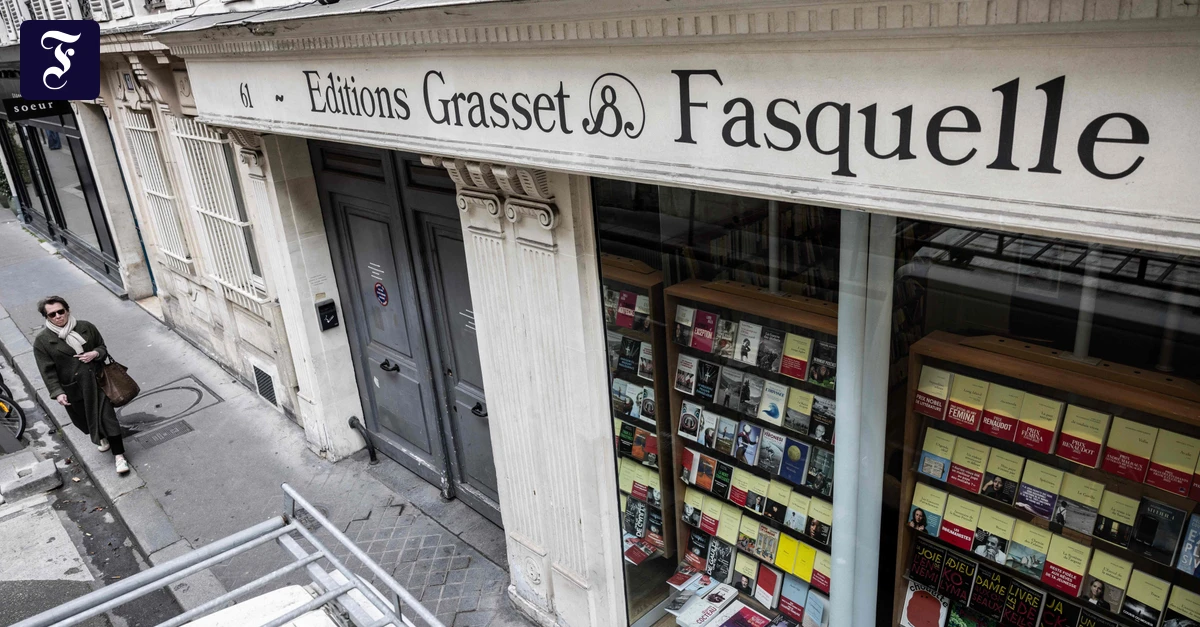
Since the huge shock caused by Olivier Nora’s dismissal on April 14 after decades at the helm of Grasset, aftershocks have shaken France’s publishing world almost daily. Within a day and a half, 115 authors from the traditional Parisian house agreed to publish their future books elsewhere – the number has since risen to over two hundred.
“Once again,” they castigated in an open letter, “Vincent Bolloré says: ‘This is my house and I do whatever I want in it,’ with no regard for all those who write, for all those who look after, edit, proofread, produce, distribute and sell our books – and for all those who read us. We do not want our ideas, our work, to be Bolloré’s property. Today we have one thing in common: we refuse to be hostages to an ideological war, who wants to impose authoritarianism everywhere in culture and in the media.”
The division of the authors, if it was intended, failed
After numerous media companies, the right-wing extremist billionaire and tycoon Vincent Bolloré has already put one of the houses of his Hachette publishing group at the service of his Catholic-identitarian culture struggle: Fayard. Now he’s switching on a second one these days: Grasset. If he had intended to divide the publisher’s authors, it would have failed. Among the signatories of the open letter are such completely different personalities as the sensitive biographer Claude Arnaud and the trashy novelist Virginie Despentes, the reactionary journalist Pascal Bruckner and the queer crier of the era of “pharmaco-pornography” Paul B. Preciado, the reform rabbi Delphine Horvilleur and the greatest philosopher in all of Saint-Germain-des-Prés, Bernard-Henri Levy.
Nora was fired because he didn’t want to be talked into his publishing program. But one of the triggers for his termination was the poaching of Boualem Sansal a month ago, which was negotiated over his head by the company’s management. At that time, Nora had informed Antoine Gallimard about the novelist’s transfer to Grasset – the two publishing directors are experienced businessmen, but also gentlemen.
Clear criticism of Bolloré’s instrumentalization
As if to rub his competitor Bolloré’s lack of good manners under his nose, Gallimard published an open letter immediately after Nora’s dismissal in which he reaffirmed his “total solidarity” with his professional colleague and made the postulate of publishing neutrality: “Where politics is exhausted in the pursuit of power, it is poison for the publishing industry.” A clear criticism of Bolloré’s instrumentalization of his publishing and media companies into electoral drums for the right-wing extremist Rassemblement National with a view to next year’s presidential elections.
The following day, Antoine Gallimard doubled down and, alongside around two hundred professional colleagues, signed a text that interpreted Nora’s “brutal expulsion” as a sign of an “unprecedented upheaval”: A media and publishing company makes no secret of its political intentions and is openly waging a cultural and ideological war. From the heart of this same company, over a hundred voices reached Le Monde and expressed their concern for creative freedom in its columns. In the end, the Hachette employees – who remained anonymous for fear of reprisals – sent a call for help to politicians. But while the left screams in outrage, there is no sound from the right camp.
Two exceptions in the conservative concert of silence
Do the silent representatives of the people, Thomas Legrand asked in “Libération”, agree “with the authoritarian takeover of power in a large part of the French publishing world by a self-proclaimed soldier of Christ? Or are they afraid? The result is the same: a spiritual alliance between bourgeois and right-wing extremists.” Two exceptions in the conservative concert of silence: the President of the Île-de-France region, Valérie Pécresse, and President Macron. He called for the defense of publishing diversity at the Paris Book Fair.
For the Fayard and Grasset refugees, the fight is just beginning: They want to regain the rights to their books. And we are pushing for the creation of a conscience clause like the one that exists for journalists: If a publishing house is taken over by a shareholder whose ideology the authors under contract do not share, they should be allowed to leave under acceptable conditions – along with their works.