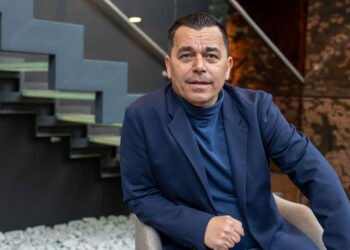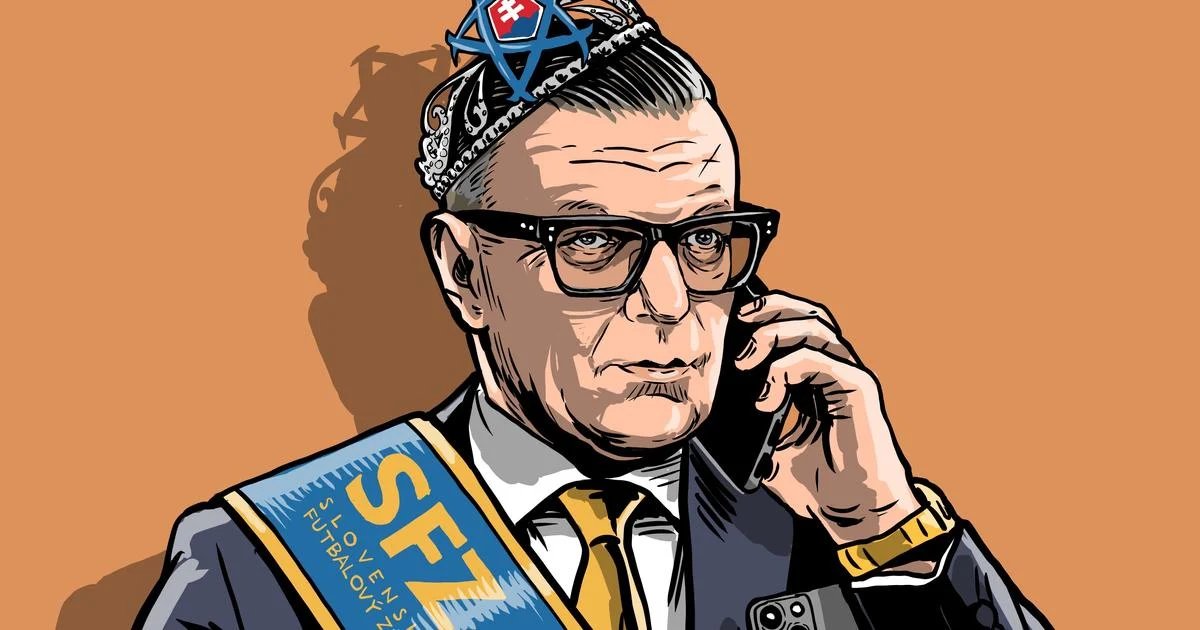

Ján Kováčik. (source: Hey You!)
Most people who know him by hearsay associate Ján Kováčik with the position of president of the Slovak Football Association (SFZ). It is not surprising, he has been in charge of Slovak football for sixteen years and regularly appears in the media in this regard.
However, even before assuming the position of SFZ president, Kováčik developed into one of the richest Slovaks.
His business career was connected with influential figures of the business and social environment. And he would probably like to forget some of the circumstances himself, because they still raise questions.
We describe Ján Kováčik’s business career in the next part of the series Tycoons from the regions.
Boy from Horehron
The extent to which you will be successful often depends on how you can approach problems. It seems that this is also the case with Ján Kováčik.
After graduating from the Secondary Vocational School of Services, he immediately got a job. “My mother and I were left alone and my brother was still going to school. Because I had two jobs, I couldn’t study at university,” he recalled in 2008 for Hospodárske noviny.
A gentle revolution caught Kováčik shortly before his 27th birthday. He did not think long and already in March 1990 he started his business. At first he sold building materials, to which he later added cars.
In 1992, together with the Pole Adam Pietkiewicz, he founded the company Euromotor. It was based in Banská Bystrica, while Kováčik listed the village of Čierny Balog as his permanent residence for a long time.

The current issue of INDEX is full of useful and interesting topics from the world of business, finance and economics. (source: Hey You!)
We mention Kováčik’s residence in connection with the fact that thanks to it, he met Mikuláš Černák, the later boss of the Horehron underworld, and his associate Miloš Kaštan, even during socialism.
“We went by train together. They went from Horehron, I went from Brezno to Banská Bystrica to school, then to work. We often met there,” he said in 2017 in an interview with SME.
“We used to go shopping at Miloš Kaštan’s meat store, Mikuláš Černák drove us by bus, he was the driver. So I know them from that period,” he explained.
“When we met, we said hello, shook hands and everyone went their separate ways. We knew who was who, but we didn’t spend time together,” he explained. It was Kováčik who was supposed to arrange a meeting with Mikuláš Černák for Pavlo Rusk, then director of Television Markíza. Mask should have turned to the boss of the underworld with a request for the liquidation of Sylvia Volzová’s business partner.

Ján Kováčik after his re-election as head of SFZ at the end of February 2026. (source: TASR/Jakub Kotian)
The king of fun
Already in the 1990s, Kováčik became one of the sponsors of the Banská Bystrica football club. Above all, however, he started other business activities. “My main business became entertainment. I don’t like to use the word show business,” he recalled in 2008.
Under “entertainment” you should imagine the Miss and Slávik projects. They were covered by Kováčik’s company Forza, which grew at the turn of the millennium thanks to cooperation with Markíza television.
“When Markíza started broadcasting in August 1996, I visited her with the offer that we would do these projects there,” he explained.

Kováčik’s company organized the Miss competition. (source: SME/Pavol Majer)
Already in April 1997, the first Miss was broadcast on Markíza. And it was on the ground of this television that a business partnership was born, which we can perceive as controversial from today’s point of view.
Kováčik joined forces with Pavlo Rusk, the director and co-owner of the television station at the time. In contemporary articles, they were referred to as “friends”, but primarily they had joint business activities.
When speculation began in October 1999 that Russia would sell its stake in the company Markíza-Slovakia, which held a license to broadcast television, Kováčik was mentioned as his successor. This was soon confirmed.
“Russia first sold its share in the company ARJ. Milan Fiľo was a part of it with 51 percent (privatizer of Rožombersk paper mills, editor’s note)Pavol Rusko had 34 percent and I had fifteen,” explained Kováčik later.
In 2001, he increased his stake in the company Markíza-Slovakia through the company Media Invest, when he convinced Sylvia Volzová, who had a publicly shaken conflict with Russia, to sell him her stake.
“The process began, which was not easy, because there were a lot of lawsuits. But both sides had very competent legal representatives and we saw it through to the end. In November 2001, we signed the contract on the transfer of shares,” claimed Kováčik.
Only a few days after buying the stake, he publicly admitted that he was reselling part of the stake. The American company CME, which owned half of the Markízy (Slovak television company) service organization, showed interest. In 2002, it acquired a controlling 34 percent stake in Markíza-Slovakia.

Pavol Rusko (first from the left) was Kováčik’s business partner for a long time. (source: SME/Jozef Jakubčo)
“Grey Eminence”
These changes took place at a time when it was clear that Pavol Rusko was heading into politics. Television newspapers on Markíza heavily “promoted” his new party, the Alliance of New Citizens (ANO), giving it extra space.
During the publication of the election results in 2002, after which ANO entered the government, Kováčik appeared at the party’s headquarters. The media even called him her gray eminence.