KANSAS CITY (Special Envoy).- A World Cup is prepared with training, tactics, rest, nutrition and meticulous physical planning. But also with the head. Argentina will face the defense of the title with a base that few champions were able to preserve: 17 of the 26 that this Tuesday, against Algeria, they will take the field in Kansas City, they have already lifted the World Cup in Qatar 2022. And that opens a question as inevitable as it is difficult to answer: what is going through the head of a team that has already achieved the maximum objective? Does arriving as a champion give more confidence, add pressure or can it generate some relaxation?
The answer is not linear. Having reached the top can provide greater security, and that is reflected both in day-to-day life and in decision-making during games. But it also adds an extra challenge: stay up. And in a World Cup, where a detail can define a match, the head weighs as much as the legs.
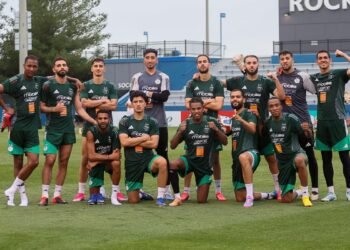
At the Compass Minerals National Performance Center, where this Sunday the team held its penultimate training session before the World Cup premiere, You don’t see a group conditioned by the weight of revalidating the title. But neither is one who is satisfied with what he has already achieved. The injuries and recoveries of some footballers also marked the pulse of these days: the most experienced were in charge of maintaining the balance and the coaching staff, to transmit an unalterable rule: whoever is not fit, will not play. There is room for jokes and a certain relaxation, but as the debut approaches, concentration is gaining ground.
The AFA has a psychologist for all its categories and disciplines: Juan Manuel Brindisi, son of the former Huracán, Boca and Racing soccer player who played with the team in the 1974 World Cup. However, he is not part of the major’s stable coaching staff nor does he accompany the squad during the World Cup. The daily life of the campus, then, is mainly supported by two pillars: the leadership of Lionel Scaloni and his collaborators, and the internal dynamics of a group that has been sharing a dressing room for yearssuccesses and also difficult moments.
“The mind has something very interesting: when one brings up a memory, for the brain that experience is relived almost as if it were present. These players They have recorded what they felt when they were champions and can reconnect with that feeling“explains Verónica Franciscutti, an Argentine psychotherapist who has lived in Kansas City for a little less than two years, with a long history of working with athletes and former soccer players, including several Argentinians who played for the national team. For her, that background works as a plus point: “The same brain that processed that endless final against France, that penalty shootout, that scream. That experience lives in your nervous system. The question is how that circuit is operating today.”.
The idea finds support in a concept that is often repeated among those who accompany elite athletes: the affective memory of achievement. This team built that capital after the consecration in Qatar and reinforced it with new objectives, such as the Copa América 2024, the victories against Brazil and first place in the qualifying rounds. That footprint crossed them and, Far from generating conformity, it fueled the group’s confidence. and today it allows them to face the tournament with less uncertainty than a team that is still building its identity, although in football, of course, many other factors come into play, an area in which Argentina also built one of its main virtues.
For the sports psychologist Carlos Lionti, author of the book The Social Factor and a specialist in working with high-performance teams, group continuity represents an advantage that is difficult to measure, but very important. “Experience is usually a source of confidence. Having gone through certain situations reduces the impact of uncertainty, because these players already have that record and know how to respond,” he explains. And he adds that, in a time in which physical, technical and tactical preparation is increasingly equal, “the constitution of the group, its leadership, its codes and its internal regulations They have a huge percentage of impact on the sporting result”.
However, that past can also become a double-edged sword. “Being a champion has two sides of the coin. Or it can activate all your mechanisms to defend what is yours, or it can appear, even if unconsciously, the feeling of ‘we already fulfilled’. And a thousandth of a second of relaxation, in a World Cup, can make a difference,” warns Franciscutti. But, from the point of view of specialists, that fear of not being up to par is not necessarily an enemy: it is the sign that there is something important at stake. The challenge is not to avoid that feeling, but to know how to live with it.. And that seems to be one of the strengths that this team was building.
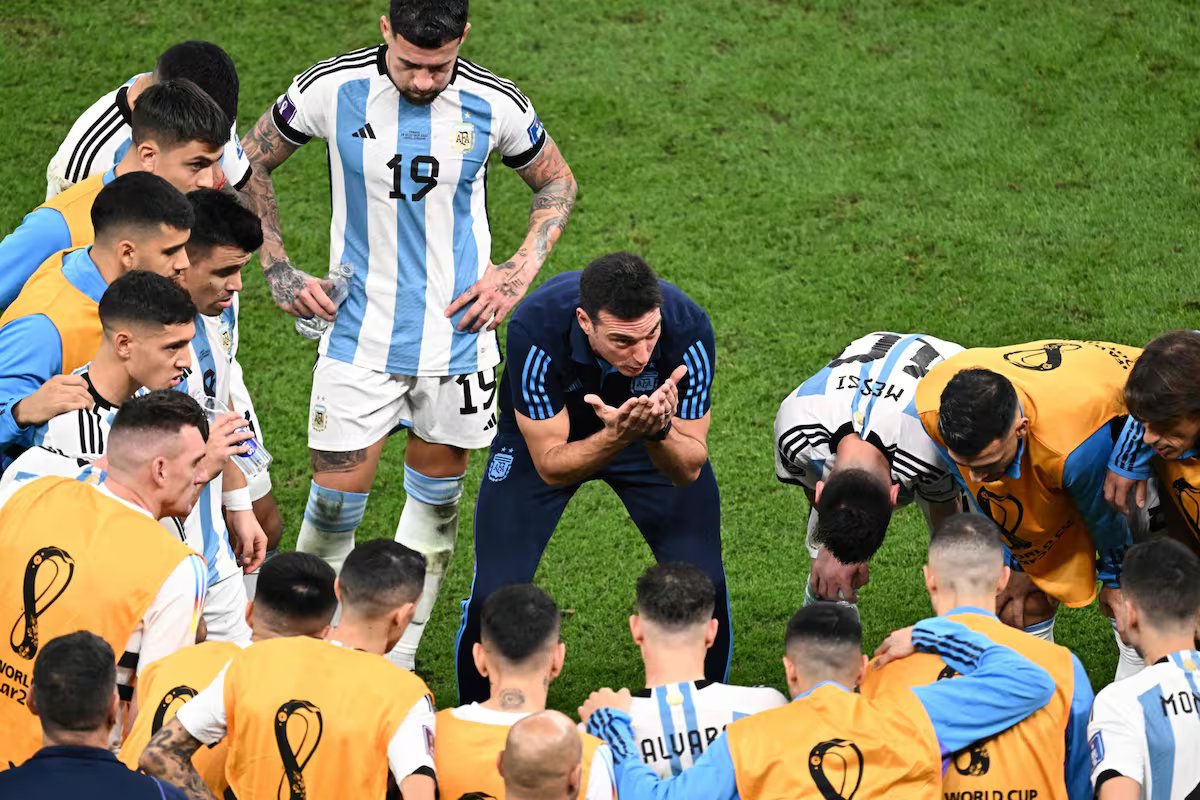
That is, perhaps, the main invisible battle that the team faces. Lionel Scaloni summarized it a few weeks ago in an advertisement with a phrase that today appears plotted, with Argentine colors, in different sectors of the Origin hotel, where the team is concentrated: “We are not going to win it. We are going to defend it”. A kind of mantra for the challenge that lies ahead for this group. It is no coincidence: the coach has long insisted on not underestimating any situation or any rival, a premise that was reinforced after the unexpected debut with a defeat against Saudi Arabia in Qatar.
For Franciscutti, that difference is not just a matter of words. “If the message is ‘we are going to defend what is ours,’ the mind activates very strong protection and motivation mechanisms. It is a way of saying: ‘This cost us a lot to get and we are not going to deliver it’”, he proposes.
What is perceived in the day-to-day life of the national team seems to be going in that direction. There is a consolidated group dynamic that works almost automatically. In practices open to journalism, you do not see a staff paralyzed by pressure; rather, a group of footballers who already know the times of a World Cup and who seem to know perfectly when it is time for everything.
The injuries that appeared during preparation, in fact, put that dynamic to the test. The loss of Leonardo Balerdi, the discomfort of Emiliano Martínez and the recoveries of Nahuel Molina, Gonzalo Montiel and Leandro Paredes forced the team to go through uncomfortable days before the debut. And again it was the most experienced ones who maintained the balance. The Qatari champions, those who have already gone through extreme situations together, once again fulfilled that silent role of containment.
Something similar had happened in March. On the FIFA date in which the team had to face Spain in the Finalissima, Argentina beat Mauritania fairly and, for the first time in a long time, left the feeling of a team disconnected from the context and the demands of representing the world champion. Those who know the intimacy of the campus say that That match set off an alarm signal indoors. Scaloni, the coaching staff and the referents intervened. And the response was immediate: just three days later, the team showed another side and defeated Zambia with authority.
Lionti considers that, in a team whose daily work does not involve the permanent presence of a psychologist within the staff, the leadership of the coach and those of reference takes on even greater weight. “The performance of a team is a direct reflection of who leads it.. When the driver transmits clarity, is coherent and leads by example, the competitive culture of the group tends to be positive,” he explains. A study by the American consulting firm Gallup, based on more than two million responses, reveals that 70% of a team’s commitment depends on its leader.
Within hours of the debut against Algeria, the main capital of this team may not only be the individual talent of its figures: the personality of Dibu Martínez, the security of Cuti Romero, the football of Lionel Messi or the goals of Julián Alvarez and Lautaro Martínez. What distinguishes this group is somewhat less visible: the shared experience of having reached the highest point together and seeing that this path has already worked for them. Maybe because the best way to defend a Cup is to remember, every day, how difficult it was to get it.