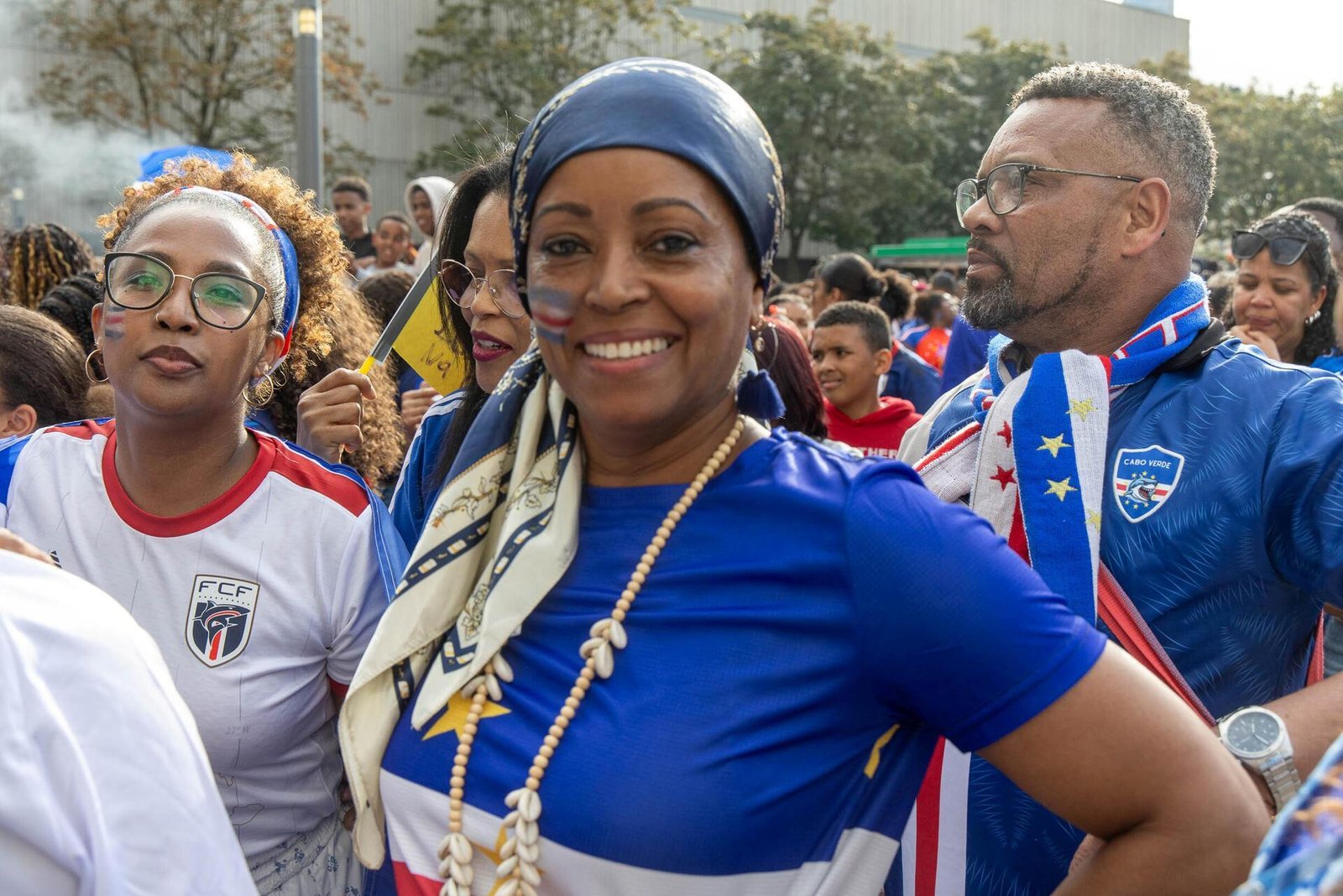
When we arrive in Ettelbruck, several hundred fans of the Cape Verdean national team have already gathered in the city. While driving, everyone guessed the game result. Nobody expects anything other than a clear defeat for the “Blue Sharks”, as the team is called, against the reigning European champions Spain. “Hopefully we don’t have the same fate as Curaçao against Germany,” says Nelson Neves. The team from the Caribbean suffered a 7-1 defeat the evening before. The renowned Luxembourg artist of Cape Verdean origin knows that a respectable success for the island’s footballers is good for self-confidence. His son, the former karateka Jordan Neves, is also full of anticipation: “Today all Cape Verdeans in Luxembourg are proudly rooting for the Blue Sharks.”
Cape Verdean immigration to the Grand Duchy began in the 1960s as part of immigration from the then colonial power Portugal. According to a study by the “Centre d’étude et de formation interculturelles et sociales” (Cefis) from 2017, the number of residents of Cape Verdean origin in this country at that time was 8,000 to 9,000 people. This is confirmed by the national statistics office Statec with 8,358 people (as of 2025). There are three subgroups: Luxembourgers of Cape Verdean origin, Cape Verdean citizens and Cape Verdeans of, among other things, Portuguese nationality. From 2011 to 2025, the number of Cape Verdean citizens in this country rose to 2,894, while 1,684 Cape Verdeans accepted Luxembourgish citizenship during the same period, according to an article by historian Denis Scuto on “L’Immigration capverdienne et le passé colonial du Luxembourg: retour sur les années 1970”.* Scuto recalls that the Luxembourg’s Afro-Portuguese population had disappeared from political discourse for a long time: “Cape Verdeans did not appear in public statistics until 2011.”