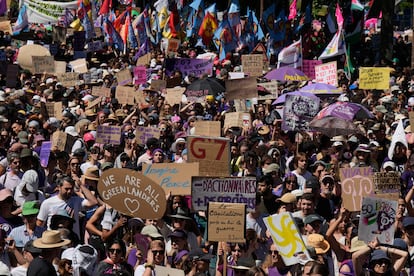
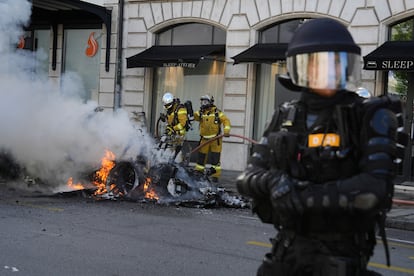
Encouraged by the resonance effect of the Rue de la Servette tunnel, one of the bands that cheered up this Sunday’s demonstration in Geneva (Switzerland) against the G-7 meeting scheduled for the next day, he worked hard to ensure that the famous anti-fascist anthem Bella Ciao It would be thunderous. He succeeded, and the moment had a cathartic effect. Shortly behind was a girl parading with a sign that said We want snow during the winter. Not far from there, a Tesla was burning, a dark omen of riots that took shape throughout the afternoon in different places in the center of the city. The three tiles were part of the great mosaic of indignation that has paraded in the Swiss city between anti-imperialist, anti-fascist, anti-plutocracy, environmentalist, feminist and other slogans.
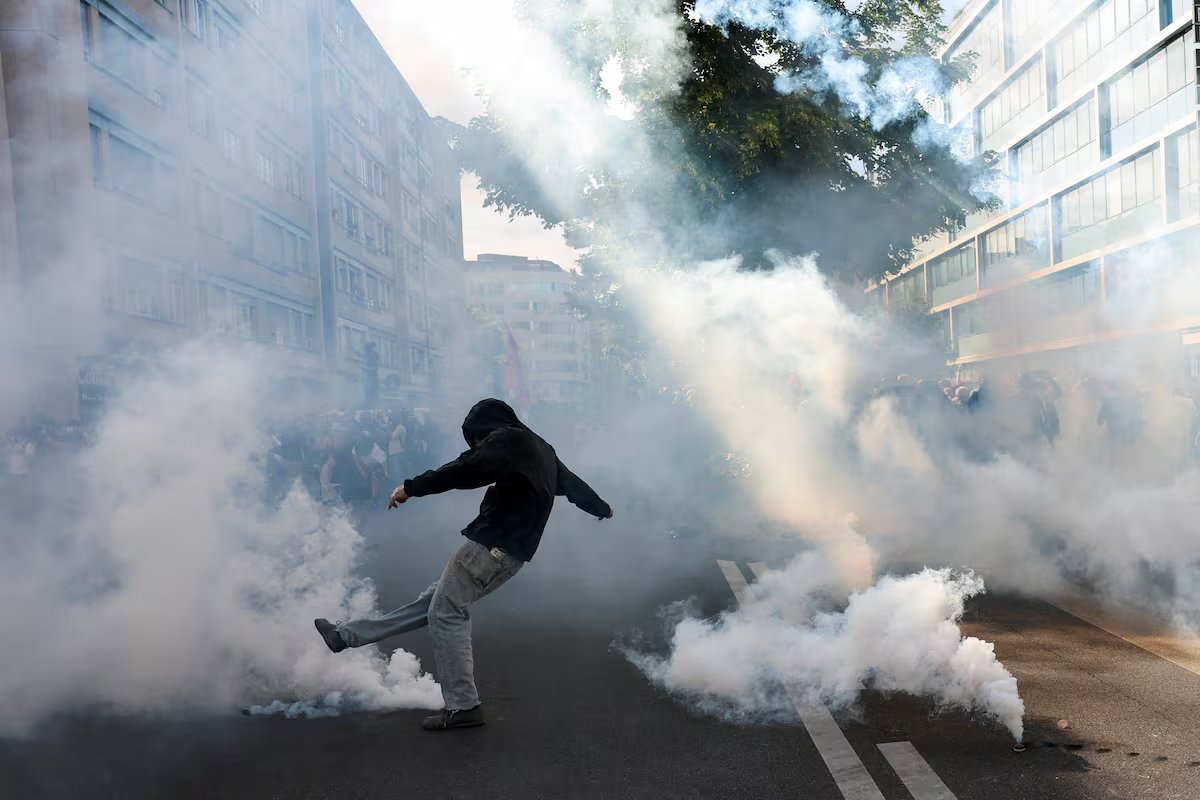
Some 20,000 people, according to the police, and up to 60,000, according to the organizers, joined the call on the eve of the summit, which is scheduled to be held in nearby Évian-les-bains (France) from Monday to Wednesday. The parade was surrounded by a strong police presence. Many stores in the Swiss city had their windows boarded up for fear of acts of violence. The presence, from the beginning, of numerous protesters with their faces hidden led to fears in the early afternoon that these precautions made sense. And, in fact, around six o’clock there were already several acts of vandalism and the police used tear gas to disperse some points along the line of the demonstration.
Small groups with a violent attitude threw stones at symbolic establishments of capitalism and the world order, whether banks or United Nations facilities. Police sources cited by local media put the number of people involved in violent actions at around 600. What had begun in a festive manner took on dark overtones as the afternoon progressed, with the ominous noise of helicopters and ambulances, destroyed furniture and urban areas under tension as the riots intensified.
Everything had started differently, under a harsh sun and with a notable flood of peaceful protesters. “I am worried about the advancing fascism. It scares me,” says Audrey Petoud, 34, a representative of the UNIA union and resident of Lausanne. She carries a sign with a play on words: “G-7 rage in moi”, which when read in French sounds like “I have this anger inside me.” The anger he reflected on Peter Sloterdijk At the beginning of the century it continues to revolutionize the world. In recent years, far-right groups have capitalized on it, channeling it into their nationalist projects. But the Geneva demonstration shows that certain excesses are brewing anger on the other side.
Nelia De-dea is 16 years old. He is a student and participates in the march wearing a kefia. She is one of many participants who show their outrage at the suffering of the Palestinian people with signs or symbols or chants. “Doing nothing is an unbearable hypocrisy. That’s why I’m here. “There are too many people who close their eyes,” he says.
Posters, slogans, faces and comments illustrate the striking confluence of different demands. An official of an international institution who prefers not to publish her name expresses her indignation at the powers that violate international law with impunity and her concern about the deterioration of democracy. “Social networks polarize us, we stop thinking, we don’t understand,” he says, pointing to the techno-oligarchs. “Fuck Trump” and the like have been recurring slogans and slogans.
Chirstophe Kobaich, a 26-year-old student, accuses the G-7 countries of being responsible or co-responsible for abuses and genocides. “One way or another, they participate.” This is a recurring issue: although the difference between a project like Trumpism and European leadership is evident, indignation over the weak reaction, or even a perceived complicity, with certain actions emerges time and again in conversations.
Some protesters carried a sign reading Carlo livesin reference to Carlo Giuliani, the young anti-globalist killed by a shot by Italian security forces during the G-8 in Genoa in 2001. It was, in a sense, the end of a protest movement that criticized—sometimes radically—the previous world order. It remains to be seen if Geneva represents the beginning of another movement against the order that is born from the ashes of the precedent.