AKASH SAMAROO
Lead Editor – Politics
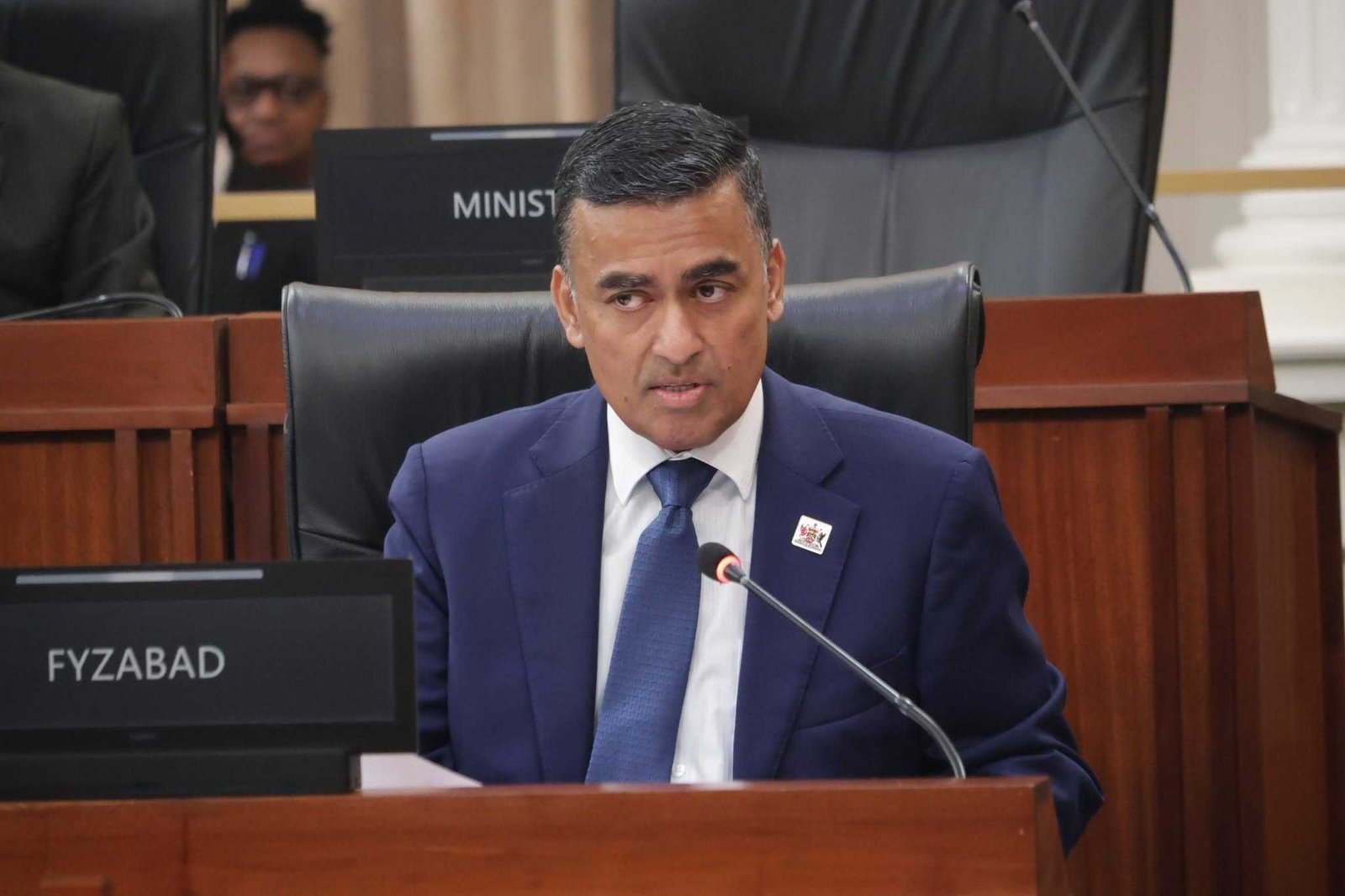
Finance Minister Davendranath Tancoo has assured nurses, teachers and other public sector workers still awaiting the conclusion of salary negotiations that financial relief is on the way. However, the necessary monetary allocation will be made in the 2026/2027 budget package.
Piloting the motion for the House of Representatives to adopt the report of the Standing Finance Committee this morning, Tancoo said provisions for outstanding wage settlements would be included in the 2027 Budget once ongoing negotiations and calculations are completed.
Addressing workers anxiously awaiting settlements, Tancoo said Government was committed to honouring its obligations.
“I want to tell nurses, teachers and whoever else that are currently at the bargaining table or are awaiting finalisation that relief is coming,” he said.
“The documentations are being provided now, and in fiscal 2027 the relevant appropriations will be made.”
His assurance came as Government sought parliamentary approval for $2.927 billion in supplementary funding to cover recurrent and development expenditure through September 30.
Tancoo argued that the request reflected an administration actively implementing projects and programmes rather than merely making promises.
“We are supplementing because we are delivering,” he said.
The Finance Minister also painted a relatively optimistic picture of the country’s fiscal performance, revealing that stronger-than-anticipated energy prices and improved revenue collection measures were expected to boost Government income during the remainder of the fiscal year.
The 2026 Budget was based on an average oil price of US$73.25 per barrel and natural gas prices of US$4.25 per MMBTU. However, Government now expects oil prices to average approximately US$85 per barrel and natural gas prices around US$4.50 per MMBTU by the end of the fiscal year.
As a result, Tancoo said total revenue is projected to increase by approximately $381.7 million.
For the period October 1, 2025 to April 30, 2026, Government collected approximately $30.1 billion in revenue, exceeding the original projection of $28 billion. Expenditure during the same period amounted to $31.8 billion, below the projected $34.5 billion, resulting in a fiscal deficit of approximately $1.7 billion.
Despite the additional expenditure being sought, Tancoo said Government was making steady progress in improving the country’s fiscal position.
He reported that the overall fiscal deficit inherited from the previous administration had been reduced from $10.07 billion, equivalent to 5.8 per cent of GDP, to $7.01 billion, or roughly four per cent of GDP.
Interest payments on public debt have also declined from $7.13 billion to $6.91 billion, freeing up resources for public services and development initiatives.
However, Tancoo placed particular emphasis on what economists describe as the primary balance, the difference between Government’s revenue and non-interest expenditure.
He said the primary deficit had fallen dramatically from $2.93 billion under the previous administration to approximately $101 million.
“In just one year this Government has reduced the primary deficit by more than $2.8 billion, bringing Trinidad and Tobago to the threshold of primary balance following consecutive years of primary deficits,” he said.
“This is more than an accounting improvement. It is the foundation of a stronger and much more resilient economy.”
Tancoo also highlighted what he described as evidence of stronger fiscal discipline and improved management of the country’s financial reserves.
He reported that the Heritage and Stabilisation Fund had grown from US$5.98 billion at the end of April 2025 to US$6.6 billion as of June 4, 2026, an increase of approximately US$620 million in one year.
“That is discipline. That is economic management,” he said.
“This is a Government protecting the people today while also protecting the country’s future.”
The Minister also pointed to the early success of several revenue measures introduced in the October 2025 Budget.
According to Tancoo, the commercial bank asset levy, electricity surcharge, landlord registration fee and business surcharge have already generated approximately $224 million since their implementation in January.
He said those measures formed part of a broader revenue reform agenda designed to improve collection and strengthen long-term fiscal sustainability.
Among the initiatives now under way are the modernisation of the Inland Revenue Division and Customs and Excise Division, improvements to ICT systems, the establishment of a Real Estate Investment Trust and preparations for the launch of a third National Investment Fund bond later this year.
He said government is also advancing transfer pricing legislation aimed at improving tax compliance and strengthening foreign exchange earnings.
While acknowledging that some of the reforms are still in their implementation phase, Tancoo said their full benefits would become more evident during fiscal 2027 and beyond.
The supplementary appropriation itself contains allocations across a wide range of ministries and agencies.
Among the largest recurrent allocations are $499.9 million for the Ministry of Health, $454 million for fuel subsidy liabilities owed to NP and Unipet, $362.9 million for the Ministry of Works and Transport, $197.3 million for Housing, $179.2 million for Rural Development and Local Government and $97.7 million for the Ministry of Education.
Additional funding is also earmarked for the Trinidad and Tobago Police Service, the Tobago House of Assembly, the Judiciary, the Ministry of Defence and several social service agencies.
On the development side, Government is proposing an additional $30 million for the acquisition of laptops for Form One students, $25 million for the establishment of a Tier Four data centre, $15 million for reconstruction work at Scarborough Secondary School and almost $9 million for drainage and irrigation projects.
Tancoo said the additional spending would be financed through a combination of domestic and external borrowing, including support from multilateral development institutions.
He argued that the country’s economic management was already earning international recognition, pointing to Trinidad and Tobago’s successful US$1 billion bond issue, its removal from the European Union’s list of non-cooperative tax jurisdictions, positive engagement with international financial institutions and a recent revision of the country’s outlook by Moody’s from negative to stable.
But while much of his presentation focused on Government’s fiscal performance and spending priorities, Tancoo began his contribution with a scathing assessment of the decade-long People’s National Movement administration that preceded the UNC’s return to office.
He accused the former government of leaving behind weakened institutions, deteriorating infrastructure, revenue collection agencies plagued by underinvestment, and a fiscal position that required urgent correction.
The Finance Minister argued that years of mismanagement, corruption and poor planning had stifled economic growth and squandered opportunities for diversification.
“The people of Trinidad and Tobago did not vote for management of decline,” he said.
“They voted for renewal. They voted for competent leadership, and they voted for a government prepared to do the difficult work of rebuilding a nation that had been held back for far too long.”
Tancoo maintained that while the task of rebuilding the economy remained challenging, the UNC administration was already demonstrating that a different approach to governance was producing results.
“We are fixing it,” he declared.
And with nearly $3 billion in additional spending now before Parliament, the Finance Minister said Government intended to continue investing in public Services, honouring its commitments to workers and pursuing what he described as a path toward fiscal stability, economic recovery and renewed national confidence.