Change font size:
What began as a protest over Zvernec and Sazan has become a nationwide civic movement demanding the resignation of the government and challenging corruption, oligarchic power and a political system many Albanians say has exhausted the country.
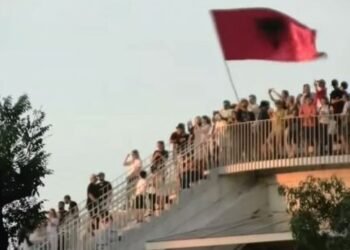
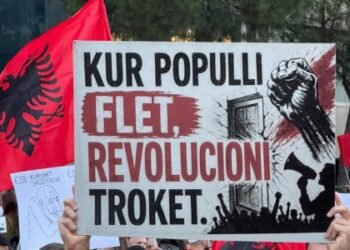
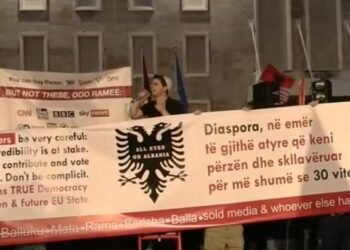
Tirana Times, June 15, 2026 – A protest movement that began with anger over a luxury tourism project in Zvernec and Sazan has grown into one of Albania’s most significant civic mobilizations in years, bringing thousands of citizens into the streets against what they describe as corruption, abuse of power, organized crime, oligarchic privilege and the collapse of public accountability.
For many Albanians, the scenes in Tirana and other cities recall the spirit of 1990, when citizens rose against one of Europe’s most isolated communist dictatorships. Today’s protests are not directed against a communist state. But demonstrators say they are confronting another form of domination: a political order built over three decades of transition, in which power is concentrated in the hands of party leaders, public wealth is controlled by a narrow circle and ordinary citizens are left with few choices other than silence, submission or emigration.
The protests have entered their third week. What began as an environmental objection to construction near the Narta Lagoon has turned into a national debate over the meaning of development, democracy and European integration in a country where distrust of institutions has deepened sharply.
From Zvernec to a National Protest
The immediate trigger was the government backed plan for luxury resorts in Sazan, an island in the Ionian Sea, and Zvernec, a peninsula near Vlora close to the protected Narta Lagoon. The project, reportedly worth about 4 billion dollars, is backed by Affinity Partners, the investment firm founded by Jared Kushner, the son in law of U.S. President Donald Trump.
Prime Minister Edi Rama has strongly defended the investment. In an interview with MS NOW, the new name of the former MSNBC network, Rama said negotiations were continuing and denied any conflict of interest, arguing that talks had begun before Trump returned to the White House. He dismissed environmental objections to the project as “ideological nonsense” and said Albania was being used by American media and influencers as a tool to attack the Trump administration.
The development plan includes hotels, apartments and villas along the coast near the Narta Lagoon and on Sazan island. Critics say the project threatens one of Albania’s most sensitive ecological areas and reflects a broader pattern in which strategic investment status is used to transfer public assets to powerful investors with limited transparency.
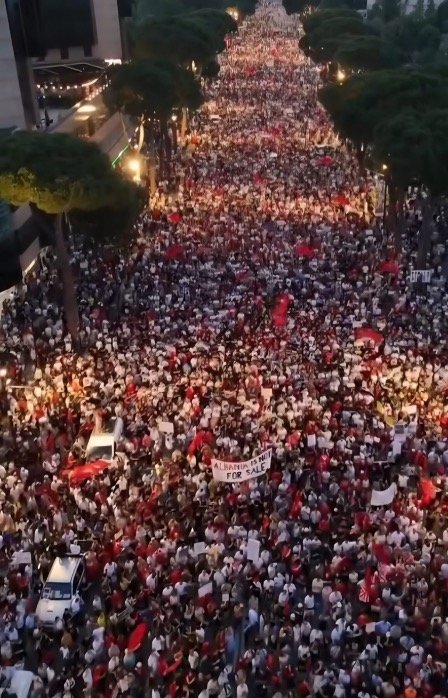
Thousands of citizens have marched in Tirana under the slogan “Albania is not for sale.” Flamingos, a symbol of the Narta Lagoon, have become one of the visual signs of the movement.
The European Commission has reminded Albania that progress toward European Union membership depends on respect for environmental standards and legislation. Rama has said he is not concerned and that the project does not endanger Albania’s European aspirations.
A Movement Against Fear
The protests have taken on a moral and emotional force that goes beyond the details of the investment. In Korca, a teacher holding the Albanian national flag addressed protesters with a message that quickly spread across social media.
“We must not be afraid. We must kill fear,” she said. “The corrupt rulers, criminals and thieves should be afraid, not us.”
Her words captured the deeper meaning of the demonstrations for many citizens. Albania has seen protests before. But for years, the country’s most dramatic form of protest was emigration. Hundreds of thousands of Albanians left, often because they no longer believed they could build a dignified life in their own country.
Now, many are returning to the streets rather than leaving in silence.
An Albanian professor who had just arrived from London described the atmosphere in Tirana as unexpected and extraordinary.
“What is happening is wonderful,” he said. “We never thought this would happen. Hope for change had almost disappeared. The idea that citizens would rise again against arrogance and fear seemed almost impossible.”
The demonstrations have drawn a broad social mix: young people from Generation Z, students, professionals, older citizens, mothers with children and people who have not been active in party politics. Many protesters say they do not see the movement as belonging to any party.
That independence has made the protests more difficult for the government to contain or define.
The Government Blames Disinformation and Foreign Enemies
Rama has accused the protest movement of being manipulated by disinformation and foreign actors. Speaking during the 35th anniversary of the Socialist Party, he defended the Zvernec project as a strategic opportunity worth more than one seventh of Albania’s national output and said the country must choose between entering the elite tourism market or remaining economically behind.
He said the original concerns of some protesters may have been sincere, but argued that the movement had been transformed by digital manipulation, half truths and false claims about skyscrapers, wildlife and environmental damage.
Rama also accused Iran, which Albania considers a hostile state following the 2022 cyberattacks and the severing of diplomatic relations, of trying to exploit public anger through digital networks. He said foreign rivals and regional competitors were also interested in blocking Albania’s rise in high end tourism, mentioning Greece, Croatia and Montenegro as countries that already dominate that market.
In another public appearance, Rama said the protests were harming the local economy by causing cancellations of tourist reservations in coastal cities such as Vlora and Durres. He also criticized what he called online bullying against people with different opinions, describing such pressure as a “fascist spirit” that does not need weapons or uniforms to appear.
His comments have sharpened the political divide. Protesters say the government is trying to delegitimize a civic revolt by presenting it as foreign manipulation. Government supporters say the protests are being exploited to damage Albania’s economy and political stability.
SPAK Investigation Adds a New Front
The political crisis deepened after Albania’s Special Anti Corruption Structure, SPAK, opened or advanced verifications linked to land ownership procedures in the area where the resort is expected to be built.
A separate SPAK investigation into alleged money laundering has raised even broader questions. According to material cited in the investigation, prosecutors are examining suspected links between land transactions in Zvernec, construction projects in Tirana and proceeds from international cocaine trafficking.
SPAK has reportedly issued security measures against several figures, including individuals linked to land holdings in Zvernec and construction activity in the capital. Prosecutors are also reported to have seized about 138 million euros connected to transactions involving Albanian Land Development and payments tied to investors involved in the Zvernec land consolidation process.
The full investigation file has not been made public. All suspects are presumed innocent unless convicted by a court.
Still, the case has had a powerful political effect. It has connected, in the public mind, three of the most controversial features of Albania’s current development model: luxury coastal projects, the boom of towers in Tirana and the suspicion that money from organized crime has entered the legal economy through construction and real estate.
For years, economists, urban experts and foreign law enforcement officials have warned that Albania’s construction sector has grown beyond what the country’s legal income and domestic demand can explain. In Tirana, towers continue to rise, even as many apartments remain empty and prices move far beyond the reach of average citizens.
Critics say the skyline has become a monument not to modernization, but to the power of money of unclear origin.
The Politics of Oligarchy
The anger in the streets is also directed at what protesters describe as Albania’s oligarchic system. They say a small network of political leaders, business groups and privileged investors has divided and controlled the country’s wealth, natural resources and future.
The government presents strategic investments as a path toward modernization, tourism development and international capital. Critics say the same label has often become a shield for opaque deals, weak public scrutiny and unequal access to public assets.
For many citizens, Zvernec is no longer only an environmental issue. It has become a symbol of a larger system: protected areas opened to luxury construction, the coast reshaped for private profit, public institutions weakened and the economy increasingly dependent on construction and real estate.
A local analyst said the line between organized politics and organized crime has become increasingly difficult to see.
That perception has turned the protests into a referendum on more than one project or one government decision. It has become a challenge to the political economy of transition itself.
Cracks Inside the Socialist Party
The movement has also produced signs of discomfort inside the ruling Socialist Party.
On the 15th day of the protests, a member of Parliament from the governing majority left the Socialist Party and announced she would continue as an independent lawmaker. In a public statement, she said her boundaries were defined by the ideals and values she held before joining any political party.
Former Foreign Minister Arta Dade refused an invitation and a medal from Rama during the Socialist Party anniversary. She described the party event as an “anti rally” and sided publicly with the protesters, saying the true spirit of socialists was not in events organized from above but in the square where young people were protesting for dignity and social rights.
Former Foreign Minister Ditmir Bushati called the demonstrations “protests of dignity” and warned that Rama was “playing with fire” by ignoring and mocking public anger. He said freedom inside the Socialist Party had been lost and accused the government of drifting into partnership with oligarchy.
Former Finance Minister Arben Malaj also expressed support for the movement, saying the resignation of the prime minister was a realistic objective because, in his words, Rama’s personal government was rotten and everything rotten eventually falls.
Such criticism does not yet amount to an organized rebellion inside the Socialist Party. But it shows that the protests have begun to reach beyond the streets and into the political camp that has supported Rama’s long rule.
The End of Post Communist Transition
For many analysts, the deeper meaning of the protests is that Albania’s post communist transition may be reaching its end.
After the fall of communism, Albania’s political elite promised democracy, rule of law and European integration. But over 35 years, critics say, the country developed a political culture that reproduced many features of the old system in new forms: centralized power, fear, party control, loyalty to leaders, weak institutions and the domination of public life by one man at a time.
Under successive governments, politics has often revolved around powerful leaders who decide appointments, contracts, public investments, party discipline and relations with business groups.
The result, critics argue, is a democracy in form but not in substance.
“We are not simply asking to remove Edi Rama,” one protester said in Tirana. “The prime minister has already fallen morally and politically. We must remove the regime that he and others have built.”
That language reflects a growing belief that Albania’s crisis is systemic. The target is not only Rama, but a model of rule that many Albanians believe has kept the country trapped since the early years of transition.
A Country That Was Leaving
One of the strongest themes of the protests is emigration. Albania has lost a large share of its population during the past three decades, not because of war, but because of poverty, corruption, lack of opportunity and distrust in the future.
An expert on international relations described Albania as one of the rare countries in modern history to lose such a large part of its population in peacetime.
“Albanians have been protesting for years, but in a tragic way,” he said. “They were leaving their country.”
That is why the return of citizens to the streets has been described by some observers as almost miraculous. It suggests that a society widely seen as exhausted and resigned may still possess the capacity for civic resistance.
For protesters, the choice is no longer between staying silent or leaving. It is between accepting a captured state or trying to change it.
The International Community Faces Questions
The protests have also placed Albania’s international partners under scrutiny.
The European Union, the United States and Western embassies have strongly supported Albania’s justice reform and have praised SPAK as a central institution in the fight against corruption and organized crime. That support remains important. But local observers say Western governments have been far more cautious when speaking about the political and economic system that allowed suspicious capital, oligarchic privilege and institutional capture to expand.
Critics say the silence of parts of the international community has been damaging. By prioritizing stability, geopolitical loyalty and transactional cooperation, they argue, Western partners have helped sustain a system that speaks the language of Europe abroad while weakening democracy at home.
Albania remains formally committed to European Union membership. But protesters and analysts say that integration cannot be reduced to technical chapters, diplomatic meetings and official photographs.
A country where democracy is reduced to a façade, they argue, cannot become a genuine member of the European Union.
For the EU, the question is whether it will continue to treat Albania as a success story because of geopolitical alignment, or whether it will confront the reality of a state where citizens are protesting against corruption, captured institutions and public wealth concentrated in private hands.
Whatever the immediate political outcome, this civic awakening has already changed Albania.