This Sunday, day that the president of the United States, Donald Trump, had signaled for the signing of the memorandum of understanding with Iran and the reopening of the Strait of Hormuz, began with a strangely familiar choreography. As happened just a week ago in a very similar context, Israeli Prime Minister Benjamin Netanyahu again ordered the bombing of the suburbs of Beirut, the capital of Lebanon. And, as then, Iran threatened retaliation. Israel canceled concerts and banned mass gatherings because it anticipated the arrival of missiles “in the next few hours.” The agreement between Washington and the Islamic Republic was thus once again left up in the air.
In the end, the pact came at the end of the day, after Pakistan announced it, Trump confirmed it and, finally, Iran said that yes, a new phase is beginning after three and a half months of war: 60 days to reach a lasting agreement whose details are not yet known.
Also as happened last week —when the attack on Beirut led to the first exchange of fire between Iran and Israel since the ceasefire declared in April—Trump charged this Sunday against Netanyahu, stating that “he doesn’t have a fucking shred of judgment” and reproaching him for having bombed just before the signing of the agreement. That attack, he said, “should not have happened.” “He has delayed it (the signing) for a few hours. It was scheduled right now and has been set for a few hours,” the US president told Axios. “I have already told you: I am not at all happy with your attack on Beirut,” he insisted.
On his social network, Truth, the Republican had previously stressed that the pact with Iran will include the cessation of hostilities in Lebanon, and had asked Tehran to reverse its announced response. Both in that message and in the telephone statements to Axios – a novel tactic to disseminate his messages (responding on the fly to a journalist), which he has taken a liking to since the beginning of the penultimate crisis in the Middle East – the Republican’s impatience was clear.
It is, on the one hand, a war whose end has eluded him, and which has caused him serious problems of unpopularity in a year in which his party (and himself) is risking control of one or both chambers of Congress, and, with it, the viability of the second part of the legislature. He was also in a hurry because this Sunday was his 80th birthday and in his way, always focused on the spectacle, of seeing the world, a beginning of a peace agreement would be a welcome gift for a president who usually exaggerates by saying that he has stopped a dozen wars since he returned to power.
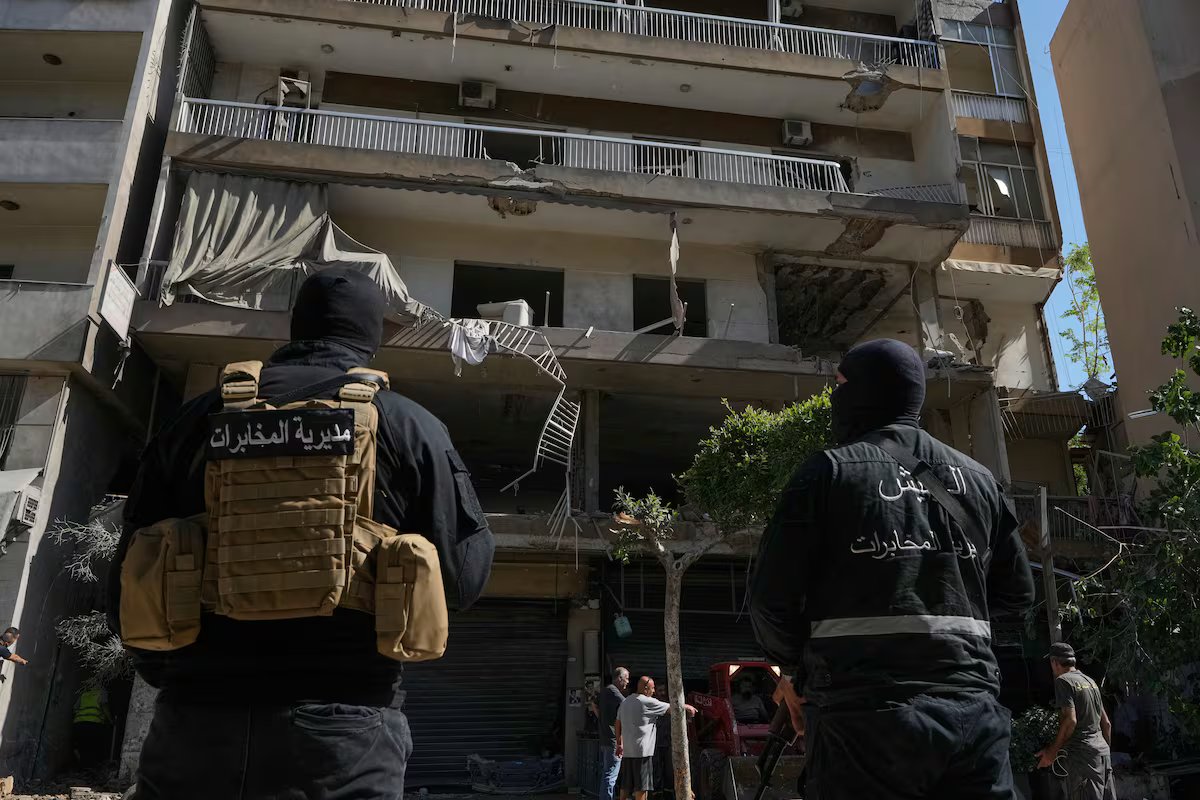
In its objectives, it interposed the Israeli bombing, at mid-morning (local time), on a residential building in Dahiye, the Shia-majority suburbs south of Beirut. It caused at least three deaths and seven injuries, according to rescue services. It arrived without prior warning, so the images of the attacked places show how the explosions hit cars that were circulating in the area.
Israel claimed to have targeted a “Hezbollah headquarters” in response to the launch by the pro-Iranian Lebanese militia of three drones against northern Israeland left one of his commanders, Ali Mussa Daqduq, for dead in another attack in the south. “Israel will not tolerate attacks against its territory,” Prime Minister Benjamin Netanyahu and his Defense Minister Israel Katz said in a joint statement.
Shortly after, Sardar Asadi, a member of Iran’s main joint military command, Khatam al Anbiya, asserted: “Without a doubt, these crimes will not go unanswered.” Its commander, Ali Abdollahi, later threatened a “strong response” and warned that he has “his finger on the trigger,” ready to attack the “heart of the enemy.” Israel, in fact, “is preparing for a possible attack” against its territory “in the coming hours,” its army admitted this afternoon. Uncertainty dominated the end of the day, with Trump asking Tehran not to launch its announced retaliation and considering the signing of the agreement to be imminent.
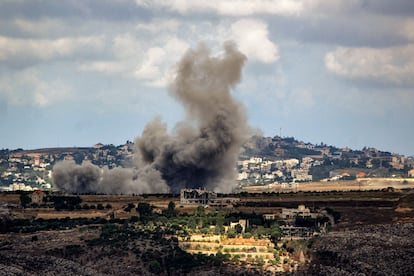
The escalation was the result of the equation that Netanyahu has been trying to establish. Despite a ceasefire in Lebanon being in effect on paper, “freedom of action” has been attributed to continue occupying the south of the country, bomb it daily and destroy all their villages, except the Christian ones; but it only assumes that Hezbollah opens fire on the soldiers who are in Lebanese territory.
Every time, like this week, the Lebanese militia launches drones against targets in northern Israel, the army bombs the suburbs of Beirut. This was what happened this Sunday. And since Iran – an ally and financier of Hezbollah – has established another equation (every bombing in the Lebanese capital involves missiles against Israel), the script of crossed threats is being repeated.
The Israeli equation has so far had one desired consequence (boycotting an agreement between Iran and the United States as much as possible) and another undesired one: the growing mistrust between Netanyahu and Trump, each with their own interests (increasingly distant) and their own appointment with the polls this year.
The attack in Beirut has not only generated a crossroads of threats between Iran and Israel, but has immediately muddied the dialogue that Trump wants to close as soon as possible with the Islamic Republic.
The head of the team of negotiators and president of the Iranian Parliament, Mohamed Baqer Qalibaf, has threatened to break off negotiations with the United States, considering that Washington “lacks the will to fulfill its commitments or the ability to do so” and “cannot obtain concessions by giving the green light” to Israel. Thus, he added, “it is impossible to talk about moving forward.”
“The ‘good cop, bad cop’ tactic has become obsolete”Qalibaf said in a message on the social network
Draft
The draft agreement pending signature includes Iran suspending its nuclear program and Washington lifting oil sanctions for 60 days aimed at reaching a final agreement, a senior Iranian official told the Reuters news agency.
In the United States, the question is whether the agreement that ends up emerging from this war and a months-long tug of war will not end up being very similar to the one reached in 2015 by former President Barack Obama, or even worse. Obama himself declared this Sunday to ABC News that it is “doubtful” that the two differ significantly.
And that would be a difficult setback for Trump to accept, who on Saturday once again attacked his predecessor and what he achieved through diplomacy. That was, he wrote in Truth, “an easy, beautiful, unobstructed path toward (Tehran’s acquisition of) a nuclear weapon.” He is looking, he added, for “a wall that prevents” that access.
In particular, Trump usually criticizes that that pact included the payment of 1.7 billion dollars in cash, and insists that his agreement does not entail any economic compensation, although analysts agree that the ayatollah regime will obtain relief from the economic sanctions imposed by Washington.
In an interview with the Secretary of Defense, Pete Hegseth, on CBS, the presenter made him see this Sunday that lifting the Hormuz blockade will also mean an immediate influx of money, from the sale of oil, for the Iranian regime. “They haven’t given up, they are negotiating,” the reporter reminded her. To which Hegseth said that the memorandum includes that Tehran “will not seek, will not have, nor will it be able to purchase nuclear weapons.” Also, the difference from the pact 11 years ago, whose text also had that point, is that the “military threat” was not on the table then.