
It did not take long. After securing a super-majority in yesterday’s parliamentary election, the Prime Minister-elect has used his very first speech to taunt, threaten, blackmail, and intimidate members of the previous government and public officials. His speech is in line with what the Hungarian conservative sphere has warned about for years: Péter Magyar is an instrument of vengeance and humiliation with a carte blanche from Brussels to remove the only remaining obstacle to the EU elites’ political ambitions. There is no way back though.
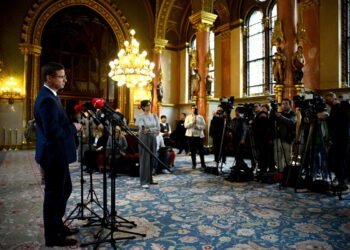
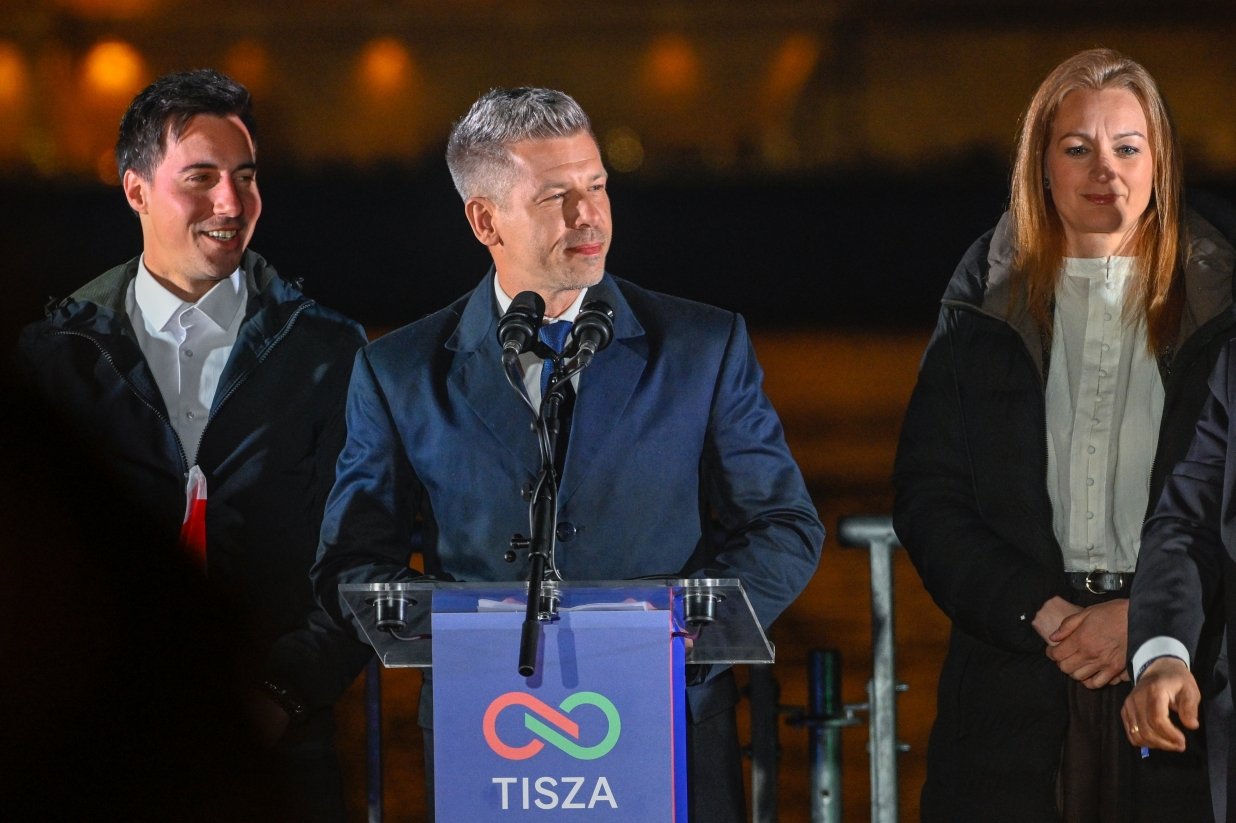
In his first speech after his election victory, Péter Magyar addressed a bleary eyed crowd at the banks of the river Danube in Budapest, choosing the Houses of Parliament as his background. Although the picturesque location he chose to introduce himself to the nation as their new leader might have suggested some level of magnanimity towards the loosing side, some decorum or politeness, it was not to be.
He attacked Hungary’s conservative sphere and public institutions with the fury and determination of a man on a mission to destroy. The man we saw there was a person incapable of respect, with no ability to create consensus.
He started by calling the elections a “regime change,” accusing the government of Viktor Orbán of imitating the former communist regime, despite the fact that the current prime minister was one of the central figures in the overthrowing of the former communist dictatorship in Hungary. He also accused the government of using the country’s intelligence service to destroy his party, Tisza, even though similar accusations have been equally tossed at him during the election campaign with regard to foreign intelligence services’ involvement on his party’s behalf.
The cosmic struggle between truth and lies figured heavily in his address. He characterized his win as no less than the “victory of truth against lies,” saying that the election is a reflection of Hungarians’ decision to reject deceit and betrayal. With hubris bordering the obscene, he even compared his electoral success to the Anti-Habsburg revolution of 1848-49 and, in a manner that will be taken as an insult to the memory of our anti-communist freedom-fighters, to the Hungarian uprising of 1956. With his trademark pomposity he called his party’s success a golden date in Hungarian freedom, a victory over those who have allegedly oppressed and betrayed them.
He then went on to use his first public address after the elections to issue his demands to the current government, namely that Orbán should only continue to act as a caretaker prime minister, and refrain from making any serious decisions, despite the fact that the current leadership has every right to do so. In an equally worrying manner, he instructed decision-makers who were in any way aligned with the current government to leave public life immediately. And to top it all off,
he directed the President of the Republic, Tamás Sulyok, to appoint him as the new PM without delay and then to resign immediately “with the dignity that he still may have left.” Many observers might agree that we did not have this kind of rhetoric here since the Stalinist era of dictator Mátyás Rákosi.”

President Tamás Sulyok. Photo: MTI/Bruzák Noémi
He then went on to call democratically and lawfully elected public officials “puppets,” commanded the president of the Supreme Court to resign, and the same for the president of the National Office for the Judiciary, the Chief Prosecutor, the President of the Constitutional Court, the State Audit Office, the Competition Authority, and the Hungarian Media Authority. He threatened them by saying if they do not go willfully, he will send them packing himself.
He also pledged to join the European Prosecutor’s Office, which would allow him to delegate some of the less palatable cases of his “chistka,” political purges, to be handled by foreign judicial authorities. He also pledged allegiance to the EU, and promised to return to the embrace of the bloc as its strong ally.
Magyar has also informed the nation that his first foreign trip is going to be to Poland, Hungary’s historic ally, currently lead by Donald Tusk, his fellow left-wing politician from the European Peoples’ Party, who has long been accused of leading an anti-democratic witch-hunt against his political opponents. He also told his audience at the river bank that he is soon heading to Brussels to reclaim the long-withheld European funds that have been denied to the government of Viktor Orbán by the European Commission on the basis of rule-of-law procedures. Judging by Poland’s earlier precedent, the Commission’s objections will miraculously disappear as soon as he is inaugurated as new prime minister. The question is, where the nearly 20 billion Euros are going to end up, whether in the shady network of Soros NGOs or on the battlefields of Ukraine.
Finally, in his long speech, Magyar has managed to deliver perhaps the most disingenuous olive branch ever offered to a rival political camp in modern Hungarian political history. He has pledged to be their prime minister too, but not before taunting them by saying that they have received a “really big and well deserved defeat.”
It may well be a correct assessment of the present situation, but the patronizing tone of his pseudo-conciliatory message was more of an insult to injury, rather than an indication that he is ready to heal the deep rifts within Hungarian society.
In all fairness, one of the biggest genuine failures of the Orbán government was its inability to bring people guilty of corruption, sexual violence, or fraud to justice, both from the left and from the right of the political spectrum. One should then perhaps welcome Magyar’s electoral pledge to “end the era of politics and failure without consequences.” Yet looking at parties in his own European bloc, the EPP, one can suspect that prosecution and punishment will mostly be applied selectively. In fact, in all likelihood, he will elevate the politics of no-consequences to a level previously unknown in Hungary. Just like the one in the West that sacrificed energy security at the altar of green climate dogmas, the rights and safety of women on the altar of religious tolerance, or homogeneous societies for parallel ones.
László Toroczkai, leader of the Our Homeland party, who have managed to secure six mandates, was probably right when he warned that Magyar will likely abuse his massive electoral mandate to erode democratic standards in Hungary. In a way, he has already done it even before he has managed to assume power.
The gentleman politics of Viktor Orbán, who has always insisted on sticking with not only democratic standards but also with a certain polite decorum in politics, are well and truly over. The bullying tone that we have heard on election night is only an innocent taster to what is to come. And albeit Tisza’s voters might feel that this is ok, or even desirable as long as it solely affects the Orbán crowd, it requires a generous amount of naivety to think that with time, and a very short one for that, they themselves will feel the consequences of this shift towards the politics of envy and retribution.
Having said that, there still remains one redeeming feature in the Tisza party phenomenon. Their motto: “do not be afraid.” Well, despite all the threats, we will not, we can pretty much guarantee that.
Featured Image: MTI/Hegedüs Róbert