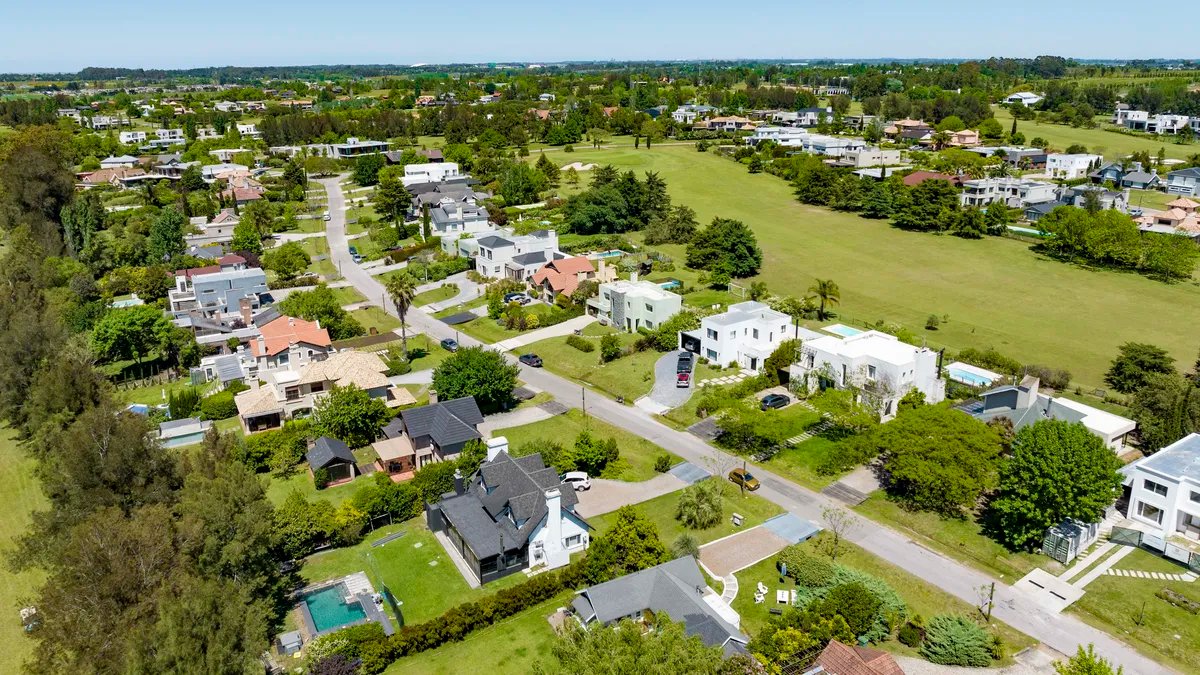
“The Municipality has a very clear territorial planning policy and has been delimiting the areas where this land occupation model can be developed. There are still a number of vacant areas with projects that are ongoing, some in development, others in consultation mode and the Camino de los Horneros Plan is in its review stage with some updates, and therefore, significant growth is expected for the coming years,” estimates Rodríguez.
On purpose, the surveying engineer Rafael Boix shared with Coffee and Business an estimate of the growth potential of private neighborhoods in the Camino de los Horneros axis.
WhatsApp Image 2026-06-10 at 4.10.55 PM

As explained, the total area, marked in orange, of approximately 2,000 hectares, represents the area delimited by the Municipality of Canelones in the Camino de los Horneros Plan.
In white you can see the area developed in private neighborhoods that is around 600 hectares and represents approximately 30% of the total.
In green, the area of potential development is distinguished, according to the current plan for the area, which includes about 800 hectares, that is, 40% of the total.
The remaining 30% is made up of sports complexes, public, commercial, productive rural and natural rural areas.
The different types of gated communities
The phenomenon of countrieslike the famous Nordelta in the Province of Buenos Aires, landed in Canelones with different models, the most historical and traditional, such as La Tahona—which sells 100 lots per year—and other well-known ones that arrived with innovative models that lower the price, such as the case of Huertas de los Horneros de La Buonora y Asociados.
“He is still in a stage of growth, of maturity, where people know him and begin to put aside prejudice,” he points out to Coffee and Business the developer of the sector Mauricio La Buonora, founder of La Buonora y Asociados.
Currently, more than 2,000 families live in the vicinity of Camino de los Horneros and La Buonora estimates that there will be 10,000 within 10 years.
Although there are more and more projects, not all are the same. In La Tahona, 1,350 plots of land have been sold and there is “US$ 1,000 million of investment that people made,” describes its founding partner, Leandro Añón.. In its proposal there are differentiated options, with their own identity and specialized urban developments for each complex.
La Tahona Vineyards

For example, Mirador de La Tahona aims at a younger profile, with children. While Viñedos de la Tahona has a strong imprint from the world of wine and includes the oenological development of Familia Deicas and a community committed to wine production.
They even bet on developments with apartment blocks that experienced a boom in recent times when some residents decided to retire in the surroundings of private neighborhoods but without the burden of maintaining a property. From that need arose, for example, La Toscana from the same business group.
In the case of La Buonora, in addition to the traditional model of private neighborhoods where the land is purchased and each owner builds their own home, They were the first to promote in Uruguay the housing model that made it possible to offer the quality of life of the private neighborhood at a lower price with a turnkey model of standardized properties.. “In the private neighborhood a lot is sold, here you have the house with everything resolved,” says La Buonora about the concept that he successfully promoted in Huertas de los Horneros.
orchards

What are residents of gated communities looking for?
Safety is the main factor why upper-middle or upper class residents opt for a private neighborhood. The profile of those who live there are families with small children who want children and adolescents to be able to move around the neighborhood without fear. They are looking, above all, for three-bedroom typologies.
Added to this are the amenities that aim to ensure that its inhabitants can have their center of life in that neighborhood: sports and recreational activities (such as a club house, paddle tennis, tennis and soccer courts), shopping centers and supermarkets exclusive for residents. Also nearby schools and even within the property, as is the case of private kindergartens in various developments and Moorlands Schools, an Argentine firm that settled in Olivos de los Horneros de La Buonora.
La Tahona Viewpoint

Another increasingly present trend is that of work spaces (cowork) with spaces within the developments, and even its own building in the area (Tahona Valley) that also includes shopping centers and spaces intended for housing.
Regarding the profile of the residents, Añón analyzes that more than 80% of those who buy land in La Tahona are Uruguayans. The remaining 20% is distributed among “many Argentines, Brazilians and some French.” Of them, several are managers of companies or multilateral organizations to whom the companies rent the house there.
The price of security and quality of life
How much does it cost to live in these neighborhoods? The answer depends on the project.
In private neighborhoods where everyone builds their own house, the final ticket value is higher. The land without construction is worth between US$200,000 and US$300,000, while the total amount will depend on the construction. The most modest houses are worth around US$450,000 and up. “We have a house worth US$5 million,” said Añón de La Tahona, although he acknowledged that a ticket of that amount is exceptional.
In housing models in which the houses are standardized, such as Huertas de los Horneros, the value of the ticket is around US$350,000. Meanwhile, common expenses are worth between $12,000 and $15,000, which is in the same range as high-end buildings, for example, in Punta del Este.
“At the end of the day it is nothing more than an overturned building,” says La Buonora and points out that in the neighborhoods it develops, coexistence is the same as that which can occur in a building or cooperative.
For Añón, his current competition is Ciudad de la Costa, “there we compete, price to price,” he noted. In real estate market publications in Solymar Sur or on corner properties on Avenida Giannattasio there are lands for sale for amounts exceeding US$200,000.