Updated ,first published
Prime Minister Anthony Albanese will join a call with European leaders to signal their intent to help restore freedom of navigation in the Strait of Hormuz after weeks of criticism from US that allies were not pulling their weight.
On Friday, President Donald Trump repeated his criticisms of Australia, claiming he was “not happy with Australia because they were not there when we asked them to be there”. He did not offer details on what he wanted from Australia.
Australian officials, who asked for anonymity, insisted the US had made no request of Australia to help combat Iran or to open the strait whose closure has crippled the global economy. Australia sent forces to help the UAE counter Iranian drones in what the government said was defensive capacity.
Trump said in response to a question from Sky News Australia while taking questions as he left the White House on Friday morning [AEST]: “They were not there having to do with Hormuz. So I’m not happy, I’m not happy with them.”
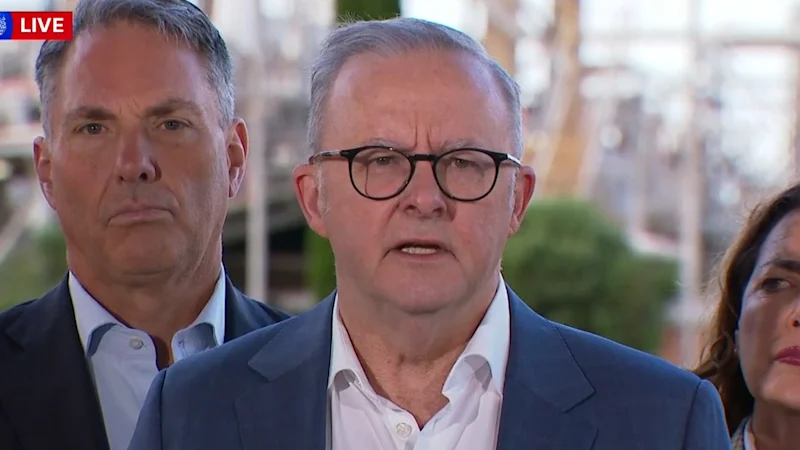
Albanese was forced to respond on Friday, ducking questions at his press conference at the Geelong refinery and saying: “There’s been no new requests at all.”
“That’s a question for president Trump. What my job is, is to engage constructively with the US administration. That’s what we do,” the prime minister told reporters at an oil refinery in Victoria.
Deputy Prime Minister Richard Marles told ABC’s Radio National the US had made no “specific request”.
Opposition Leader Angus Taylor said Albanese was “telling us one thing” but appeared at odds with the US. He declined to say if the Coalition supported Trump’s criticisms or if Australia should join the war against Iran.
Sources in the federal government said Australia’s approach to Trump was not to get too close to him, as leaders such as the UK’s Keir Starmer have tried this and suffered blowback. Trump’s increasingly erratic statements were best to be swerved or just endured, the sources said, while admitting Trump could punish Australia at some stage, even though the alliance is now embedded in the $368 billion AUKUS submarine pact.
Britain, France and others have said that joining the US blockade of the strait, designed to stop Iran exploiting its control of oil from the Middle East, would amount to entering the war. However, they have said they would help keep the strait open in the future if there were a ceasefire or the conflict ended.
French President Emmanuel Macron and Starmer will host a phone hook-up at 10pm Friday night, Australian time, joined by Albanese and several other world leaders.
Reuters news agency reported that a statement is expected at the end of the meeting to give a more tangible sense of what such a mission could entail.
“It can involve intelligence sharing, mine-clearance capabilities, military escorts, information procedures with neighbouring countries and more,” a French representative told reporters in Europe, according to Reuters. “The objective is clear, and the resources deployed will naturally depend on the situation.”
Macron said earlier this week: “This strictly defensive mission, separate from the warring parties to the conflict, is intended to be deployed as soon as circumstances permit.”
Australia boosted defence spending by $14 billion extra over the next four years in an announcement on Thursday. After pressure from the Trump administration for allies including Australia to hike military spending, Australia used an accounting change to estimate that defence spending would grow from about 2.8 per cent of GDP to just over 3 per cent by 2033.
Asked about the defence spending announcement, Trump initially said, “we’re gonna see what happens” and then spoke about the US success in Iran.
Asked again, he condemned Australia for not helping with the war.
“Australia is another one. They were not there having to do with Hormuz. So I’m not happy, I’m not happy with them,” he said.
He did not respond to further questions about whether he was still on good terms with Prime Minister Anthony Albanese.
Treasurer Jim Chalmers, speaking to reporters in Washington in the hour after Trump made the remarks, said they were consistent with sentiments the president had expressed in the past.
Chalmers, too, said he was not aware of a formal request from the US for Australia to assist in reopening the Strait of Hormuz as Trump described.
“It’s not unusual for President Trump to call for more investment from partners and allies when it comes to defence,” Chalmers said.
Get a note directly from our foreign correspondents on what’s making headlines around the world. Sign up for our weekly What in the World newsletter.
 Paul Sakkal is Chief Political Correspondent. He previously covered Victorian politics and won a Walkley award and the 2025 Press Gallery Journalist of the Year. Contact him securely on Signal @paulsakkal.14.Connect via X or email.
 Michael Koziol is the North America correspondent for The Age and Sydney Morning Herald. He is a former Sydney editor, Sun-Herald deputy editor and a federal political reporter in Canberra.Connect via X or email.