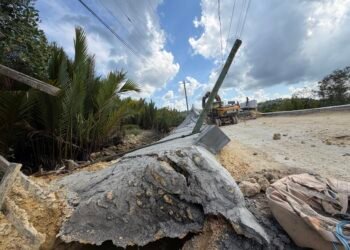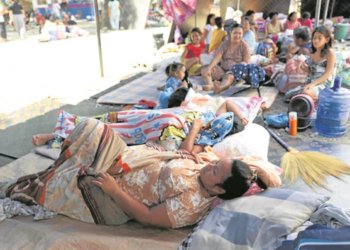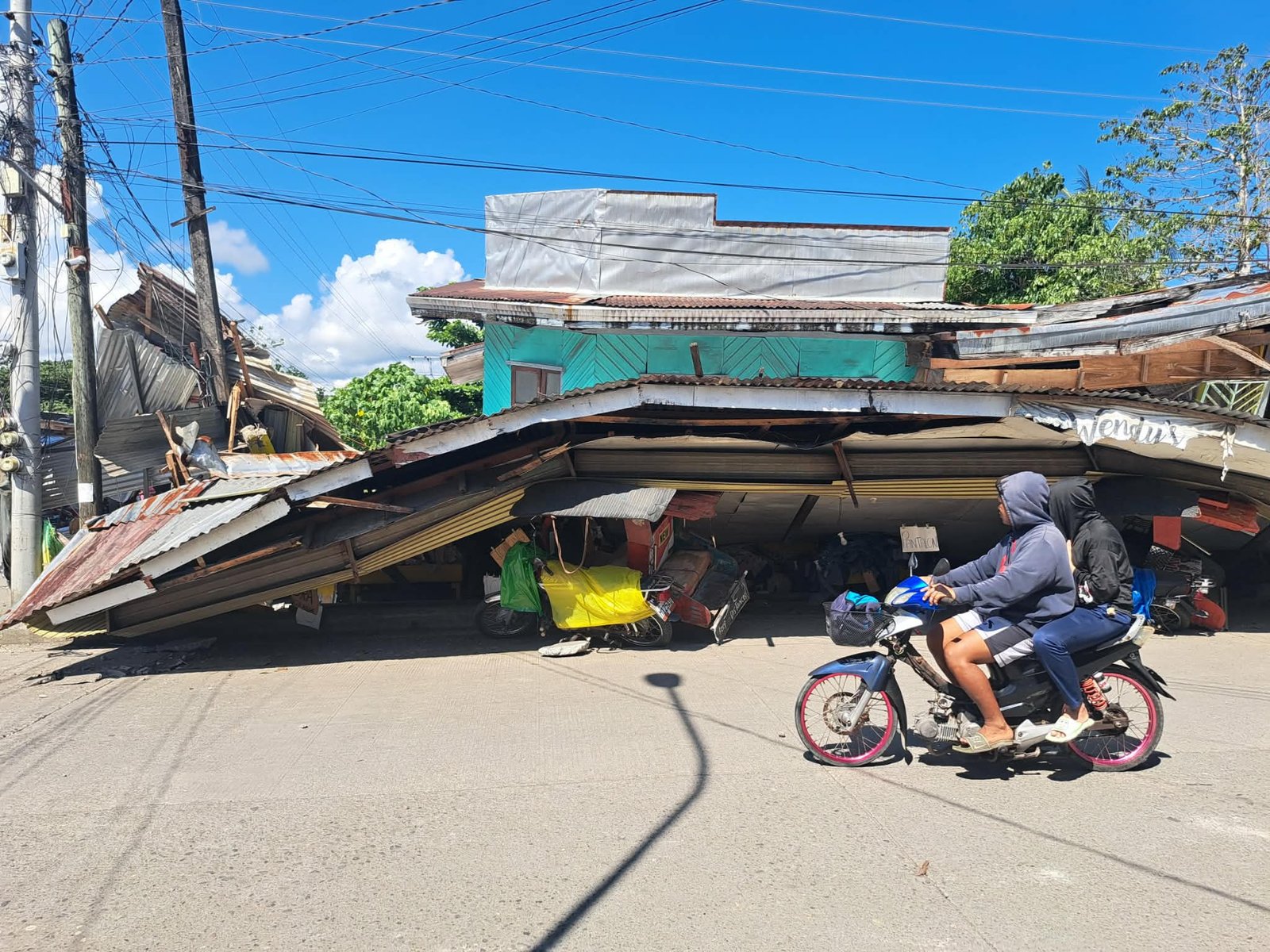

TOWN STILL IN SHOCK In many parts of Glan, Sarangani, clearing operations have yet to begin on Tuesday following the magnitude 7.8 earthquake on June 8. —BONG SARMIENTO
Years of disaster-preparedness drills helped prevent a larger casualty toll when one of the strongest earthquakes in 50 years struck southern Mindanao on Monday, officials said Friday.
Teresito Bacolcol, director of the Philippine Institute of Volcanology and Seismology (Phivolcs), said the preparations helped people anticipate and brace for extreme events like Monday’s quake.
READ: Mindanao earthquake death toll revised down to 46 after validation
“It’s good that our efforts to educate people on what to do when earthquakes hit somehow paid off,” Bacolcol told The Associated Press (AP).
The 7.8 magnitude offshore quake, which struck off Sarangani province, damaged more than 12,600 houses across farming towns and cities.
Late Friday night, the National Disaster Risk Reduction and Management Council clarified that the death toll was at 46—not 55 as reported earlier in the day—after it cross-checked information. At least 680 people were reported injured and more than 45,000 people displaced, about half them still in emergency shelters.
At least 31 were still missing.
Bacolcol said it was also fortunate that the quake hit at 7:37 a.m., a few minutes before work and classes were to start indoors.
He expressed concern, however, over the collapse of some buildings that he said should have withstood the powerful quake, if construction standards based on the country’s building code were followed
Ednar Dayanghirang, director of the Office of Civil Defense in the Davao region, said regular disaster-preparedness drills helped reduce casualties in many ways, including preventing deadly stampedes.
“We required all school principals to take one-day courses on incident management, then they appointed disaster-response teams among teachers to deal with earthquakes, tsunamis,” Dayanghirang said. “They listened and they learned.”
The Philippines, one of the world’s most disaster-prone countries, is often hit by earthquakes and volcanic eruptions because of its location on the Pacific “Ring of Fire,” an arc of seismic faults around the ocean.
Miracles
In Glan, Sarangani, one of the hardest-hit areas, the quake severely damaged the national highway and disrupted electricity, internet and water services. The town was isolated from major urban centers for three days before rescue workers could access it.
Officials said many residents were still too traumatized to return home because of strong aftershocks.
Among them were residents Rey Pantorilla and Lourdes Postejo who told the Inquirer in separate interviews that they were saved by a miracle.
Pantorilla, 50, recalled how he was knocked unconscious when a door panel hit him shortly after he had brought his three children to school.
The tricycle driver said he was saved after a fallen cabinet’s glass splinter pierced his foot, jerking him from unconsciousness and prompting him to flee the damaged house.
“It was a miracle, I was given a second lease on life,” he said.
Postejo’s house located in a neighboring impoverished coastal community was also among those wrecked.
Horrified crowds
“Fortunately, all of us were out of the house. If it was night time, we would have been all killed,” the 67-year-old said.
“I and many others at the market were floored by the strong tremor. I crawled because I couldn’t stand the force of the shaking,” she said.
Days after the earthquake hit, more videos of the chaotic moments have been posted on social media showing horrified crowds witnessing the collapse of small buildings, and flag-raising ceremonies turning chaotic when the ground started to shake on the first day of school after a long summer break.
Students were seen on videos screaming in panic, but staying seated or standing still outside school buildings, with some covering their heads with their hands as teachers admonished them to calm down.
One video, which has gone viral on Facebook with millions of views, showed dozens of grade-schoolers screaming and breaking into tears as they sat on a tree-ringed school ground, which visibly swayed them from side to side. A tin roof shed nearby later collapsed with a loud thud, prompting many to dash away, but were asked by teachers to return and stay seated.
“This incident serves as a reminder of the importance of earthquake preparedness and the value of regular disaster response drills,” the Mahayahay elementary school said in a statement.
On Friday, a 5.1 magnitude earthquake struck waters 66 kilometers southwest of Maasim town in Sarangani, Phivolcs said.
The earthquake was tectonic in origin and recorded at a shallow depth of three kilometers below the ground.
This was not the first aftershock felt in central and southern Mindanao after Monday’s earthquake. Another 5.1 magnitude earthquake jolted Sarangani late Wednesday afternoon. —WITH REPORTS FROM BONG S. SARMIENTO, ISABELLE PECHAY, GABRIEL PABICO LALU
The Inquirer Foundation is calling for support for communities devastated by the recent magnitude 7.8 earthquake that struck Mindanao.
In partnership with the Philippine Red Cross, the foundation is amplifying appeals for food, clean water and other critical assistance for affected families.
Donors may send contributions directly to the Philippine Red Cross through its official transfer channels, the complete list is available on the PRC’s Facebook page.
The Philippine Red Cross has activated its emergency fund campaign and deployed teams on the ground to provide medical services, distribute relief goods and extend psychosocial support to affected families.