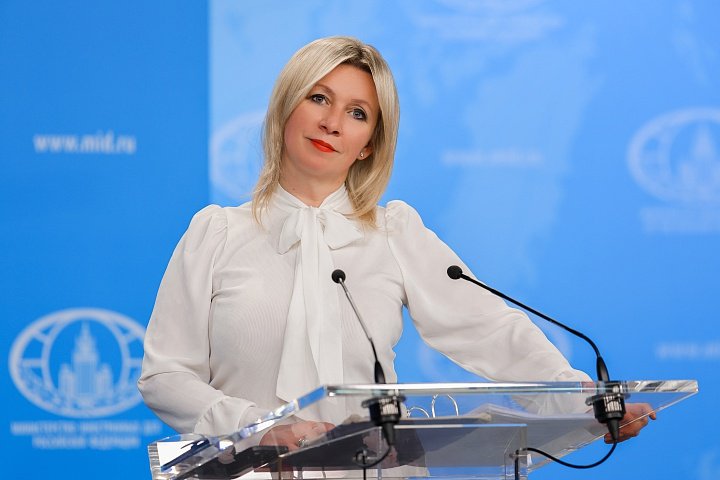
Russian Foreign Ministry spokesperson Maria Zakharova said that if Georgia were to join the European Union, Russia “would have” to include it on the list of countries with “unfriendly regimes” and extend to it “retaliatory economic measures.”
She made the comment during an April 16 press conference in response to a question about how EU membership would affect Russia-Georgia relations.
“I am not saying that we want to do this, but given the new EU requirements, Russia would have to include Georgia in the list of countries with unfriendly regimes and extend to it our retaliatory economic measures, with all the ensuing consequences for Georgian producers of wine, mineral water, fruits – everything that is supplied to our country,” she said.
Russia’s government approved its list of “unfriendly countries” in 2022, which included 48 countries and territories, among them the United States, the United Kingdom, and EU member states. Georgia was not on the list.
During the same briefing, Zakharova also said it is “not entirely clear” how Tbilisi can seek to join the EU, whose members, she said, impose sanctions on Georgia “for absolutely no reason,” claiming that “even a pretext is no longer necessary.” The spokesperson added that the EU “pushes it [Georgia] toward new anti-Russian military adventures, almost openly supports attempts to organize a coup in Georgia, and imposes alien anti-values on the Georgian people.” She further claimed that this is done through “financial and economic levers” aimed at forcing Georgia to “abandon its culture and identity.”
“What more must Brussels do for its true motives and intentions toward Tbilisi to become obvious?”
Zakharova said EU membership is “only possible […] on the condition of transferring a significant portion of national sovereignty to Brussels.” She argued Georgia would be required to align with “anti-Russian sanctions” and added that the EU would also require “the termination of air links with Russia and the introduction of a strict visa regime.”
“EU membership, given what we see as destructive demands from Brussels, would deal a heavy blow to Georgia’s tourism industry and would complicate family ties between people living in Russia and Georgia, forcing them to travel indirectly at higher cost,” Zakharova said.
She further said that Georgia would have to join an “energy embargo” against Russia, arguing that it harms those who impose it. She added that EU accession would also mean “losing preferential trade arrangements with Russia and other CIS countries, which are key export markets for Georgia.”
“The question is whether Georgia should integrate into what we see as the EU’s confrontational, anti-Russian military-political agenda. This is, of course, for Georgia and its people to decide—but the answer, in our view, is obvious,” Zakharova said.
While noting that the “relations between Tbilisi and Brussels are a matter for Georgia’s authorities and people,” in which, she said, Russia does “not interfere,” she added that “integration into such alliances entails consequences that must be clearly understood.”
“We observe a growing number of Eurosceptics in Georgia, as well as political forces advocating neutrality,” Zakharova said, adding, “At the same time, many people support preserving the country’s independence – rooted in its history, traditions, and identity, including past coexistence with Russia.”
Zakharova then reiterated that Russia remains ready to “develop cooperation” with Georgia “based on pragmatism and mutual respect, and said that “despite skepticism, recent years have demonstrated the potential and growth of Russian-Georgian economic ties.”
In another recent comment on Georgia on March 25, Zakharova said the key to Georgia’s prosperity lies “not in confrontation, but in cooperation with Russia,” when discussing prospects for political dialogue between the two countries.
Russia regularly says it is open to normalizing relations with Georgia, but Tbilisi maintains that diplomatic relations with Moscow will not be resumed while the occupation of Georgia’s two regions continues.
Also Read:
This post is also available in: