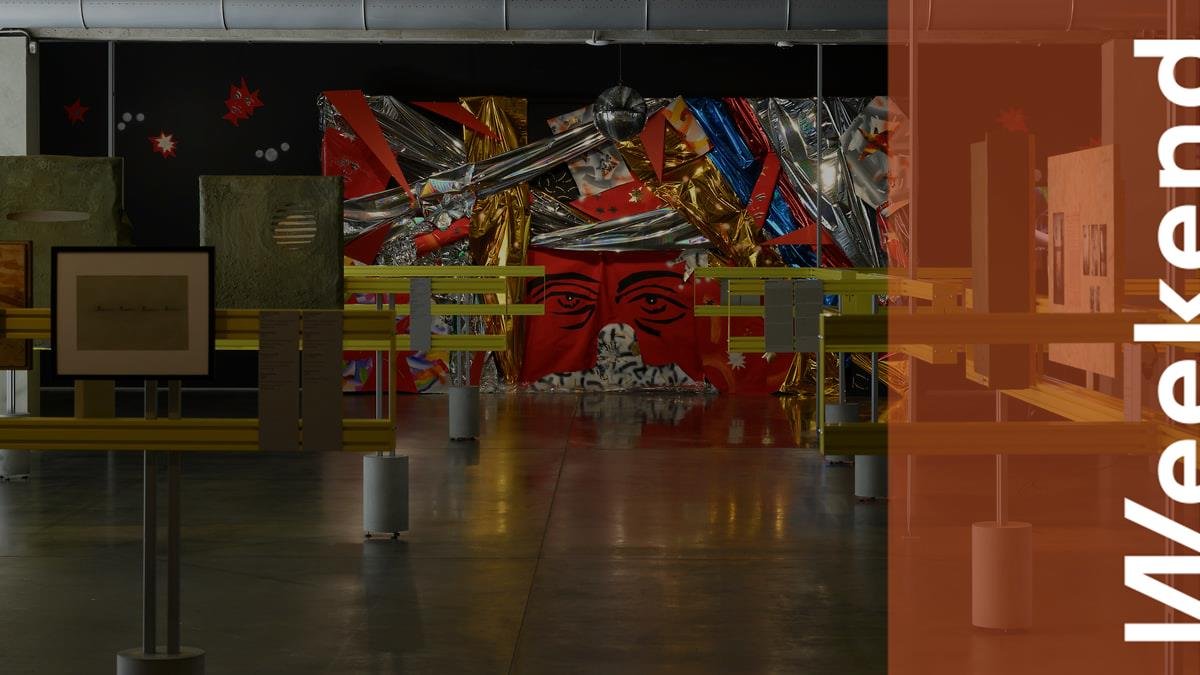
40 years ago, during a working visit to Togliatti, General Secretary of the CPSU Central Committee Mikhail Gorbachev used the word “perestroika” for the first time. This event became one of the markers of the transition to a new reality – political, economic and aesthetic. Contemporary art of perestroika, which replaced the modern art of stagnation, is the subject of a new open storage issue at the Moscow Garage Museum, “Art at the Frequency of the 1980s,” which opened on June 11.
Among the works exhibited on the second floor are those that appeared much earlier than Gorbachev uttered the word “perestroika”, and even before he became known at all. Curators Anastasia Kotyleva, Anastasia Mityushina, Nikita Nechaev, Sasha Obukhova and Oksana Polyakova turn to the concept of the “long 1980s” – so the exhibition also includes artifacts from the 1970s as harbingers of a new aesthetics. For example, the reconstruction of the action of Gennady Donskoy, Mikhail Roshal-Fedorov and Victor Skersis “Hatching the Spirit”, which the artists held at VDNKh in 1975, opens the route. This was the first object-process work in the USSR to be exhibited on an official platform.
Even then, the curators remind us, there were authors working who broadcast art on a new frequency, hitherto unknown to Soviet listeners, which would later become the mainstream—“on the frequency of the 1980s.”
New art was persecuted – this is the corner dedicated to the infamous “bulldozer exhibition” (1974). But a decade later, modern authorities also approved contemporary art, and it moved from apartments and abandoned buildings to official institutions. The 17th Youth Exhibition in the exhibition hall on Kuznetsky Most in 1986 destroyed the boundary between official and unofficial art, and the street action “Bitsa for Art, or Art against Commerce” (1986), the works of which were presented in open storage, showed that bulldozers will no longer come – anything can be exhibited anywhere.
About the quintessence of perestroika processes in art – the film “Assa” by Sergei Solovyov (1987) – the exhibition contains several artifacts: stills, posters, a recreated “communication pipe” through which Alika and the boy Bananan talked.
In general, the cinematic nature of the era of change in open storage is strongly emphasized: cinema as a medium has collected all the creative nodes of the time, as well as its other feature – musicality. Here you can listen to archival recordings of the Kino group, works by Leningrad “New Composers” and audio experiments by Sergei Kuryokhin.
Among the Soviet art already inscribed in the world context and presented in the exhibition are works by Konstantin Zvezdochetov: from the archives of the still stagnant art group “Mukhomor” to the sculpture “Oedipus Complex” (1991), created specifically for the exhibition in Florence.
The beginning of the 1990s was also included in the exhibition dedicated to the 1980s, because this was the peak and end of Soviet contemporary art. Contemporary art in the USSR has come a long way, and an important part of it can be seen and understood in open storage.
In addition to the exhibition, the Museum has prepared a public program where they offer a look at the art of the 1980s through five thematic blocks – cinema, music, literature, fashion and society. There will be conversations with artists, discussions with experts and master classes that will demonstrate the intermediality of the Soviet 1980s.
The project runs until September 23.