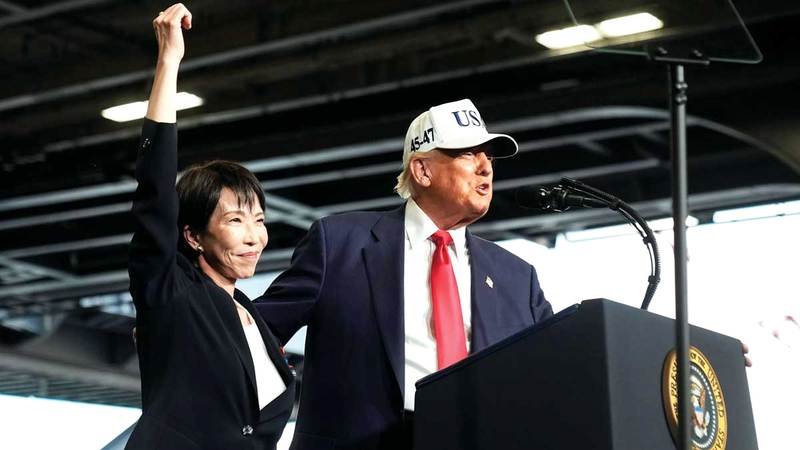
This is considered a “new golden age” for the Japan-US relationship. However, concern about the credibility of US commitments to the alliance was evident in the comments and writings of officials in the Japanese capital, Tokyo.
This is not surprising, but what is more troubling in the long term is Prime Minister Sanae Takaichi’s position at home. Will she maintain the political support necessary to take the steps required to implement her program to revitalize national security and satisfy the Americans? This question is the most disturbing.
“Golden Age”
The term “Golden Age” was adopted by the two countries after the summit held between Takaichi and US President Donald Trump, in October 2025, and this term is still in vogue, and in April, Japanese Finance Minister Satsuki Katayama used it to describe relations between the two countries, and promised more cooperation on matters of economic security.
This is an appropriate description in many ways. All bilateral meetings between high-level officials are positive and forward-looking, with smiles on everyone’s faces, the list of concluded agreements growing, and there are regular statements from American officials that raise surprise and concern. However, Japanese officials always respond that any specific complaint, whatever it may be, has not been raised in their conversations with their American counterparts.
Defense spending
The most prominent example of this is the continuing call by US officials for Japan to increase defense spending. US Defense Secretary Pete Hegseth repeated this demand last week during the “Shangri-La Dialogue,” the annual gathering of security officials that provides an overview of the current situation. There, he warned that while Japanese defense spending is “moving in the right direction,” more effort must be made.
As Gabriel Dominguez and Jesse Johnson of this newspaper – “The Japan Times” reported, US Defense Secretary Pete Hegseth said that the Trump administration has “high expectations of our Japanese allies,” and that “there is still a lot of hard work ahead of them.” Hegseth reminded Tokyo and other countries by saying: “We are asking our allies and partners for 3.5%, and we are far exceeding this number,” referring to the required percentage of defense spending.
As expected, Japanese Defense Minister Shinjiro Koizumi avoided answering questions about the impact of this statement, telling reporters after bilateral talks with his American counterpart that the topic of defense spending had already been raised, but that they were not holding discussions “with any specific numbers or conclusions in mind,” and he repeated Hegseth’s statements during their meeting in October 2025, when he said that he would not make any demands on Japan.
Declining confidence in America
Tensions in this relationship are not new. The Asia Society issued a report in December 2025, that is, two months after the declaration of the “Golden Age,” in which it warned that Trump’s return to the White House “profoundly affected” Japanese-American relations. The report highlighted the relative decline in the power of the United States, the loss of confidence in the credibility of the United States among the public in Japan, and the decline in elite confidence in extended deterrence.
This may seem like an exaggeration given the progress that has been made since then, but polls confirm the Asia Society’s pessimistic conclusions. Last year, 2025, an April Asahi poll showed that only 15% of Japanese people believed the United States would “protect” Japan in a military emergency. About 77% said they did not believe Washington would protect its coalition partner. This is not dismissed as just typical Asahi pacifism; A poll conducted by the Yomiuri Shimbun newspaper showed that only 22% of participants “trust” the United States, which is a decrease of 12 percentage points compared to a similar poll conducted immediately after Trump won a second term. In contrast, 68% said that they do not trust the United States either (not much) or (they do not trust it at all).
In December 2025, a poll conducted by the Center for US Studies at the University of Sydney showed that 59% of Japanese people thought the Trump presidency was bad for their country, and the number who said the alliance between the two countries made them safer fell by five percentage points over a year to 47%.
The Asahi newspaper also asked about attitudes toward foreign policy, with less than a quarter of respondents (24%) saying Tokyo “should follow Washington’s wishes as much as possible,” while 68% said Japan “should be as independent as possible.”
The Japanese public and politicians in Tokyo are aware of the big picture, and in a Foreign Ministry survey conducted in March of this year, 79.3% of respondents agreed that the security environment surrounding East Asia “has become more dangerous.”
The US Secretary of Defense’s warning that “President Trump believes in helping countries that help themselves” resonated in Tokyo, and the lesson Japan learned from Ukraine is that the world will only come to the aid of countries that defend themselves. This was implicit in former Prime Minister Fumio Kishida’s insistence that “Today’s Ukraine is tomorrow’s Asia.” About “The Japan Times”
• University of Sydney poll: 59% of Japanese believe that Donald Trump’s presidency was bad for their country.
• Yomiuri Shimbun: 68% of Japanese do not trust the United States, either “not much” or “do not trust it at all.”