Of Chiara Curti
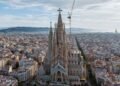
No, the Sagrada Família is not finished. And we don’t even know when it will end or how. On June 10 the Pope did not come to place his imprimatur to a completed work. On the other hand, Gaudí had done the same: he had undertaken a project knowing that he would not finish it. A man free from the phrase “it is my work” which would have made him an “owner”. His role is closer to that of the gardener who makes the garden of which he is the guardian grow. Free men.
Pope Leo
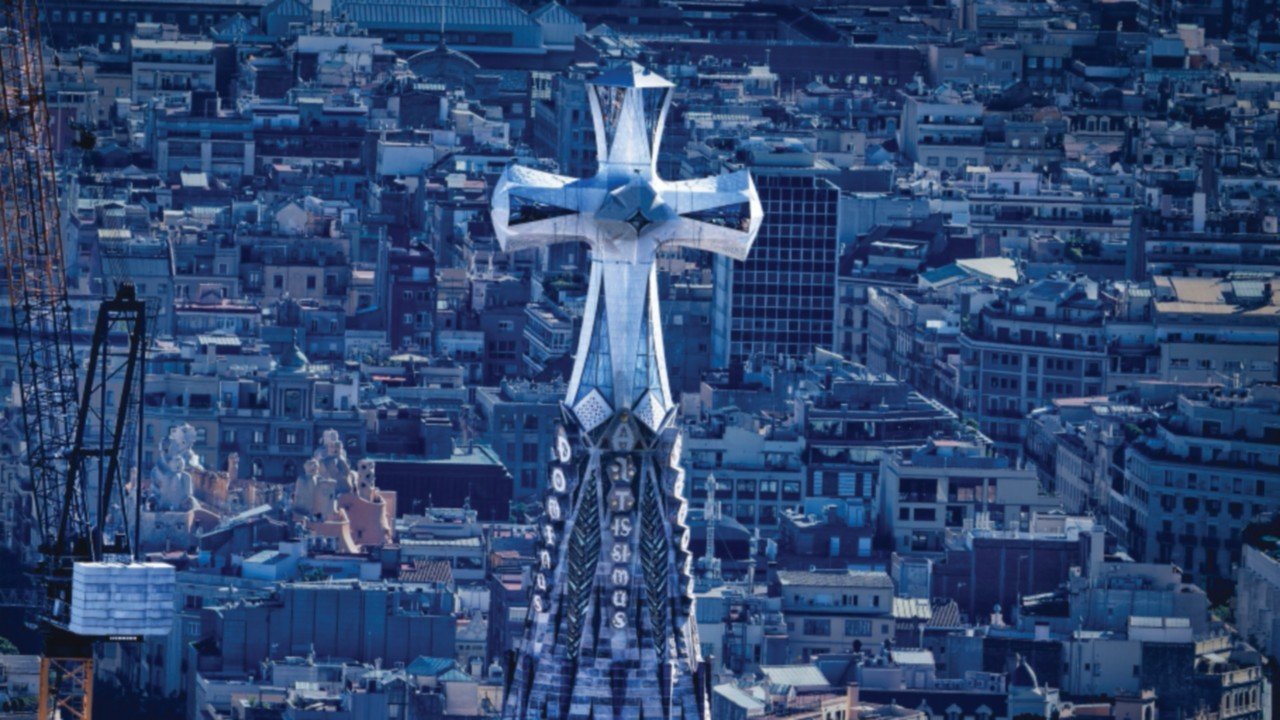
Many things can be said of the complex capital of Catalonia: contradictory and extraordinary, with a harsh reputation as a rebellious, anticlerical, working-class, republican city. But also more. With the 1992 Olympics, Barcelona recognized itself as a European, creative city, open to the world. And then decades of urban transformations, the new neighborhoods for technology. And today the cross, the new skyline of the city.
A four-armed cross, a sign of contradiction, of victory over death, and which recalls Byzantium, while embracing the four cardinal points to symbolize the world; open arms, with Christ at the center. Barcelona thus becomes the city of the cross.
It was the first thing that Gaudí explained when he accompanied the children on visits to the construction site. He himself planted a large wooden cross in the center of the transept. “A large cross-shaped tower will grow here.” And then he asked them to stretch out their arms: “Your bodies are also in the shape of a cross.” He showed how the sign of the cross was drawn on their bodies. And then he explained that, in the rite of dedication of the temple, the bishop would mark with a cross the columns that would support the church, whose plan, in turn, is in the shape of a cross.
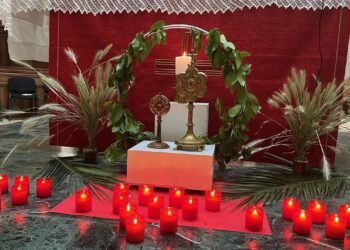
But the cross placed at the highest point of the Sagrada Família will be like a lighthouse. Gaudí explained that he would light up the darkness on the nights of the great holidays. Like when, at Christmas, the celebration begins with little light and then the church gradually lights up. Or in the Easter Vigil, when little by little the candles are lit and the darkness is overcome. In Barcelona this is not just an internal liturgy, it goes outside: it is for the whole city. And so, on Christmas night, a light will indicate where to find the child who is born, and on the Easter Vigil, the light of the Risen One: Lumen Christi.
And then, he continued explaining, from the twelve apostles he had imagined as many lights directed towards the cross, but also towards all those who would gather around it. “They will come from all over the world to see it,” he prophesied, and he was right. Those lights, falling on the people gathered, would have made the variety of charisms visible; and, at the same time, they would have illuminated Christ, because each apostle is the bearer of a charism, but they all point to Christ, the cross.
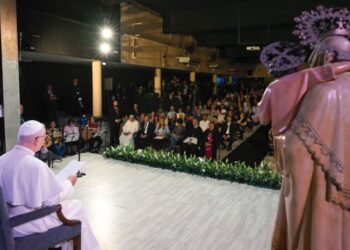
Even the Pope blesses it from the outside: from the only place from which it is possible to bless it.
Leo, first of all, as Leo XIII, the Pope contemporary to Gaudí who with the Rerum novarum he was able to indicate how to deal with the epochal change caused by the industrial revolution: putting the dignity of the person and work at the centre. Leo, then, like Leo XIV, who signed the Magnificent humanity on May 15th, on the 135th anniversary of the Rerum novarum. Here too, in the face of a new epochal change, no longer just industrial but technological, the criterion remains the same: protect the human person, remain human. And Leo, finally, like Brother Leo, the closest companion to Saint Francis: that Francis who inspired Gaudí in the construction of the largest nativity scene in the world.
Thus the name Leone brings together three threads: the workers’ question, human dignity, Franciscan poverty. And all three lead to Gaudí. Faced with workers alienated by industrial work, Gaudí imagined a construction site where everyone could introduce their creativity. Not an anonymous mass, but people called by name within a common work. And, at the top, the cross.
In 1907, the poet Joan Maragall, his close friend, wrote: «Every time I enter the enclosure of the Sagrada Família I feel the same sensation of stepping out of time; I mean that the present moment suddenly acquires, in my eyes, a historical perspective: it moves away and, moving away, I see myself in the Temple in the year two thousand and a hundred, when it will be entirely completed, consecrated and old on the inside, blackened by the smoke of incense, and on the outside toasted and polished by the sun, the rains and the wind. (…) I see myself, from that moment, as in a historical time: in the time in which the Sagrada Família began to be built, and I envy myself for having lived in such times, just as we could envy those who witnessed the elevation of the most ancient cathedrals. And if, returning to myself, I think that this heroic past is my present, I am overcome with great pride and I feel like a pure spirit.”
That “year two thousand and a few hundred” has not yet arrived, and Pope Leo has come to bless not the ending, but the story. «Finish», «finished», «terminated»: expressions that speak of separation, breakup, missed relationships. Pope Leo instead came to bless the history, the journey. We too will then perhaps be “envious of ourselves” in thinking that yes, we were witnesses to the construction of the Sagrada Família, which accompanied the construction of our lives.
Read also: