Sjogren’s Disease Latest News
Researchers from Japan recently discovered a self-reinforcing loop between different immune cells that sustains autoimmune responses in patients with Sjögren’s disease.
About Sjogren’s Disease
- Sjögren’s disease (also called Sjögren’s syndrome) is a chronic autoimmune disorder where the immune system mistakenly attacks its own moisture-producing glands.
- It typically attacks the glands that produce tears, saliva, and sweat. Other parts of the body may also be affected.
Sjogren’s Disease Cause
- The exact cause of Sjögren’s syndrome is unknown, though there seems to be a genetic influence.
- It is thought that factors such as viral infections, stress, and hormone changes can trigger symptoms of Sjögren’s syndrome.
- Sjogren syndrome can happen at any age. But most people are older than 40 at the time of diagnosis.
- Ninety percent (90%) of adults diagnosed with Sjögren’s are women.
- Sjogren’s can occur alone or in association with other autoimmune diseases, most commonly lupus and rheumatoid arthritis (RA).
Sjogren’s Disease Symptoms
- People with Sjögren’s syndrome can have:
- dry eyes, which may also feel painful, burning, itchy, or gritty
- a dry mouth, making it difficult to swallow, speak, or eat dry foods
- swelling of the glands in the face and neck areas
- Some people with Sjögren’s syndrome also notice:
- joint pain, swelling and stiffness
- dry skin or skin rash
- vaginal dryness
- persistent dry cough
- ongoing fatigue
- Sometimes the liver and kidneys are affected. A few people will also develop lymphoma (cancer of the lymph nodes).
Sjogren’s Disease Treatment
- There is no cure for Sjögren’s syndrome.
- Treatment for Sjogren’s disease attempts to relieve the effects of chronic dryness of the mouth and eyes by increasing the lubrication and moisturization of the affected tissues.
Source: NM
Sjogren’s Disease FAQs
Q1: What is Sjögren’s disease?
Ans: It is a chronic autoimmune disorder in which the immune system mistakenly attacks the body’s moisture-producing glands.
Q2: Which glands are primarily affected by Sjögren’s disease?
Ans: The glands that produce tears, saliva, and sweat.
Q3: Is there a cure for Sjögren’s syndrome?
Ans: No, there is currently no cure.
Q4: What is the main goal of treatment for Sjögren’s disease?
Ans: To relieve chronic dryness of the mouth and eyes.
Angkor Thom Latest News
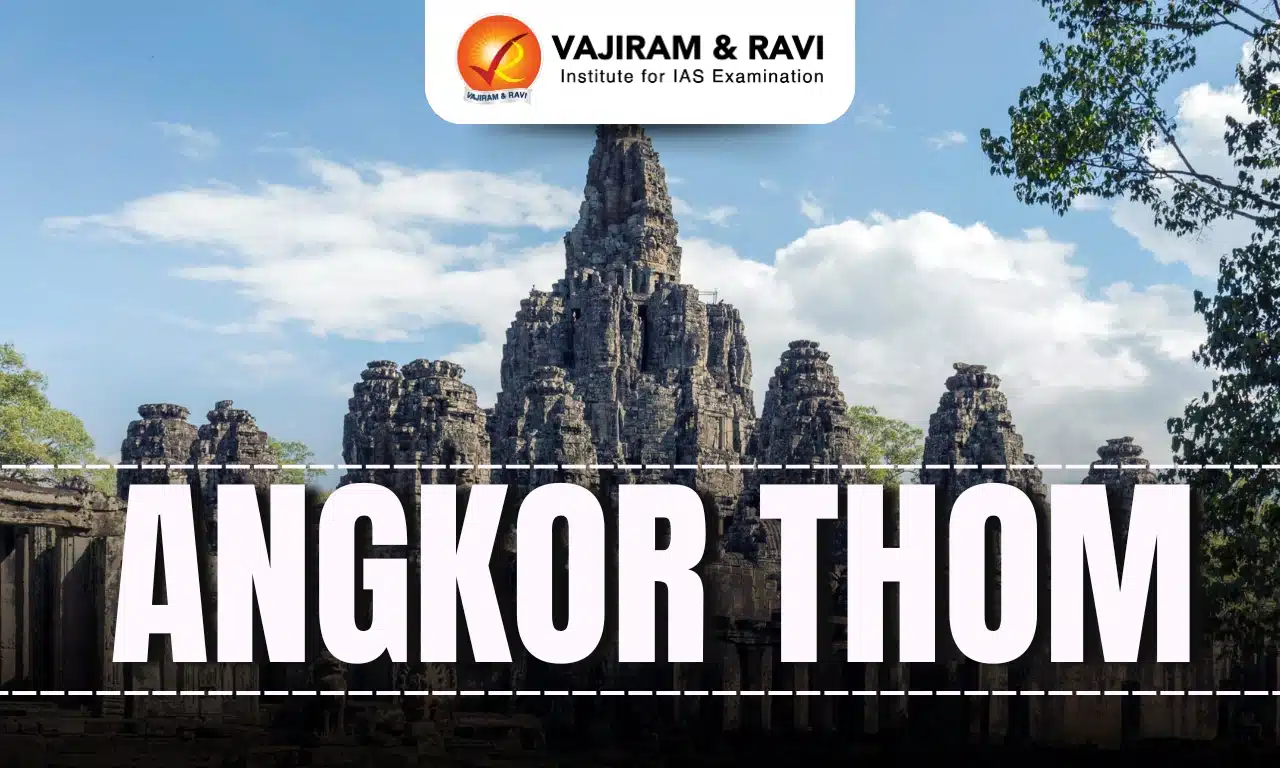
Archaeologists recently uncovered significant remains of a 12th-century hydraulic system and architectural features within the ancient royal palace complex of Angkor Thom.
About Angkor Thom
- Angkor Thom, located in present-day Cambodia, was the last and longest-lasting capital of the ancient Khmer Empire.
- Angkor Thom translates into English as the “Great City”.
- The complex is located in the north of Angkor Wat, between West Baray and East Baray.
Angkor Thom History
-
- It was established after Jayavarman VII reclaimed the Khmer capital from the Cham invaders in 1181.
- Unlike earlier Hindu temples, Angkor Thom was designed as a Buddhist city, reflecting the king’s devotion to Mahayana Buddhism.
- However, it also incorporated elements of Hinduism and ancestral worship, showcasing the empire’s religious syncretism.
- Angkor Thom witnessed the reign of the greatest Angkor king until 1219 and remained the capital of the Khmer Empire throughout its decline, which probably led to the complete abandonment in the 16th century.
Angkor Thom Features
- It covers an area of 9 km, within which are located several monuments from earlier eras as well as those established by Jayavarman and his successors.
- It is a square-shaped city with walls approximately 8 metres high and about 3 kilometres long on each side.
- A moat surrounds the outside of the city.
- Bayon Temple: At its centre stands the famous Bayon, renowned for its numerous giant stone faces.
- Other Important Structures:
- Terrace of the Elephants
- Terrace of the Leper King
- Baphuon
- Phimeanakas
- Angkor Thom is part of the Angkor Archaeological Park, a UNESCO World Heritage Site inscribed in 1992.
Source: HD
Angkor Thom FAQs
Q1: What is Angkor Thom?
Ans: Angkor Thom was the last and longest-lasting capital of the ancient Khmer Empire.
Q2: In which present-day country is Angkor Thom located?
Ans: Cambodia.
Q3: Who established Angkor Thom?
Ans: King Jayavarman VII.
Q4: Which religion primarily influenced the design of Angkor Thom?
Ans: Mahayana Buddhism.
Q5: Which famous temple stands at the centre of Angkor Thom?
Ans: Bayon Temple.

Marshall Islands Latest News
The World Bank recently approved an additional US$9 million in financing to help the Republic of the Marshall Islands manage sharply higher energy costs that are affecting households, businesses, public services and the national budget.
About Marshall Islands
- The Republic of the Marshall Islands (RMI) is a country located in the central Pacific Ocean.
- It lies northeast of Papua New Guinea and southeast of the Federated States of Micronesia.
- It consists of 29 low-lying coral atolls comprising 1,156 individual islands and islets.
- These atolls and islands form two parallel chains referred to as the Ratak (Sunrise) chain and Ralik (Sunset) chain that are both oriented in a northwest-southeast direction.
- Capital: Majuro
- Official languages: English and Marshallese
- Government:
- It is a presidential republic with a parliamentary system.
- The President is both the head of state and the head of government.
- Economy: Agriculture and tourism are the mainstays of the economy.
- Official Currency: US dollar
- In 2018, RMI became the first country to issue its own cryptocurrency and certify it as legal tender.
- History:
- The islands have been under the control of various nations throughout the last few centuries, including Spain from the late 1400s to the late 1800s, Germany from 1885 to World War I, and Japan from 1914 to World War II.
- After World War II, the RMI became a part of the United Nations (UN) Trust Territory of the Pacific Islands under the United States (US) administration.
- The RMI Government was officially established in 1979, following the signing of the Constitution.
- The RMI gained its independence in 1986 after signing the Compact of Free Association with the US, ending the UN-US Trusteeship Agreement.
- Compact of Free Association with the United States:
- It provides the Marshall Islands with financial assistance, defense protection, and access to U.S. government programs.
- The Compact recognises RMI’s right to self-government and seeks to promote economic development and budgetary self-reliance.
- The United States has full authority and responsibility for security and defense of the Marshall Islands.
Source: DEVD
Marshall Islands FAQs
Q1: What is the Republic of the Marshall Islands (RMI)?
Ans: It is a country located in the central Pacific Ocean.
Q2: What are the two parallel island chains of the Marshall Islands called?
Ans: Ratak (Sunrise) Chain and Ralik (Sunset) Chain.
Q3: What is the capital of the Marshall Islands?
Ans: Majuro.
Q4: What form of government does the Marshall Islands have?
Ans: A presidential republic with a parliamentary system.
Q5: Which country has full authority and responsibility for the security and defense of the Marshall Islands?
Ans: The United States.
Doctrine Of Forum Non Conveniens Latest News
The Supreme Court recently held that where the question of pursuing a constitutional remedy is involved, and invocation of writ jurisdiction is traceable to clause (1) of Article 226, the doctrine of forum non conveniens may rarely apply.
About Doctrine Of Forum Non Conveniens
- It is a common law legal principle that allows a court to dismiss or stay a case when it believes that another forum is more appropriate for hearing the case, even if the court itself has jurisdiction over the case and the parties.
- The term “forum non conveniens” is Latin for “inconvenient forum,” and the doctrine has been applied in various legal systems, particularly those with roots in English common law.
- This doctrine plays a critical role in private international law (conflict of laws), where courts frequently deal with cross-border disputes that involve multiple jurisdictions.
- The application of the doctrine is typically discretionary, meaning that trial courts have significant latitude in deciding whether to dismiss or stay a case based on this principle.
- Courts are required to balance several factors in determining whether to apply the doctrine, including both private and public interests.
- Courts consider various factors, including the convenience of the parties, the location of evidence and witnesses, the applicable law, and the availability of a fair trial in the alternative forum.
- The overriding consideration is whether the interests of justice would be better served by litigating the matter in another jurisdiction.
- Generally, the doctrine is invoked by defendants who argue that the current forum is inappropriate and that a different jurisdiction would be more suitable for the case.
- The defendant must demonstrate that an alternative forum exists where the case can be adequately heard.
- This forum must have jurisdiction over the parties and the subject matter of the case and must provide the plaintiff with an adequate remedy.
Source: VERD
Doctrine Of Forum Non Conveniens FAQs
Q1: What is the Doctrine of Forum Non Conveniens?
Ans: It is a legal principle that allows a court to dismiss or stay a case when another forum is more appropriate for hearing it.
Q2: What does the term “forum non conveniens” mean?
Ans: It is Latin for “inconvenient forum.”
Q3: Under what circumstances can a court apply the Doctrine of Forum Non Conveniens?
Ans: When it believes another jurisdiction is more suitable for hearing the case, even if it has jurisdiction itself.
Q4: Why is the Doctrine of Forum Non Conveniens important in cross-border disputes?
Ans: Because such disputes often involve multiple jurisdictions, and the doctrine helps determine the most appropriate forum.
RISA: Timeless Tribal Latest News
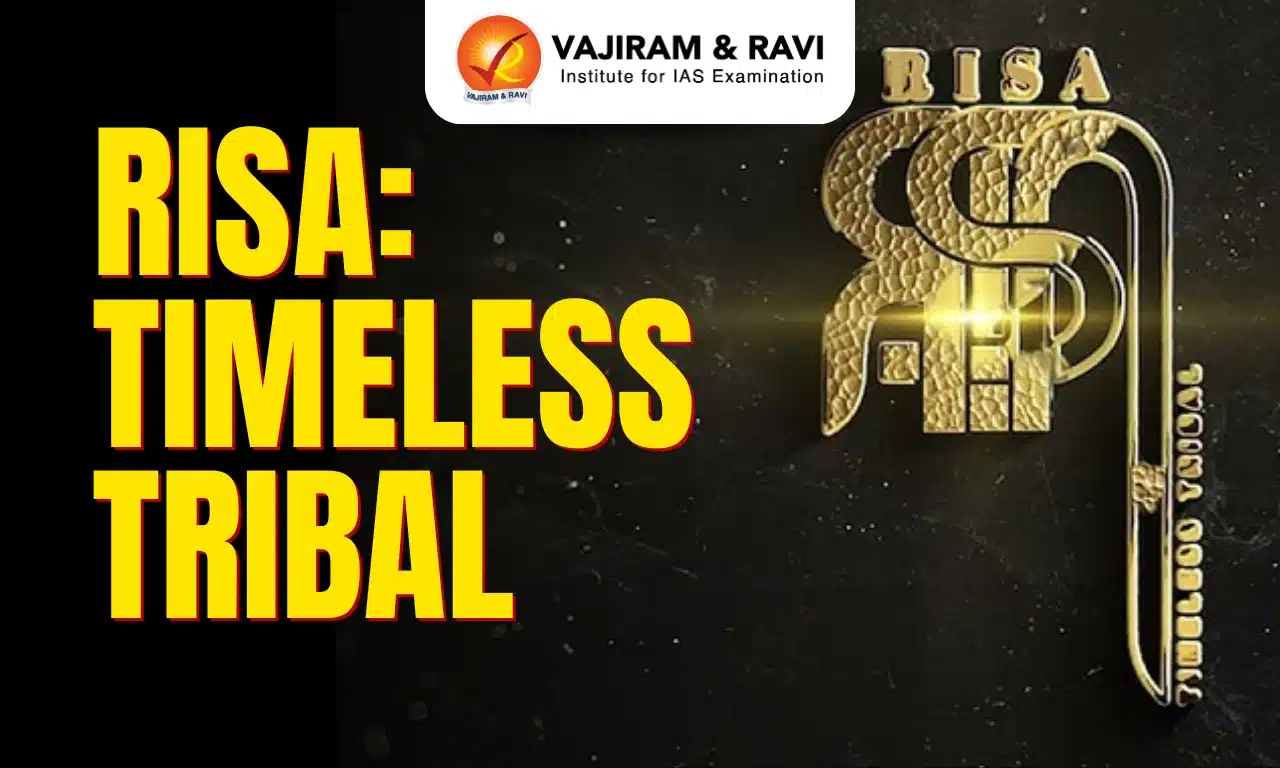
The Ministry of Tribal Affairs, through the Tribal Cooperative Marketing Development Federation of India (TRIFED), recently unveiled a dedicated premium signature brand, ‘’RISA – Timeless Tribal’’.
About RISA: Timeless Tribal
- It is a dedicated premium brand for tribal textiles, embroideries, and handicrafts.
- It was launched by the Ministry of Tribal Affairs, through the Tribal Cooperative Marketing Development Federation of India (TRIFED).
- The RISA initiative has been conceptualised
- to create a distinct brand identity for tribal products
- strengthen market linkages for tribal artisans
- facilitate design development and product diversification, and
- promote tribal heritage in premium domestic and international markets.
- It seeks to generate enhanced livelihood opportunities for tribal artisans while ensuring the preservation of traditional crafts and indigenous knowledge.
- As part of the first phase of implementation, seven tribal textile and embroidery traditions have been identified based on their cultural significance and market potential.
- These include Eri Silk and Muga Silk of Assam, Santal Cotton of Jharkhand, Changpa Pashmina of Ladakh, Kotpad Cotton and Dongria Embroidery of Odisha, and Toda Embroidery of Tamil Nadu.
- The first phase also includes focused promotion of selected tribal handicrafts, namely Longpi Pottery of Manipur, Turtuk Brass Cutlery of Ladakh, and Dokhra Art of Chhattisgarh.
- To facilitate design interventions and product development, eminent fashion designers have been associated with the initiative.
- The initiative is being implemented through the National Design Centre (NDC), an autonomous organisation under the Ministry of Textiles.
- The project encompasses design development, creation of garment prototypes, capacity building of tribal weavers and artisans, establishment of stitching facilities, strengthening of weaving and handicraft clusters, and improvement of product presentation and packaging.
- The National Institute of Design (NID), Haryana, has been engaged for the development of premium and environmentally sustainable packaging solutions for products marketed under the RISA brand.
- First exclusive RISA Store: Gallery No 2, Rajiv Gandhi Handicrafts Bhawan, Connaught Place, New Delhi.
Source: HT
RISA: Timeless Tribal FAQs
Q1: What is RISA: Timeless Tribal?
Ans: It is a dedicated premium brand for tribal textiles, embroideries, and handicrafts.
Q2: Which Ministry launched the RISA: Timeless Tribal initiative?
Ans: The Ministry of Tribal Affairs.
Q3: What are some key components of the RISA project?
Ans: Design development, garment prototypes, capacity building, stitching facilities, cluster strengthening, and improved packaging.
Q4: Where is the first exclusive RISA Store located?
Ans: Gallery No. 2, Rajiv Gandhi Handicrafts Bhawan, Connaught Place, New Delhi.
International Labour Conference Latest News
Recently, the Union Minister of State for Labour and Employment Shobha Karandlaje led the Indian delegation at the 114th International Labour Conference (ILC) in Geneva, Switzerland.
About International Labour Conference
- It is the supreme deliberative and decision making body of the International Labour Organization.
- The Conference meets annually, bringing together tripartite delegations from the Organization’s 187 Member States and a number of observers.
- Tripartite Delegation: Each national delegation has a minimal composition of two Government, one Employers’ and one Workers’ delegates (2–1–1). The Government, Employers’ and Workers’ delegates participate and vote independently.
- Role of the International Labour Conference
- Crafting and adoption of international labour standards (Conventions and
- Recommendations);
- Supervision of the application of standards through its Committee on the Application of Standards;
- Approval of the biennial programme and budget of the Organization and the allocation of expenses among Member States;
- Election of the members of the Governing Body;
- Admission of new Member States which are not members of the United Nations;
- Discussion on the reports of the Director-General and the Chairperson of the Governing Body;
- Adoption of resolutions that provide guidelines for the ILO’s general policy and future activities.
- Source: News On Air
International Labour Conference FAQs
Q1: Which major declaration was adopted at ILC in 1998?
Ans: Declaration on Fundamental Principles and Rights at Work
Q2: ILC follows which unique structure?
Ans: It follows Tripartite structure which includes: Govt, Employers, Workers
Epichlorohydrin Latest News
The Bureau of Indian Standards (BIS) has implemented strict standards for tea bags, prohibiting harmful chemicals like epichlorohydrin.
About Epichlorohydrin
- It is an epoxide in which one of the methyl hydrogens is substituted by chlorine.
- Properties
- It is a volatile and flammable, clear, colorless, liquid, chlorinated cyclic ether with an irritating, chloroform-like odor.
- It emits toxic fumes of hydrochloric acid and other chlorinated compounds when heated to decomposition.
- It is soluble in water.
- Applications
- It is used mainly for the manufacture of glycerol and unmodified epoxy resins.
- It is used in the manufacture of elastomers, water treatment resins, surfactants, ion exchange resins, plasticizers, dyestuffs, pharmaceutical products, oil emulsifiers, lubricants and adhesives.
- Impact on Health: Exposure to epichlorohydrin irritates the eyes, skin and respiratory tract, and can cause chemical pneumonitis, pulmonary edema, and renal lesions.
Key Facts about Bureau of Indian Standards
- It is the national standard body of India established under the Bureau of Indian Standards Act 2016.
- Objective: It was established for the harmonious development of the activities of standardization, marking, and quality certification of goods and for matters connected therewith or incidental thereto.
- It is the successor of the Indian Standards Institution (ISI), which was created in 1947.
- BIS represents India in International Organization for Standardization (ISO) and International Electrotechnical Commission (IEC).
- Nodal Ministry: It is functioning under the administrative control of the Ministry of Consumer Affairs, Food and Public Distribution.
- Headquarter: It is headquartered in New Delhi and maintains regional and branch offices throughout the country.
Source: LM
Epichlorohydrin FAQs
Q1: What is the chemical formula of Epichlorohydrin?
Ans: C3H5ClO
Q2: Epichlorohydrin is mainly used to manufacture which plastic/resin?
Ans: Key raw material for epoxy resins

Tajikistan Latest News
India and Tajikistan have agreed to deepen their economic partnership during the 12th Session of the India-Tajikistan Joint Commission on Trade, Economic, Scientific and Technical Cooperation.
About Tajikistan
- Tajikistan is a landlocked country in the heart of Central Asia.
- Bordering countries: It is bordered with Kyrgyzstan (North), Uzbekistan (West), China (East), and Afghanistan (South).
- It is one of the members of Shanghai Cooperation Organisation.
- Political Structure: It is governed by the President, and the legislative function is assigned to the bicameral parliament.
- Capital City: Dushanbe
Geographic Features of Tajikistan
- Terrain: Mountainous region dominated by the Alay Mountains in the north and the Pamirs in the southeast.
- Climate: It consists of mid-latitude continental, hot summers, mild winters; semiarid to polar in Pamir Mountains.
- Highest Point: Tajikistan’s highest point is Qullai Ismoili Somoni which peaks at 24,589 ft. (7,495 m).
- Rivers: It has a dense river network, including the Syr Darya and the Amu Darya.
- Lakes: Lake Karakul and Iskanderkul
- Natural resources: It mainly consists of Petroleum, Uranium, Mercury, brown coal, lead, zinc, antimony, tungsten, silver, gold etc.
Source: PIB
Tajikistan FAQs
Q1: Tajikistan was part of which former union before 1991?
Ans: Soviet Union
Q2: Which river originates in Tajikistan and flows to Aral Sea?
Ans: Amu Darya

Credit Guarantee Scheme for Microfinance Institutions-2.0 Latest News
Recently, the Government of India has approved extension in validity of the Credit Guarantee Scheme for Microfinance Institutions-2.0 (CGSMFI-2.0) upto 31.8.2026.
About Credit Guarantee Scheme for Microfinance Institutions-2.0
- It was launched in 2026.
- It aims to provide guarantee cover to Banks/ FIs through National Credit Guarantee Trustee Company Limited (NCGTC).
- It provides guarantee against expected losses on the financial assistance extended by them to Non-Banking Financial Company-Microfinance Institutions (NBFC-MFIs) and MFIs for on lending to small borrowers.
- The Government of India has also approved an increase in maximum loan amount capped to Large Sized NBFC-MFIs/MFIs from ₹300 crores to ₹1000 crores under the overall ceiling of 20% of Assets under Management (AUM).
Features of the Scheme
- Eligible borrowers: Existing or new small borrowers within the regulatory definition of micro finance as prescribed by RBI from time to time.
- Guarantee coverage: 80% of amount in default for small, 75% for medium and 70% for large NBFC-MFIs/ MFIs.
- Guarantee Fee: 0.50% p.a., on sanctioned amount (1st year) & outstanding amount (thereafter).
What is Microfinance?
- It refers to the provision of small-scale financial services, including loans, savings, and insurance, to individuals and small businesses that lack access to traditional banking services.
Source: PIB
Credit Guarantee Scheme for Microfinance Institutions-2.0 FAQs
Q1: Which organization provides guarantee cover under CGSMFI-2.0?
Ans: National Credit Guarantee Trustee Company Ltd
Q2: What is Microfinance?
Ans: Microfinance means providing small-scale financial services to low-income individuals, poor households, or micro-entrepreneurs who lack access to traditional banking.

C-295 Aircraft Latest News
Recently, the Indian Air Force (IAF) said that the first made-in-India C-295 military transport aircraft successfully completed its maiden flight.
About C-295 Aircraft
- It is a new-generation medium tactical military transport aircraft.
- It is a reliable and highly versatile tactical transport that is tailored for missions that range from carrying troops and cargo, maritime patrol, airborne warning, surveillance and reconnaissance to signals intelligence, armed close air support, medical evacuation, Air-to-Air refueling.
Features of C-295 Aircraft
- The aircraft, with a flight endurance of up to 11 hours, can function under all weather conditions.
- It is capable of carrying up to nine tonnes of payload, or as many as 71 troops, at a maximum cruise speed of 260 kts.
- The C295 is designed to provide outstanding low-level flight characteristics for tactical missions, flying at speeds as slow as 110 knots.
- It is powered by two turboprop engines.
- It has short take-off and landing (STOL) characteristics and the ability to use unprepared airstrips.
Source: TH
C-295 Aircraft FAQs
Q1: Where is India’s first private C-295 aircraft assembly line located?
Ans: Tata Advanced Systems Ltd, Vadodara, Gujarat
Q2: C-295 deal is part of which policy push?
Ans: Make in India & Atmanirbhar Bharat in defence