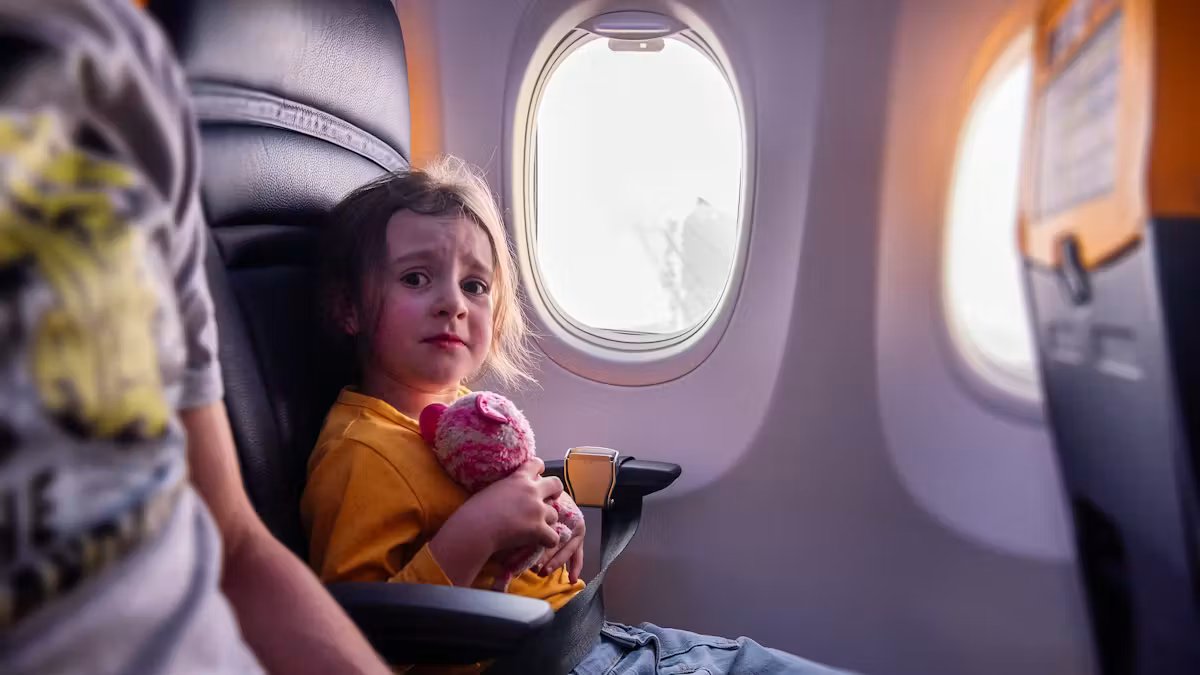
«I was recently on a flight the film “Wuthering Heights” looked. There are some explicit scenes, a lot of sex and also violence,” says reader A. “There was a girl about six years old sitting next to me. When I looked at it, I felt a little bad towards her, but I also thought that it wasn’t my problem.”
Reader S. also knows this situation: “When I flew recently, I ‹Off Campus› watched on the cell phone. There are several nude and really explicit sex scenes in the series,” she says. “For these scenes, I dimmed or fast-forwarded the brightness of my cell phone screen.” If there were children around, she probably wouldn’t have watched the series. “On the other hand, airlines also offer films with violence or sex scenes on the screen. That’s why I don’t see it that closely.”

Swiss shows films from 18 – child psychologist classifies
Swiss has over 700 films, series and games in its entertainment program. “This also includes films for ages 16 and 18,” says Swiss media spokeswoman Silvia Exer-Kuhn. It can happen that a child accidentally witnesses a violent or sexual scene on a plane.
“It’s not that bad,” many people might think. It’s not quite that simple, says psychologist and child and youth coach Melania Montanari. “Children do not yet have an inner drawer for violent or sexual images.” What an adult classifies and forgets in seconds can stick with a child. “Not because the picture was so bad, but because no one explained what it meant,” she says.
“Four to eight year olds are particularly vulnerable. At this age, the line between fantasy and reality becomes blurred,” she explains. But ten to fourteen year olds often react more strongly than expected. “Your brain is in the middle of development, emotional regulation is not yet a given.”
Do you watch series or films on the plane that are rated for ages 16 or 18?
Swiss does not show films with plane crashes
Does Swiss check films and series first before they are included in the entertainment program? “We select films that can be licensed for the in-flight entertainment program on aircraft,” explains Exer-Kuhn. Some licensors offer edited versions of films, others do not allow changes. “We usually show unchanged cinema versions and select them very carefully,” said the media spokeswoman. “This is also in the knowledge that the perception of film content is always subjective.”
That’s what’s behind the airline edits
Some airlines do not always show unchanged theatrical versions. There are sometimes so-called airline versions of the on-board program, in which sex scenes, nudity, strong violence, coarse language or sensitive flight scenes are shortened. Reasons include protection of minors, cultural or legal requirements and consideration for other passengers. How strict the cut is varies depending on the airline.
Each airline sets so-called editorial guidelines and decides for itself what to show on board within the framework of these editorial guidelines and what not. “We would never show a film in which a plane crash occurs,” says Exer-Kuhn as an example. “Such content could cause fear or discomfort and does not fit the travel experience on board.”
Parents can have their children’s screens regulated
Good to know: “Parents can request that our cabin staff only see age-appropriate content for their child,” says the media spokeswoman. The on-board program could be limited to certain age ratings or to films with a rating of “PG” (Parental Guidance). During the holiday season during the summer months, the offer is supplemented with child and family-friendly content.

But what if children keep looking at strange screens? «Distracting the child is often the easiest first step. Whether with a children’s film with headphones, a game on the tablet, a book or simply a conversation,” recommends Montanari. But she also thinks it’s legitimate to ask the person sitting next to her in a friendly manner: “Sorry, my child keeps looking over – would you mind tilting the screen a little or dimming it?”
What if children have nightmares after the flight?
“After the trip: stay open and listen,” recommends the child psychologist. “Some children don’t talk about what’s bothering them until days later.” Then we can classify the situation together. “For example, with an evening ritual such as reading aloud, saying goodnight or leaving the lights on if necessary.”

It is important to distinguish between a short-term shock reaction and a trauma reaction. “A shock reaction is normal: the child is upset, asks questions or perhaps sleeps poorly one night,” says Montanari. However, if the reaction lasts longer, the child avoids certain situations, has nightmares for weeks or suddenly develops fears in everyday life, this could indicate a trauma reaction. “Then parents should get support.”
Whether violence, sex or horror: Does it bother you if the person sitting next to you on the plane watches a film or series with such content? When choosing a film, do you pay attention to who is sitting next to you?

Laura Zygmunt (lmz) has been working for 20 minutes since 2022. She is an editor in the lifestyle department and writes about the world of travel.