Tegucigalpa, Honduras
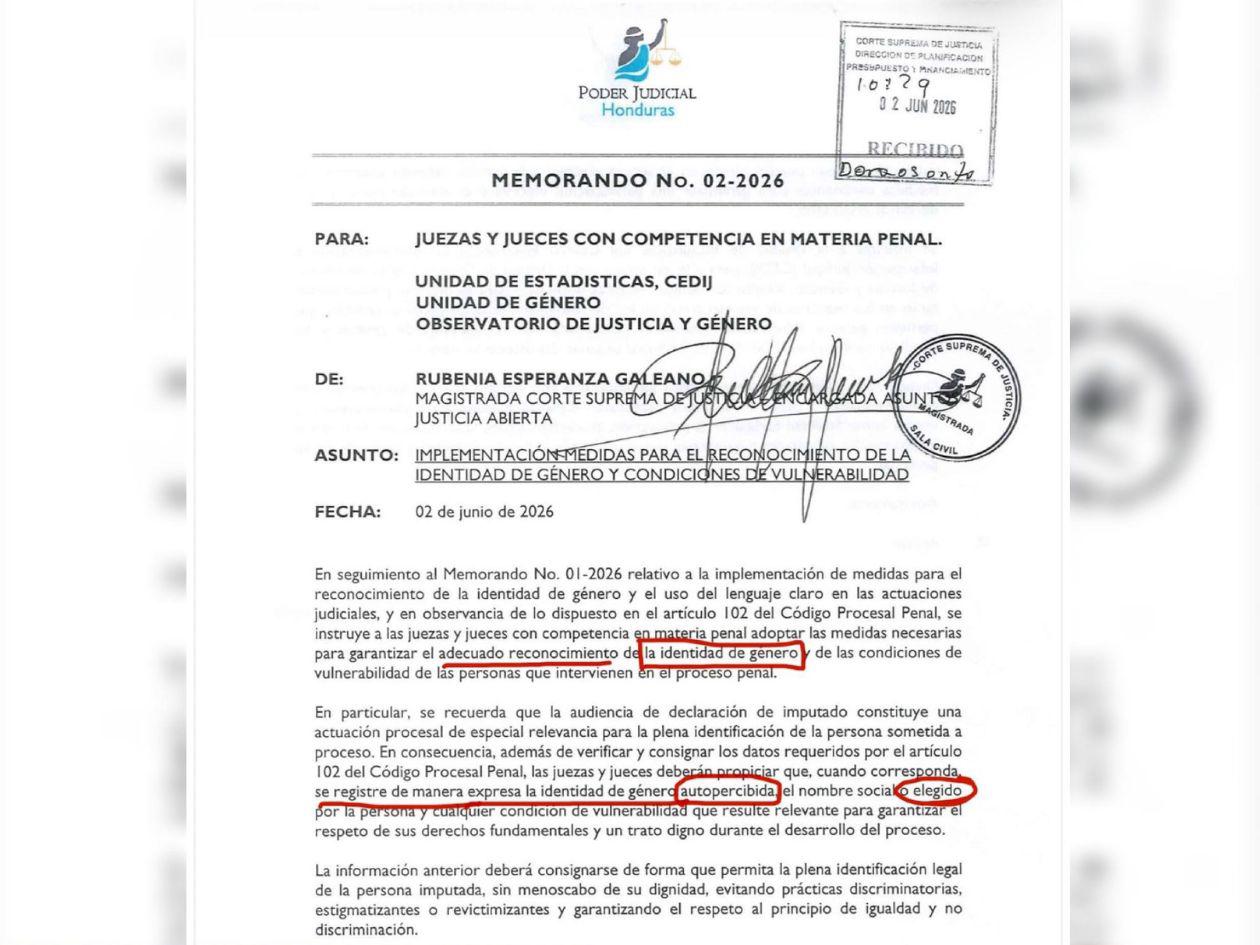
A Judiciary memorandum which instructs judges and administrative agencies to incorporate records on “self-perceived gender identity” in judicial proceedings and information systems opened a new legal and social debate in Honduras.
The provision, contained in the Memorandum No. 02-2026implies that within the processes, files or internal records of the judicial system, the way in which a person identifies themselves in terms of their gender is taken into account, beyond the sex officially recorded in their documents.
In other words, in practice, this means that if a person appears registered as a woman, but before the judicial system states that they identify as a man, the court should treat and register them according to that self-perceived identity within the judicial proceedings.
That is the point that generated the rejection of the Movement for Our Children, which questions that a category of this nature is introduced through an administrative instruction and not through a legal reform discussed and approved by the National Congress.
Total rejection at the disposal of the Judiciary
The Movement for Our Children expressed its rejection of Memorandum No. 02-2026 of the Judiciary, through which judges and administrative agencies are instructed to incorporate records related to “self-perceived gender identity” in judicial proceedings and information systems.
Through a public statement, the organization expressed its concern about the scope of the provision and questioned that this type of records are incorporated through administrative means, without prior legislative discussion in the National Congress.
“It is very serious that, under the argument of inclusion and non-discrimination, an attempt is made to introduce into judicial practice concepts that have not been the subject of express legislative development by the National Congress,” the movement noted in the statement.
The organization maintained that the Judiciary would have exceeded its administrative functions when issuing the memorandum, considering that a measure of this nature corresponds to the legislative sphere and not to an internal instruction of the judicial system.
According to the statement, the mandatory nature of these provisions could open the door to the institutionalization of criteria that, in the opinion of the movement, contradict the cultural, anthropological and religious vision of the majority of Honduran families.
“Normalizing these types of categories in the judicial system sets a direct precedent that can be extended to educational, health and child protection environments, exposing them to content and decisions contrary to their best interests,” the organization warned.
He Movement For Our Children argued that the Constitution of the Republic establishes clear limits for each power of the State and that substantial modifications in matters related to civil status, the legal identity of people or public records must be discussed and approved by the bodies empowered to legislate.
In this sense, he stated that the institutional incorporation of categories associated with gender identity generates legal and social uncertainty about the future scope of these measures, in addition to possible confusion in the application of current regulations.
The organization cited several constitutional articles that, in its opinion, could be violated with the implementation of the memorandum. Among them he mentioned articles 1 and 59 of the Constitution, related to the form of State, the dignity of the human person and fundamental rights.
He also made reference to article 112, maintaining that the State protects marriage, motherhood and the family. According to the movement, any policy that modifies the legal conception of the person in relation to biological sex can have effects on the pillars of the family and civil registries.
Furthermore, he mentioned the article 218 of the Constitutionunder the argument that it is exclusively up to the Legislative Branch to create, reform or repeal laws, so the Judicial Branch should not introduce provisions of this type through an institutional memorandum.
After expressing its rejection, the Movement for Our Children asked the president of the Supreme Court of Justice to render Memorandum No. 02-2026 null and void, considering that its application could generate legal and social controversies.
The organization also asked the Public Ministry to evaluate the legality of the provision and, if appropriate, promote the necessary actions to protect the rule of law.
Likewise, he called the president of the republic to maintain a commitment to the values of the Honduran family and urged civil society to remain informed and active in the face of this type of institutional decisions.
“Honduras is a sovereign nation with values deeply rooted in faith, family and justice,” the movement’s statement concluded.