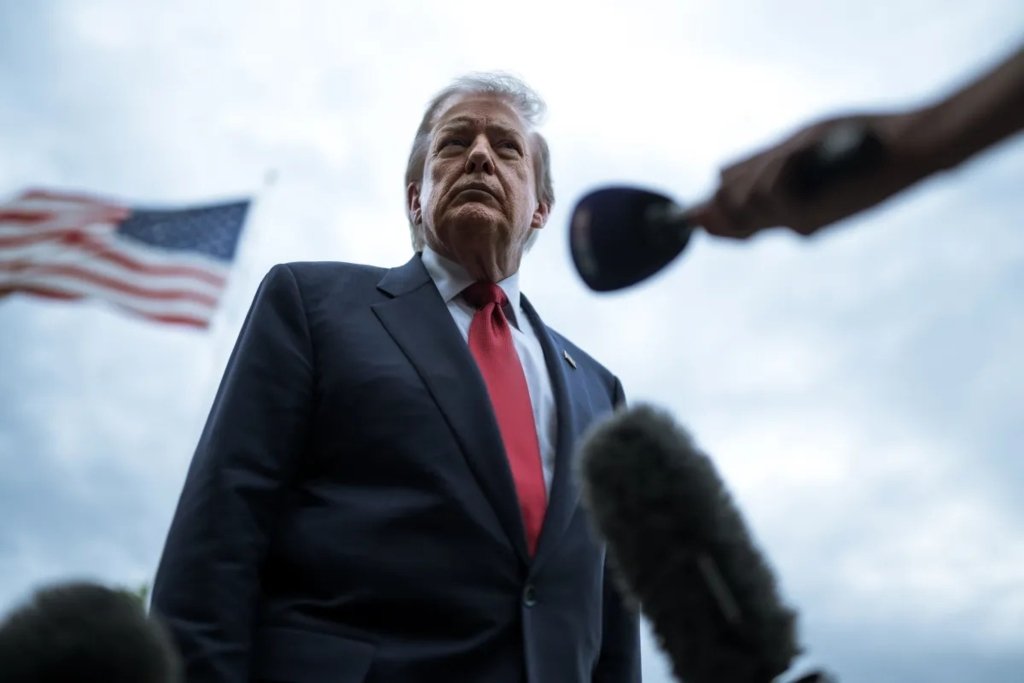

Donald Trump, President of the USA PHOTO White House
The best hope for ending a poorly planned war—started with minimal consultation from Congress or the American public—appears to be an unsatisfactory peace. Such a compromise risks leaving critical issues unresolved and deepening political fault lines from Washingtonaccording to CNN.
The president Donald Trump reiterated in recent days that an agreement to stop the conflict with Iran is imminent. In the past, however, his predictions have turned out to be mere wishful thinking or a misinterpretation of Tehran’s true intentions. So it’s no surprise that his latest claims of a framework deal are being viewed with skepticism and confusion by both hard-line Republicans and Democrats, with both camps fearing that the White House leader is about to cave to a disadvantageous deal.
However, diplomatic signals indicate that a deal to reopen the Strait of Hormuz and lift the US blockade on Iranian ships and ports could be close. Such a step would represent the starting point for negotiations through which the Trump administration will try to block Tehran’s nuclear ambitions.
A concrete deal, beyond the current fragile truce, would be welcomed worldwide, offering the hope of de-escalating the global energy and economic crisis triggered by the strait blockade.
The war in Iran, captive to Washington’s political games
Like all politics in the American capital, the war in Iran is hostage to entrenched ideologies and electoral interests. The Trump administration’s aggressive refusal to accept criticism of a conflict in which Iran’s resilience has been underestimated has only complicated the situation.
Politically, Trump is in a no-win position. Polls show that most Americans oppose the war, meaning that ordering more attacks would trigger a harsh public backlash and risk a violent escalation with severe economic effects. On the other hand, the terms of the emerging new agreement seem hard to present as a military or diplomatic triumph.
According to preliminary data, Washington could unlock some Iranian assets and gradually lift the naval blockade to persuade Tehran to reopen the Strait of Hormuz. This would mean, de facto, validating the means of pressure used by the Islamic Republic and ceding important negotiating assets of US.
Moreover, Iran’s promise not to develop nuclear weapons is viewed with reservations in Washington. The proposed timetable of just 60 days to resolve the uranium enrichment disagreement seems unrealistically short in relation to the complexity of the issue. Diplomatic history shows that Tehran excels at prolonging negotiations without concrete results.
Republican pressure
The hard-line Republican camp is firmly calling on the president not to budge. Senator Thom Tillis (North Carolina) slammed the strategy’s incoherence:
“Eleven weeks ago, we were told by Pentagon that Iran’s defenses have been shattered and that it is only a matter of time before we secure the nuclear material. Are we now accepting that this material remains in Iran? What logic does that have?”
Eliminating highly enriched uranium stockpiles has been a major goal for the US and Israelbut the human cost of a military withdrawal has proven prohibitive, and the diplomatic concessions demanded by Iran are huge.
For their part, influential senators such as Roger Wicker, head of the Senate Armed Services Committee, and Lindsey Graham warn that a deal now would project a “perception of weakness” and shift the regional balance of power in Tehran’s favor, leaving control of the Strait of Hormuz under Iranian influence.
The military alternative and the offensive of the Democrats
Critics of military reconstruction, however, do not offer a clear solution to how continued conflict could defeat Tehran’s resistance. Recent US intelligence reports indicate that Iran has resumed drone production and is rebuilding its military capabilities damaged by the US-Israeli strikes. A new cycle of violence would expose US forces and critical infrastructure in the Gulf to even harsher retaliation.
Domestically, Democrats are seizing the moment to penalize the administration, anticipating that public opposition to the war may bring them victory in the midterms. Senator Cory Booker accused Trump of being “pulled on a string,” arguing that the new deal does not address the issue of the nuclear program, the original purpose of the intervention. Senator Chris Van Hollen added, pointing out that the war was a blunder: “When you’re in a hole, the first thing you have to do is stop digging.”
In New Delhi, Secretary of State Marco Rubio dismissed the criticism as “absurd” that Donald Trump would accept a deal that would strengthen Iran’s nuclear posture. Sensing the pressure, Trump reacted on social media, saying he asked negotiators to take their time because “time is on our side.”
The economic stake
As Memorial Day approaches and a tumultuous political summer begins, Republican strategists are trying to highlight the benefits of peace. Kevin Hassett, director of the National Economic Council, argued that a deal would unblock oil supplies across the strait, which could even lead to “negative inflation” due to falling energy prices.
Economic analysts, however, are much more reserved. The recovery from the blockade of the strait, where dozens of oil tankers were immobilized, will not bring an immediate improvement to the global economy. Experts at JPMorgan forecast that oil prices will remain at a high average of $97 per barrel for the rest of the year.