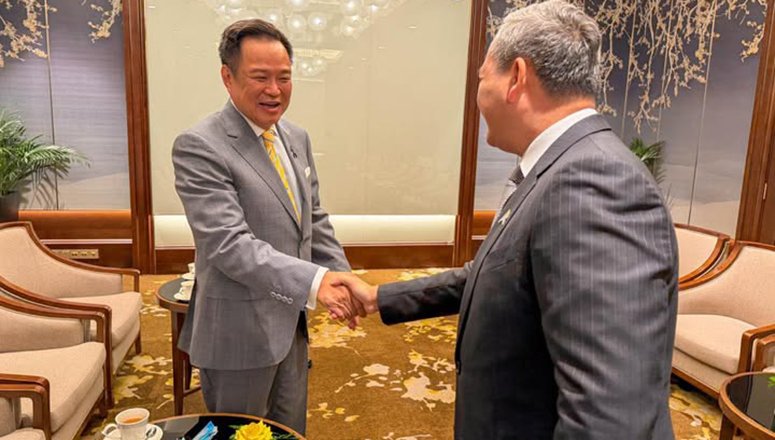
Synopsis: The two prime ministers meet in Vietnam to defuse maritime and frontier tensions.
Prime Minister Hun Manet and his Thai counterpart Anutin Charnvirakul yesterday committed to international law to transform a fragile ceasefire into lasting peace.
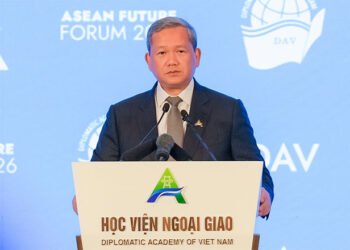
Speaking at the ASEAN Future Forum 2026, Mr Hun Manet said that while the ceasefire continues to hold, it is still unstable.
“Borders and sovereignty must never be altered by force or fait accompli,” he said, referring to tensions along the Cambodia-Thailand border.
Mr Hun Manet called for the urgent implementation of the joint statement issued by both countries on December 27, 2025, urging the Joint Boundary Commission to resume survey and demarcation work under existing agreements.
“Cambodia continues to attach great importance to its relationship with Thailand, a close neighbour with a common commitment to peace and prosperity in the region,” he said.
Mr Hun Manet said adhering to treaties through dialogue, good faith, and mutual respect is essential to protecting international boundaries, restoring trust, and allowing displaced populations to return home safely. Turning to the maritime dispute, he noted that Cambodia’s recent move to initiate compulsory conciliation under the United Nations Convention on the Law of the Sea reflects a desire for an equitable solution.
“Thailand’s expressed preparation to engage in this facilitative process under international law is a welcome step towards a peaceful resolution of the overlapping maritime claim area,” he said.
He added that resolving the maritime dispute serves the shared interests of both nations and promotes regional stability, thanking the international community and ASEAN member states for supporting the UN and ASEAN charters.
Anutin said relations between Thailand and Cambodia are at an important crossroads, noting that current decisions will shape their future.
“Thailand and Cambodia are at an important crossroads. The decisions we make today will have a bearing on the future course of our relations,” he said.
Anutin urged both countries to work together to overcome challenges and open a new chapter in their relationship.
“We need to meet the challenges together to turn a new page in our ties. It is only through demonstrating political will and resolve that we can achieve peaceful and lasting solutions,” he said.
While acknowledging the difficult path ahead, Anutin said he was confident that lasting solutions could be achieved if both sides committed to the process.
“This only requires trust and confidence as well as our good faith dialogue,” he said.
Mr Hun Manet posted on social media that he held an informal discussion with his Thai counterpart before the official opening of the forum yesterday. Details of their meeting were not immediately released.
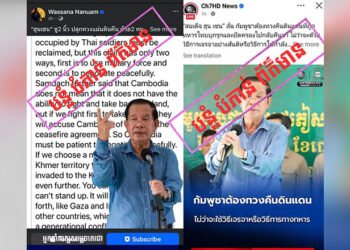
Backing the prime minister’s remarks, Acting Head of State Hun Sen said yesterday that Cambodia prefers a peaceful resolution rather than military force to settle the border dispute with Thailand, which disrupted diplomatic ties and sparked armed clashes last year.
“Some people believe pursuing a peaceful solution takes a long time, while using military force is faster. But I would ask in return: can we really solve it that way? If not, it will take even longer.
Even if fighting were possible, that area would become a contested zone forever,” he said. “We must work to heal this through negotiation, reconciliation and peaceful means.”
If Thailand does not respect the third point of the ceasefire agreement concerning border demarcation, it will bear sole responsibility before the international community, Mr Hun Sen added.
“At the very least, the ASEAN Observer Team is carrying out its work,” he said.
Although peace appeared to prevail yesterday, Thailand’s domestic political friction lingered. On June 8, Thai Senator Parinya Wongcherdkwan urged his government to halt educational assistance to Cambodia, including scholarships and student exchange programmes.
Parinya also asked National Assembly President Sophon Saram to dissolve the Thailand-Cambodia Parliamentary Friendship Group, which promotes ties between the two nations’ lawmakers, and called on the group’s nine members to resign.
In addition to cutting student subsidies and halting new educational cooperation projects, the senator proposed redirecting future academic quotas to other countries. He also called for a review of broader assistance provided to Cambodia through the Thailand International Cooperation Agency, including support for public health, infrastructure and border cooperation.
“Such aid should be suspended until the border situation returns to normal,” Parinya said.
On the Cambodian side, Defence Minister General Tea Seiha posted on social media yesterday that certain Thai media outlets and individuals had accused him of rejecting bilateral mechanisms and deploying troops to spark another conflict.
Gen Seiha rejected the allegation, saying Cambodia remains committed to resolving all issues peacefully and respecting existing ceasefire agreements.
“Cambodia remains hopeful that both sides will peacefully resolve these matters and absolutely avoid any use of force,” Gen Seiha said.
International Relations Institute of Cambodia Director-General Kin Phea accused Thai leaders of hypocrisy over their diplomatic stance.
“When speaking on international platforms, to foreign media, or in regional and international meetings, they use language that makes them appear to respect the law, respect the sovereignty of neighbouring countries, and desire peace, stability, and friendship. But their actual actions tell a different story,” Phea said.
“After the ceasefire, they continued encroaching on Cambodian territory and persisted with activities designed to create faits accomplis on the ground by placing container barriers and barbed wire and constructing civilian and military infrastructure along the border.”
Related Posts
-

April 24, 2026
-
May 29, 2026
-
April 17, 2026
-
April 9, 2026