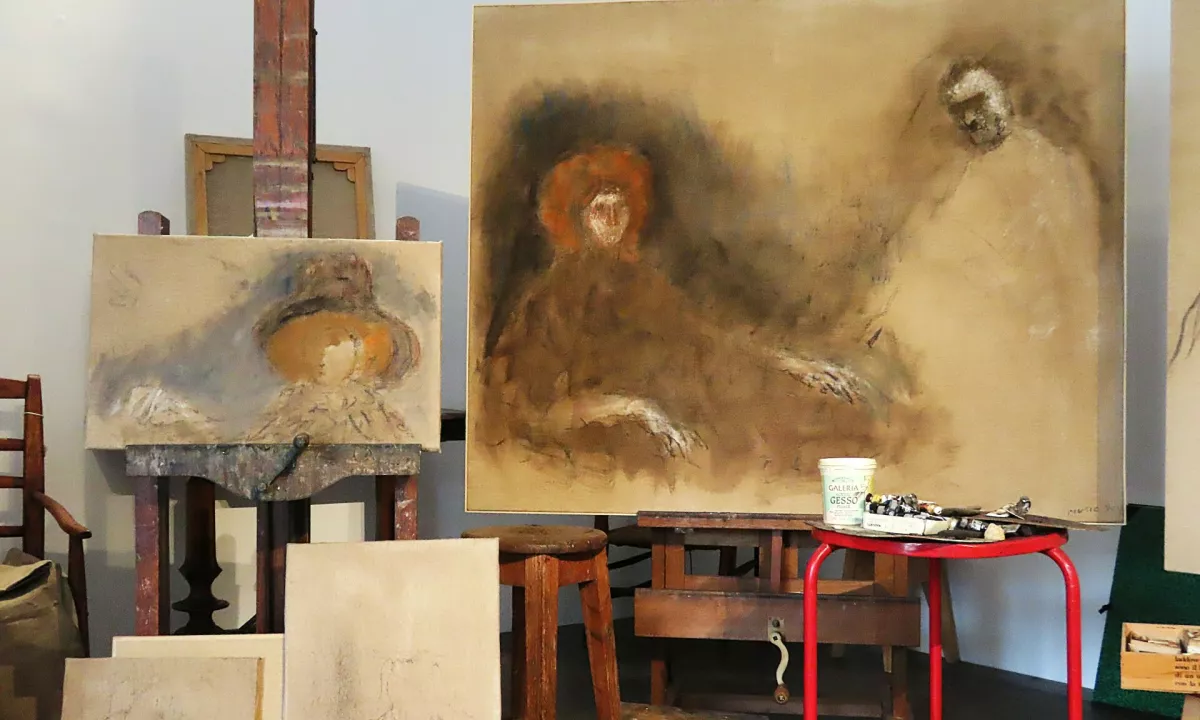
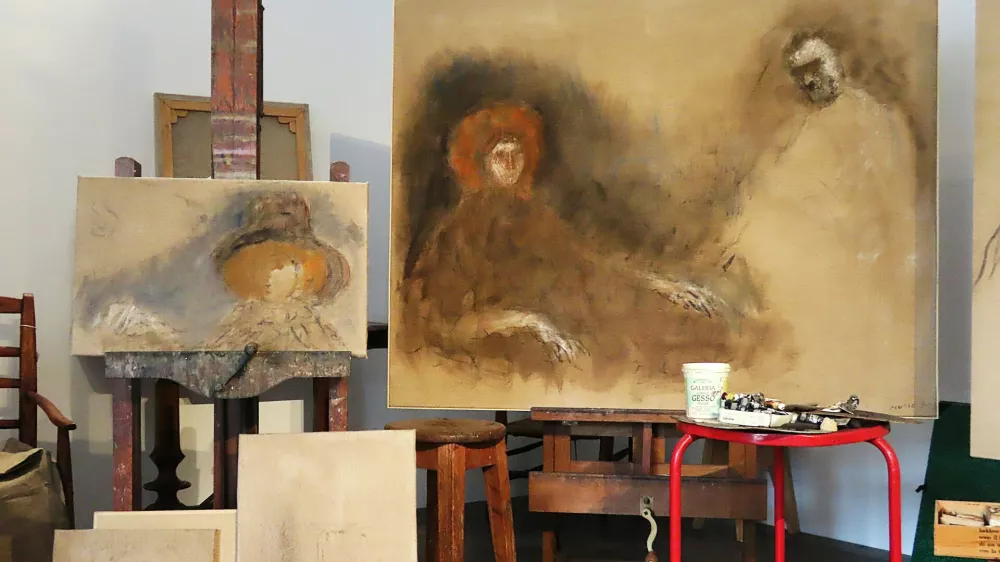
Venice studio of Zoran Mušič Photo: GCZ archive
An Italian tribute to Zoran Mušič
Zoran Mušič: Zurich room, work, studio was the title of the exhibition in the Attems Petzenstein Palace in Gorica as part of the European Capital of Culture GO!2025, and so is the title of the long-awaited professional monograph, which was published in Slovenian (Italian and English) by publishers on the Italian side. Today is exactly 21 years since Mušič’s death.
Just an art historian Saša Quinzi noticed, understood and presented the significance of an extraordinary event on the foreign side of Slovenia: the publication of a Slovenian book about the painter Zoran Mušičwhich was published by Italian publishers for themselves and for us. The book is an independent publication of 288 pages, printed separately in Italian and English. The exemplary designed and perfectly printed book is the result of the only integrated painting exhibition with the works of the artist Mušič as part of the European Capital of Culture (ECC) 2025 in Gorica and Nova Gorica.
All environments of the retrospective
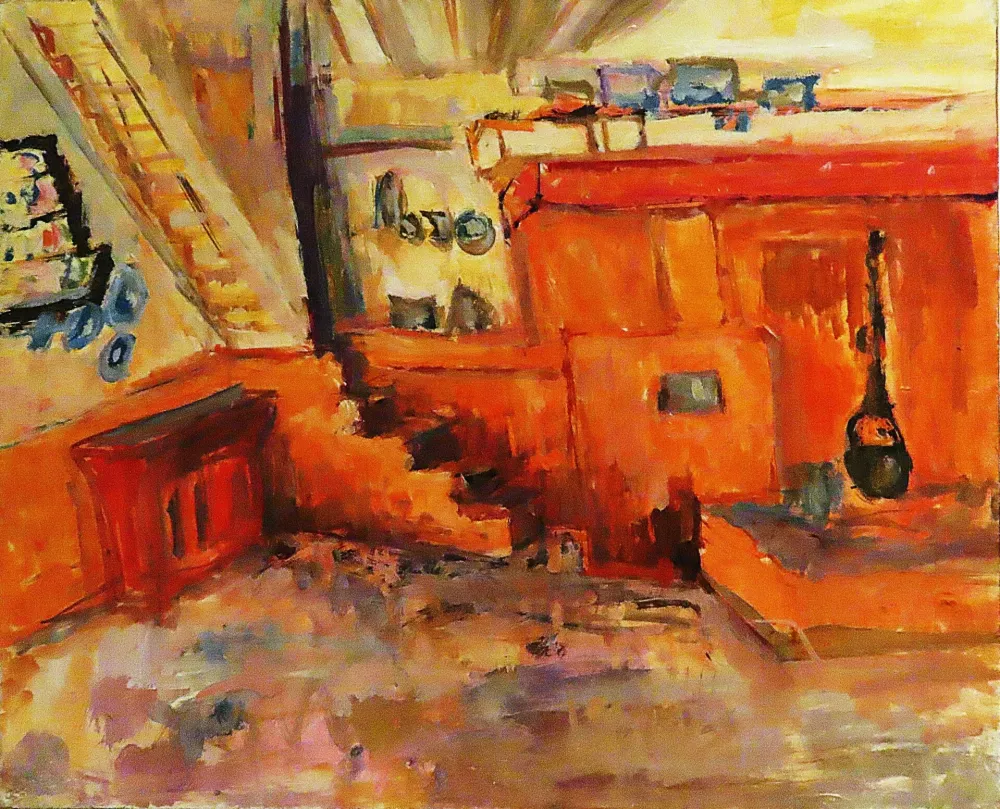
The product arrived in bookstores in February this year. The excusable reason for the delay is the last part of the book, in which color images of all the ambiences of the retrospective in the Attems Petzenstein Palace are published on as many as forty pages. The memory of a pleasant and professionally arranged and set up exhibition has been preserved. The three-part retrospective consisted of a reconstructed Zurich room, a recreated ambience of the painter’s studio and a chronological overview of more than 130 works. Among the selected images, there were only a few works on paper. For the first time, painted furniture, several ceramic plates and, for researchers, three experimental embroidery designs by Mušić from 1950 and 1952 for the ship Augustus were exhibited publicly. On the elite floor of the palace, a room with a documentary film and a space with a chronological review were added.
At the opening, the authors published a small catalog – an album in both border languages with the leading text Raffaelle Sgubin and seven quoted statements by the painter. They added a special brochure about painting a villa in Switzerland. The accompanying art exhibitions of EPK in Slovenia (Z. Mušič, V. Makuc, B. Kalin) did not have accompanying brochures or catalogs.
The new monograph is an upgrade of the retrospective. It has a selected author’s text Daniele Ferrettiwho has participated in Mušič’s exhibitions since 1985, and a series of texts by relatives of the painter’s brother-in-law Paolo Cadorinathe initiator of the rescue of Mušič’s Zurich paintings. They are signed P. Simonetta Cadorin, Monique Veillon Cadorin and Marcella Ciarnelli. He described the work and surpluses of meritorious restorers-conservators Diego Bianchi. As written in the book, with a lot of diverse knowledge, patience and organization, they managed to save a technically weak, but artistically outstanding set of the painter’s typical Venetian motifs from the 1950s. They created a portable container in which the painted ambience of the walls, ceiling and accessories, from curtains to tablecloths, came to life again.
From the Venetian studio
In the book, just as it is in the exhibition, the recreated ambience of the last Venetian studio with a few additions from Paris is stunning. Although it does not contain the painter’s library and desk, the original painted furniture, easels, unfinished paintings, materials and tools are excellent material for future research. More established is the reproduced chronological series of paintings and drawings, from the oldest from Spain and the Brda to the series We are not the last and late self-portraits. Among the highlights in the book are reproductions of eight drawings from Dachau.
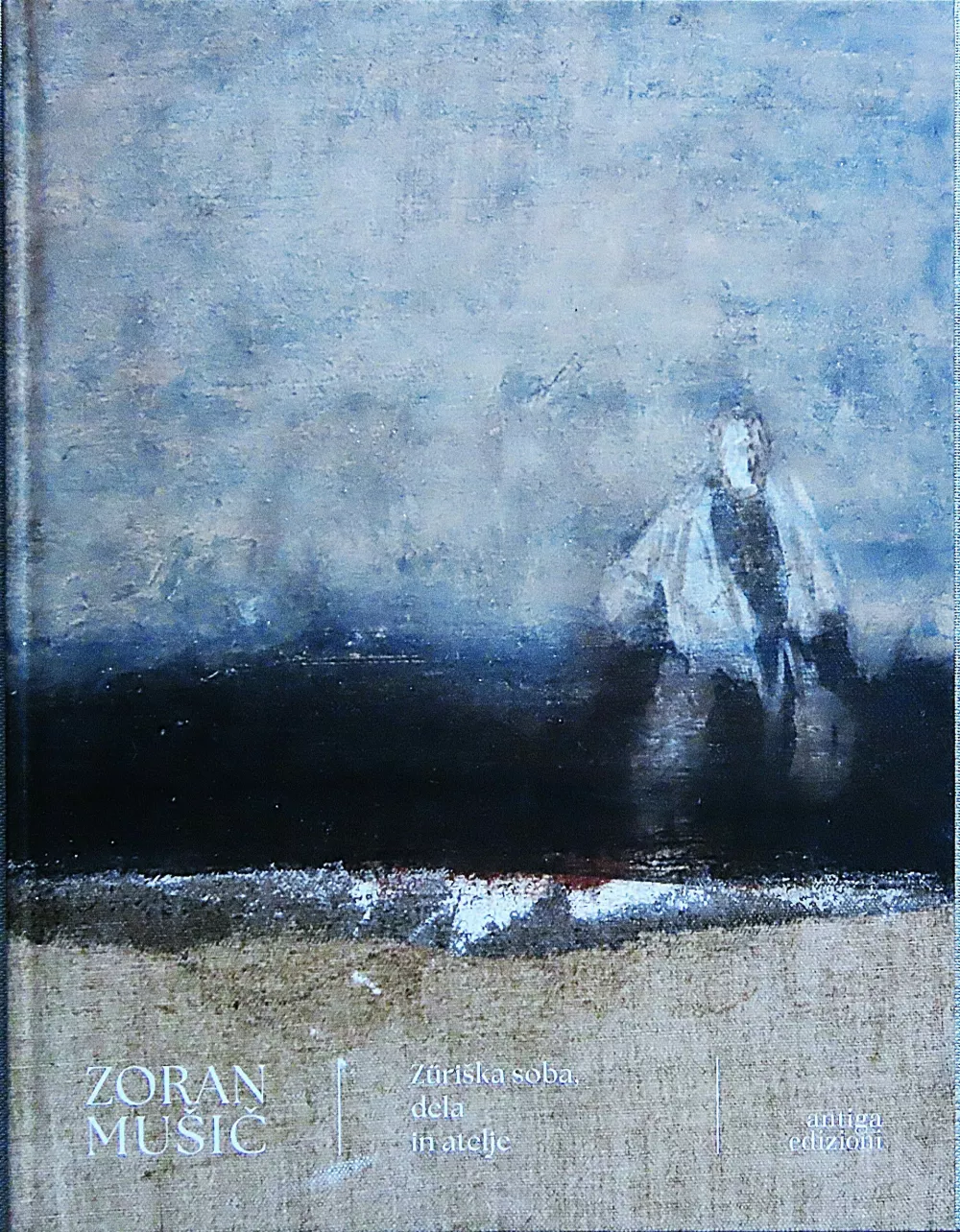
The editors have chosen the texts of two of Mušič’s longtime friends and promoters Jean Clair and by Michael PeppiattFrench and English. An independent article by a Slovenian author has been added. For Slovenia, three Peppiatt interviews have been freshly translated for the first time; despite some mistakes in the biography and the clumsiness of the translation, it is a great achievement. Similar is the fluently written biography in which Paolo Rizzo’s outdated biographical information is repeated, which is a common mistake of various writers.
The core of the picture block is enhanced with the sparks of distinguished authors, mostly Italians, who wrote about Mušič from 1949 to 2000. Pier Antonio Quarantotti Gambini, Sergio Solmi, Marilena Pasquali, Giuseppe Mazzariol, Giuseppe Marchiori, Willem Sandberg and Roberto Tassi. Antiga edizioni, which has been printing selected catalogs and books about Mušič for more than three decades, took care of the printing of the aforementioned album and monograph in three languages. Without a doubt, the new monograph as a whole is an excellent complement to the book dedicated to the artist and academic by the Slovenian SAZU in 2012.