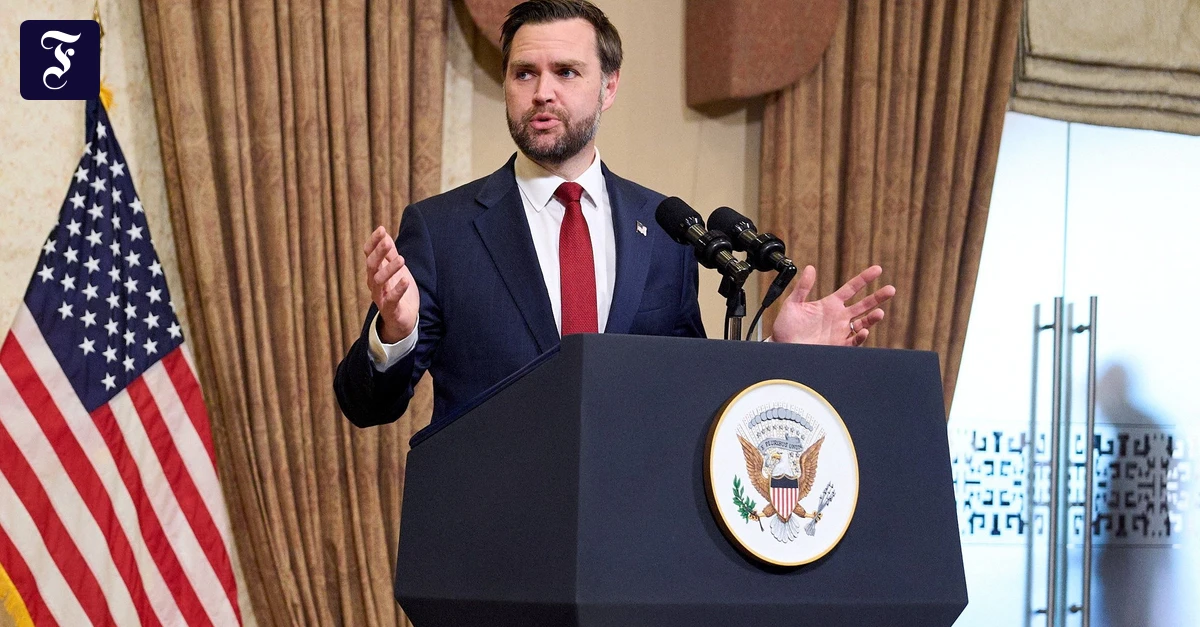
Shortly before the end of the ceasefire between Iran and the USA, a continuation of the negotiations remains uncertain. Both parties have recently shown themselves to be intransigent. But according to media reports, the US delegation led by US Vice President JD Vance is about to leave for Pakistan.
Meanwhile, the central point of contention remains the US naval blockade of Iranian ships and ports. US President Donald Trump divided Truth Social that he would stick to the blockade until there was an agreement. However, according to information from Pakistani security circles, Tehran’s participation in talks is conditional on the lifting of the naval blockade.
Iran’s Parliament Speaker Mohammed Bagher Ghalibaf, who led the Iranian delegation in the previous round, said on Platform X that he would not accept negotiations under the impression of threats. After the ceasefire, Iran has new military resources at its disposal.
Departure of US delegation expected
If the US and Iran do not reach a new agreement before Wednesday evening Washington time, war could break out again. Trump had again threatened destructive attacks in the event. Because of the difficult situation, particularly in the Strait of Hormuz, which is important for world trade, oil prices have recently risen significantly again. In the USA, too, refueling is more expensive than it has been in years – a sensitive issue for Trump in an election year. The US President nevertheless demonstrated composure: He was under no pressure to reach a deal, he wrote on Truth Social.
Trump announced the two-week ceasefire after midnight (CEST) on April 8th, a Wednesday. The end of the ceasefire for this week was often given as Wednesday night. Now Trump called Wednesday evening Washington time the end of the ceasefire. Because Iran is seven and a half hours ahead of the United States, the end of the ceasefire there would fall in the early hours of Thursday.
Despite public uncertainty about a new round of negotiations, the U.S. delegation is expected to leave for the Pakistani capital Islamabad “soon,” according to a source familiar with the matter. According to information from the New York Times and CNN, US Vice President Vance’s team is currently expected to set off on Tuesday. The long flight would give the Iranians, who have not yet officially agreed to a second round of negotiations, enough time to send a delegation from Tehran itself.
US naval blockade obstacle to negotiations
At the weekend, the conflict over the Strait of Hormuz increased tensions. Iran announced the opening of the road on Friday, but withdrew it on Saturday. The U-turn was justified by the existing US blockade of Iranian ports and ships. On Sunday, the US Navy attacked and took control of an Iranian freighter.
The Iranian news agency Tasnim now reported that participation in the “drama staged by the USA” was linked to the fulfillment of prerequisites. This includes, among other things, lifting the naval blockade in the Strait of Hormuz.
The German Press Agency also learned from Pakistani security circles that the US naval blockade is currently a key hurdle. The Pakistani army chief, Field Marshal Asim Munir, recently told Trump in phone calls that Iran wanted the US naval blockade to be lifted as a prerequisite for participating in a second round of negotiations, it was said. Munir spoke to Trump three times in the past 36 hours.
Even before the first round of negotiations, the Iranian side had left it unclear whether it would actually send negotiators to the talks in Islamabad and had attached conditions to participation. There is deep mistrust between the countries.
Pakistan wants to persuade the Iranians to talk
Pakistan appealed to the Iranians to continue the dialogue – the foreign ministers of the two countries spoke by phone for the second day in a row on Monday. Iran’s Foreign Minister Abbas Araghchi made new allegations against the USA, but did not explicitly rule out new talks. “The US provocations, threatening rhetoric and persistent ceasefire violations, especially attacks on Iranian merchant ships, are a significant obstacle to the continuation of the diplomatic process,” he said, according to a report by Tasnim news agency.
Iran’s foreign ministry spokesman had previously said at a press conference in Tehran that Iran had not yet made a decision about further negotiations with the USA. Ismail Baghai pointed out that Pakistan’s army chief Munir brought a new US proposal during a visit to Tehran a few days ago. “This is currently being examined,” said the spokesman. There are currently no further rounds of negotiations planned.
EU foreign ministers discuss the situation in the Middle East and the war in Ukraine
The messy situation in the Middle East also concerns the foreign ministers of the EU states on Tuesday. The main topic at the meeting in Luxembourg will be how the European Union can contribute to a de-escalation of tensions. Federal Foreign Minister Johann Wadephul (CDU) from Germany is expected at the meeting in Luxembourg. The deliberations will be led by EU chief diplomat Kaja Kallas.