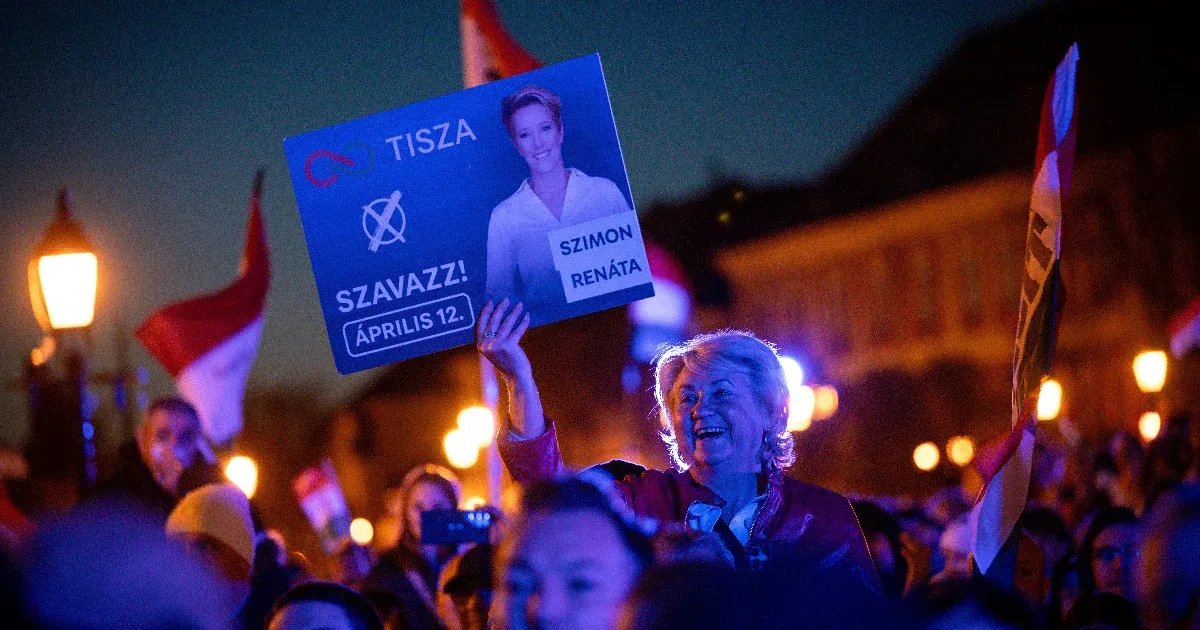
The election is decided in the individual constituencies, so it is also important for Tisza to be able to field 106 suitable candidates against the representatives of Fidesz who are embedded in the locality, even ruling for decades, sometimes acting as petty kings – we heard from political analysts countless times during the campaign. The 21 Research Center (whose last research hit him almost perfectly the result of the election) mandate calculator also calculated an extra two percent of bonus votes for Fidesz representatives who have been in office for several cycles to simulate this effect. The Electoral Geography is from last March analysis however, he came to the conclusion that the personality of the candidates is less important in the Hungarian electoral system than many people think.
Now, after reaching 100 percent processing and the announcement of the official final result, it is worth looking at how much the candidates’ personalities mattered. In order to find this out, we compared the votes received for the Fidesz and Tisza candidates in each electoral district with the votes received for the lists in the given district, and we looked at how much the candidates of the parties performed better or worse than their party.
Overall, the data show that the Fidesz representatives outperformed Fidesz’s local results by an average of 0.37 percent, while the Tiszas underperformed their party’s local results by an average of 0.47 percent. Since Tisza won the election by a large margin, these numbers can perhaps be best interpreted as:
- Fidesz proved to be even more unpopular than its own representative candidates
- The Tisza candidates, on the other hand, fell a little short of their party’s popularity
Let’s see in a little more detail!
Tisza
77 of the 106 representatives from Tisza remained within plus or minus 1 percent of their party’s local results, 29 were more than that. Only four produced a difference of more than 2 percentage points. The biggest overachiever, that is, the party’s relatively most popular candidate, was former zoo director László Gajdos, who won 64.77 percent of the votes in Nyíregyháza, 1.9 percentage points more than Tisza. Relatively significantly (which means 1-1.5% here) the local results of Tisza were also exceeded by, for example, Ervin Nagy in Dunaújváros, Gabriella Virágh in Kispest, Tímea Barna-Szabó in Nyírbátor, and Bóna Szabolcs in Csorná – the latter also did not manage to win.
The biggest underperformer was György László Velkey in Zugló, with an outstanding figure of 13 percentage points. This certainly does not indicate the unpopularity of his person, nor the popularity of his Fidesz opponent, Béla Radics (he also underperformed compared to Fidesz, by one and a half percentage points), but the influence of Ákos Hadházy, who achieved 16 percent in the constituency as an independent. Even so, Velkey won by a huge margin, receiving more than twice as many votes as Radics and three times as many as Hadházy.
The situation was similar (i.e. both the Fidesz and Tisza candidates underperformed compared to their party) in Szentes and Soroksár, where Bence Bárkányi and Zoltán Tarr won, respectively, beating Tisza’s local results by 3.8 and 2.3 percentage points. Zoltán Bihari, who underperformed by more than two percentage points in Tiszaújváros, was 2.1 percentage points behind his party, while his opponent, Zsófia Koncz, finished 3.9 points higher than Fidesz’s electoral district result – in this he was the best in the entire Fidesz, but despite this, Bihari beat him by a smooth margin of 8 percentage points.
Fidesz
Almost two-thirds of the Fidesz candidates (69 out of 106) outperformed their party. 31 people were out of the plus-minus one percent band of the party’s result (this is roughly the same as the similar data from Tisza). From the plus-minus 2 percent band, five hung out upwards, and one (Simon Miklós, who will be discussed separately) downwards.
Besides Zsófia Koncz, the biggest outperformers are Péter Ovádi (Veszprém, +2.7%), Mihály Witzmann (Siófok, +2.5%), János Hargitai (Mohács, +2.4%) and Gábor Szilasi (Zalaegerszeg, +2.1%). They all have one thing in common, that despite their overperformance, they all lost to the candidate from Tisza.
Where the dice turned
We have reached the most exciting constituencies. Such is the case of Nyírbátor, where we have already mentioned Tímea Barna-Szabó, who overachieves compared to Tisza. His opponent was the already mentioned Simon Miklós, the biggest Fidesz underperformer (minus 2.1 percentage points compared to the listed result). The result of the meeting between the popular Tiszas and the unpopular Fidesz was that Fidesz received more votes on the list in this electoral district (47.8% vs 46.3%), but Barna-Szabó won individually (47.9% vs 45.7%).
There was a similar turn in Balassagyarmat, only with the opposite sign, here on the list Tisza received more votes (45.5% vs. 44.9%), both individual candidates underperformed compared to their party, but Mihály Balla from Fidesz less than Zoltán Molnár from Tisza, so he won with a difference of only 211 votes, 44.6-44.2 percent. Here, Dávid Dócs from our country, who finished third with 9.9 percent, probably stole votes from them.
Sárvár is even more exciting from this point of view, and the numbers clearly show why he doesn’t want to admit it the Tisza is the result. In this list, Tisza received more votes (47.5% vs 44.5%), however, individually, Péter Ágh from Fidesz won with 46.2 percent, against Viktória Strompová from Tisza with 45.8 percent, the difference was only 248 votes. And an independent candidate named Péter Magyar also ran here, who handed in his recommendation forms on the last day and finally received 1.6 percent, 909 votes. This is almost four times as much as the difference between Ágh and Strompová.
The scheme is similar in Karcago, in the list Tisza received more votes (46.7% vs 46%), individually Sándor F. Kovács from Fidesz slightly outperformed, and Hunor Krisztián Kovács from Tisza slightly underperformed compared to his party, so in the end the Fidesz candidate won with 47% to 46.5%. The result was also reversed in the Ózd district, here Tisza received 47.2 percent, Fidesz 45.1 percent, individually the overachieving Gábor Csuzda from Fidesz received 46.7, and Csilla Németh from Tisza received 45.5.
In other words, out of the 106 individual constituencies, there were also five where the candidate of the party that received more votes on the list did not win individually. As a result, Fidesz was able to turn over four and Tisza one individual representative seat. The personality and local popularity of the candidates mattered so much; if it had been purely based on the support of the parties, Tisza’s victory would have been three more seats.