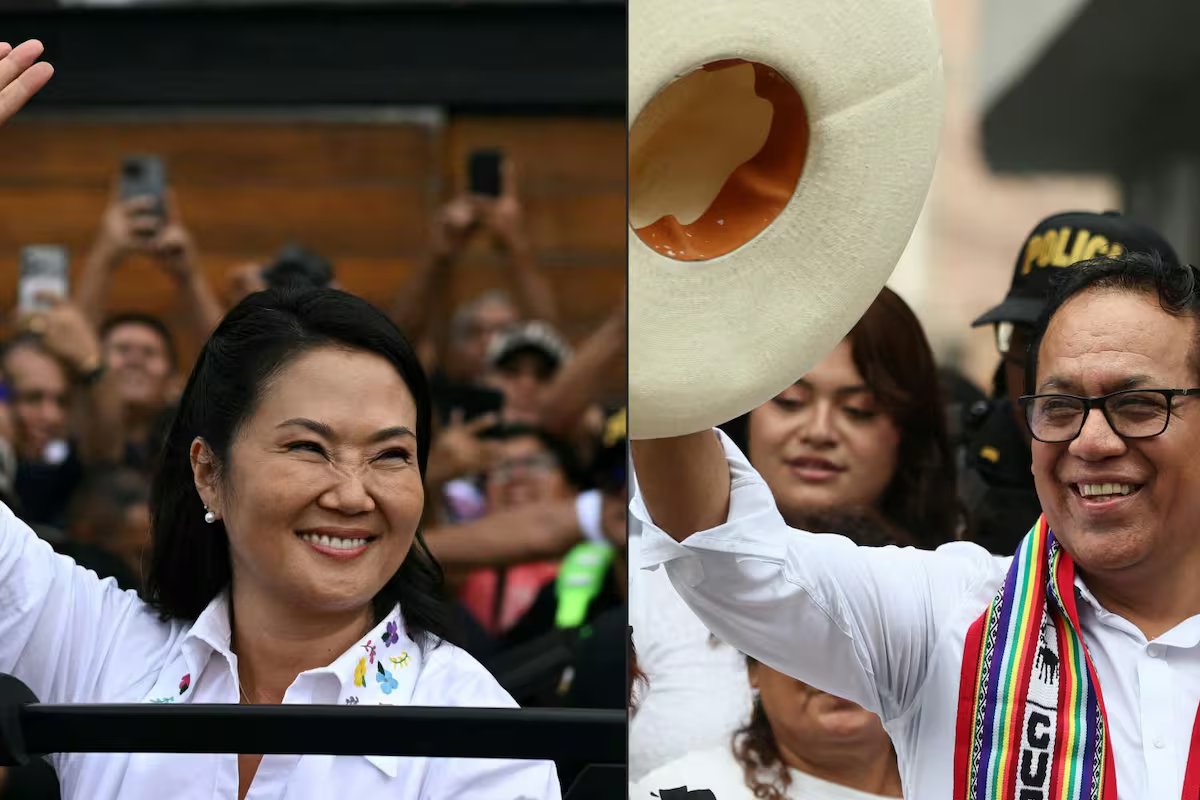
LIME.- “Closed day but with an open end”headlined this Monday the Peruvian newspaper The Commerce. Peru woke up again on the verge of a millimetric definition. With 94% of the tables accounted for, the Presidential runoff showed a technical tie on Monday between the conservative Keiko Fujimori and the progressive Roberto Sánchez, in what is already the eighth second round in the country’s recent history and one more in the long series of tight outcomes that marked his political life. The difference between both candidates is 30,000 votes.
Political uncertainty It has already begun to move to the markets. The Lima stock market fell 1.53% at the beginning of operations and Peruvian companies listed in the United States were trading lower this Monday. The Peruvian sol also collapsed by 1.70%, to 3.497/3.504.
“Polls suggest that the race remains exceptionally close, which “It leaves markets facing real uncertainty”Andrés Abadía, chief economist for Latin America at Pantheon Macroeconomics, told Reuters.
According to the official count of the National Office of Electoral Processes (ONPE), FujimoriFuerza Popular candidate, obtained the 49.9% of the votes against the 50.1% from Sánchez, from Together for Peru. The difference, of just tenthsanticipates a Prolonged and tense closing of scrutinyin line with recent antecedents. In 2016, Pedro Pablo Kuczynski surpassed Fujimori herself by only 41,057 votes (0.2 points), and in 2021 Pedro Castillo defeated her by 44,263 votes (0.3 points).
In that context, the head of the National Election Jury (JNE), Roberto Burneo, warned that the final result could take up to 30 days and called on citizens to remain calm and act with democratic responsibility. The immediate precedent reinforces this caution, since the The final count of the first round of April 12 was known more than a month later of the elections.
Uncertainty is also fueled by a tense political climatewhere the crossed versions about an eventual triumphas the supporters of both candidates celebrated, find fertile ground in the polarization. In a country that accumulates a decade of instabilitythe lack of a clear winner prolongs the feeling of institutional fragility.
Both applicants showed themselves prudentalthough with different tones. “So far there is no winner in this race,” said Fujimori. from a hotel in Lima, in a call for the patience of his followers. SanchezInstead, he opted for a most celebratory message in front of Plaza San Martín, where he thanked the indigenous peoples, peasants and vulnerable sectors “who have decided to come to recover the government for the people,” but He later stated that he hopes the official count will continue..
Regardless of who ends up prevailing, the next president will inherit a country of contrasts. On the one hand, a relatively stable macroeconomywith a GDP growth estimated at 3.4%. On the other hand, one profoundly unequal social structurewhere seven out of ten workers work informally and the insecurity became the main citizen concern.
This duality is also reflected in the markets’ reaction. In the previous days to the runoff, the Peruvian currency and the Lima Stock Exchange recorded fallsin the middle of the investor concerns faced with the possibility of a shift in economic policy. He stock index fell more than 4%with heavy losses in the mining sector, while the sol (the Peruvian currency) depreciated close to 2% against the dollar in a single day. This Monday, the Peruvian bonds registered a slight fall. In addition, the dollar opened higher with 3.5 soles per dollar, with an increase of 0.97% compared to Friday’s close (S/3.47).
The market is cautiously observing the political scenario in which instability persists. Part of that concern focuses on the future of the Central Reserve Bank (BCR) and, in particular, in the continuity of its president, Julio Velardeconsidered by analysts and operators as a stability anchor. In office since 2006 and ratified by governments of different types, Velarde went through more than two dozen changes in the Ministry of Economy without losing political support.
Sanchezduring the campaign threatened to remove him if comes to power. The eventual departure of who is seen as guarantor of monetary stability introduces a additional factor of uncertainty on investment and macroeconomic management. In parallel, the proposals of the progressive review mining concessions, increase the minimum wage by 33% and promote a new Constitution raised alerts among investors, despite their repeated clarifications that it will not expropriate assets.
Fujimoriin contrast, is presented as a defender of the current economic modelwith emphasis on private property and capital attraction. His speech aims to offer “order” both in the economy and in internal security, a promise that seeks to capitalize on citizen fear of the advance of crime. In the debate prior to the runoff, he vindicated the legacy of his father, Alberto Fujimori, and assured that he will be able to defeat criminality with the same firmness with which his government confronted the Shining Path.
Sánchez, for his part, built his candidacy with strong support in rural areas and the south of the country, with a message aimed at reducing inequalities and give greater prominence to historically neglected regions. His proposal combines a greater role of the State with the openness to strategic investmentslike the Bioceanic Train project promoted by China.
Added to this picture, according to some analysts, is the difficulty facing fundamental changes in the middle of a leadership reluctant to break inertia. “We need to apply major surgery. The political class and part of the most conservative business class do not want real changes. “They want to live with the status quo,” economist Juan José Marthans told LA NACION, describing the structural limits that the next government will face in a country where the urgency of profound reforms coexists with persistent resistance.
According to an analysis by the rating agency Fitch Ratings, the fragmentation of the bicameral Congress —where no party will have a majority—and the persistent governance problems will limit any administration’s ability to push for substantive reforms.