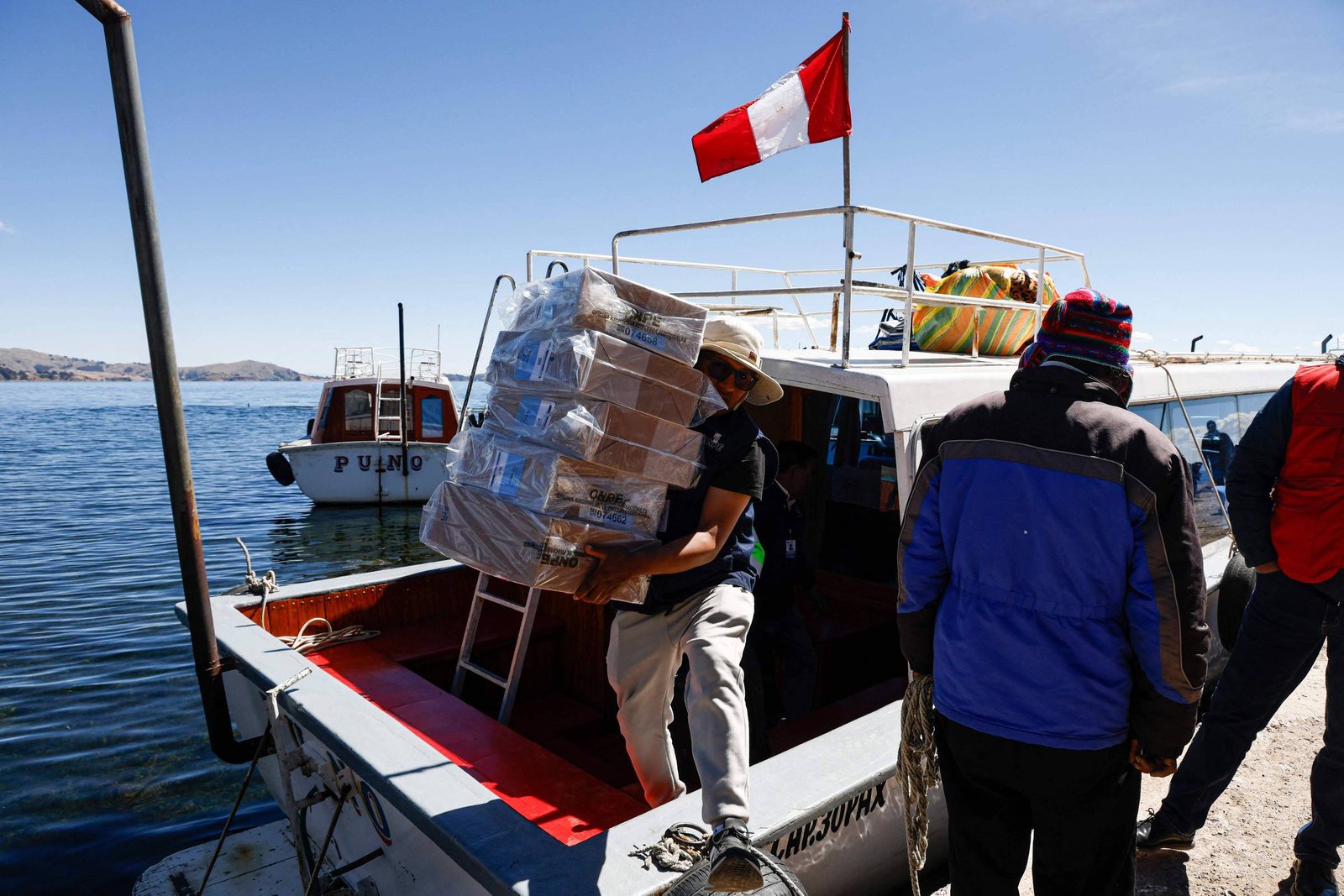
It’s déjà vu: veteran Keiko Fujimori, winner of the first round of elections Peruvians, is running for President of the country against a left-wing candidate with little national prominence who wears a sombrero as a symbol of the forgotten rural world he aims to represent.
Could it be the second round of elections that brought Pedro Castillo to powerin 2021, but the description above refers to the vote this Sunday (7) in the Perua country that has become accustomed to experiencing the same impasses in recent years.
This weekend’s daughter opposes Alberto Fujimoridictator who governed the nation from 1990 to 2000, and Roberto Sánchez, heir to the trade unionist who remained in power from mid-2021 until the end of 2022, when tried to self-coup for which he is currently imprisoned.
As polls of voting intentions indicate, neither of them won a comfortable majority of voters. According to the latest Ipsos survey, carried out on May 29th and 30th, Keiko appears with a slight numerical advantage over Sánchez: 40.4% to 38.3%, a tie within the margin of error of 2.8 percentage points. The highlight, however, goes to the blanks and nulls, which total 21.3% in the survey released last Sunday (31).
No surprise here, considering the crisis of representation that, in the last ten years, has seen nine presidents pass through Casa de Pizarro, the headquarters of the Executive in Lima, and only three parties remaining continuously in Congress from 2001 to 2021.
“For those who live in a country that has a more institutionalized political system, it is truly terrifying not to find an explanatory standard for politics”, says Carlos Ugo Santander, professor at UFG (Federal University of Goiás), about the difficulty of explaining the crisis in his home country to Brazilians.
The chaos, however, is not an accident, according to the expert. “The precariousness of institutions that are part of representative democracy is a project in Peru”, he says.
Santander refers both to the lack of control mechanisms to form parties, for example, and to the rate of professional informality, one of the highest in the region. In South AmericaPeru’s index (71.4%) is second only to Bolivia (83.9%), according to the ILO (International Labor Organization).
It is this type of material issue, according to him, that will motivate the Peruvian vote this Sunday — much more than the usual agendas that the ultra-rightist Rafael López Aliaga, third placed in the election, tried to mobilize in the first round, in vain.
Crime, which caused the cycle of protests responsible for overthrowing former president Dina Boluarte in October 2025, is the country’s main problem for 46.8% of voters, according to a survey by AtlasIntel in partnership with the Bloomberg portal released last month. The issue is second only to corruption, cited by 66.9% of those interviewed.
The concern helps explain the growing rate of undecided voters in the election. Last Friday (5), a judge accepted the request for an investigation against Sánchez, accused by the Public Prosecutor’s Office of making false statements about his party’s financing six years ago. Keiko, in turn, spent more than a year in prisonin 2018 and 2019, on charges of having received bribes from Odebrecht.
As for the other major concern, security, Fujimori’s daughter is betting on her father’s legacy, as she did in the last three elections in which she went to the second round. “Fujimori returns, order returns”, says the candidate’s motto.
“Our country lives in an upside-down world. Military and police officers are persecuted, citizens live behind bars and criminals are free and thriving”, said Keiko in the first and only debate against Sánchez, last Sunday (31). “From day one, we will act firmly. We will implement the national pacification plan.”
The presidential candidate’s bet is risky. “Alberto Fujimori is still a reference of order and stability in a scenario of violence in the 1990s, but the big problem is that the past is not a paradise either”, says Santander.
Remembered for his fight against Peruvian guerrillas, Fujimori led a repression that included at least two massacres involving civilians. Due to the violence and corruption of his regime, the dictator was sentenced to 25 years in prison and died in 2024 at homeafter receiving a humanitarian pardon.
It was precisely the anti-fujimorist sentiment that defeated her in the second round of the last three elections — a tool that she tries to mobilize against Sánchez by associating him with leaders such as Hugo Chávez and Nicolás Maduro.
“History teaches us valuable lessons about the paths to follow and those to avoid,” she wrote in X, this Friday, when describing a conversation with Venezuelan opposition leader and Nobel Peace Prize winner María Corina Machado. “Chávez’s model promised prosperity for all the people, but ended up spreading misery, insecurity and expelling millions of Venezuelans from their own country.”
Sánchez’s antidote to Keiko’s predictable criticism was to seek alliances with other parties — a move that resulted in the launch of a new government plan six days before the elections — and adopt a conciliatory tone with the market. Last Sunday, the candidate guaranteed that he will maintain the autonomy of the Central Bank, key element for Peru’s economic stability.
The promises to grant a pardon to his godfather, Castillo, resisted the repositioning of the presidential candidate’s image, as did the plan to create a new Constitution that recognizes a plurinational State, burying the Charter promulgated by Fujimori in 1993.
The candidate raced against time in the campaign for the second round, partly overshadowed by allegations of fraud coming from Aliaga, without proof. “There is a very clear rule in elections. Unknown candidates have two tasks: to become known and win the election, while the one who is known just needs to win”, says Santander.
Sánchez’s strategy was to adopt the visual identity of Castillo, a rural teacher who still enjoys great popularity in sectors that see his arrest as an injustice caused by the intransigence of the powerful Peruvian Assembly.
In the nation’s unpredictable politics, even Sánchez’s anonymity can be advantageous — although he needs to build a reputation, the candidate is not associated with the country’s chaos like Keiko, whose party has dominated Peruvian politics for years.