On Sunday, June 7, parliamentary elections were held in Armenia, the results of which will determine the vector of the country’s development for years to come. The main question is: will Armenia maintain allied relations with Russia or will it move away from it, finally taking a course towards rapprochement with the European Union and the United States. Judging by the first, preliminary results, Nikol Pashinyan will remain in power, however, the opposition forces also have a chance to strengthen their positions, which does not promise an easy life for the prime minister. A Kommersant correspondent observed the elections in Yerevan Lusine Balasyan.
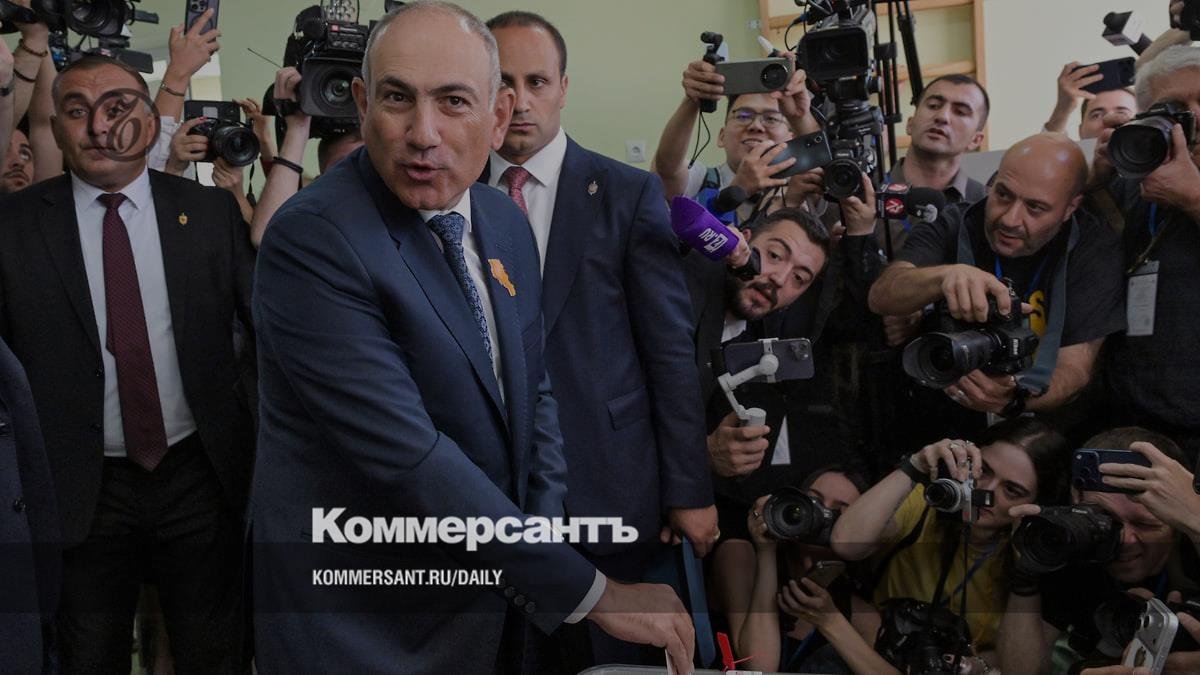
Polling stations opened at 8:00 local time on Sunday. The site on Chekhov Street in Yerevan, equipped in the building of a kindergarten, was at first practically empty, except for Armenian and foreign journalists crowding at the entrance in anticipation of Prime Minister Nikol Pashinyan. The leader of the Civil Contract party, of course, was allowed to vote, but after that they were literally bombarded with questions. And many, as expected, concerned Russia.
“Relations with Russia have an institutional basis and are based on mutual respect. But some forces operating in Armenia are trying to create tension in Armenian-Russian relations,” Pashinyan stated. He clarified that he has “very close relations” with Russian President Vladimir Putin, so, in essence, there are no problems.
The country’s foreign policy choice is perhaps the key aspect of the current parliamentary elections, especially in the context of changed geopolitical realities.
During the reign of Nikol Pashinyan, who has served as prime minister since 2018, Armenia lost Karabakh, negotiated a peace treaty with Azerbaijan, began negotiations to normalize relations with Turkey, and charted a course toward European integration while maintaining membership in the Eurasian Economic Union. The possibility of such a combination had previously worried Moscow; on the eve of the elections, the reaction of the Russian authorities to the new course of the Armenian government became much more painful.
In addition to calls for Armenia to make a final choice, for example, through a referendum, which was also spoken about by Vladimir Putin, Russia over the past month has limited the import of Armenian goods into the country, from fruits to fish. At the same time, the Armenian authorities convinced the population that the loss of exports would be partially compensated by supplies to the EU countries, and most issues with Russia would be resolved after the elections.
Many Armenian voters view their government’s actions with disapproval. “We should be friends,” says an elderly Yerevan resident standing in line at a polling station. This opinion is heard often here. But at the same time, some admit that they do not fully understand Russia’s position, “after all, no one wanted to offend it.”
“We generally need to learn to live on our own. Being only with Russia or only with Europe—nothing good can come of it. Everyone has their own interests,” says Asya, a young screenwriter. She is disillusioned with the main political forces of Armenia: Asya does not trust either the authorities or the opposition.
“I want everything to be fine” – I’ve heard this phrase here many times. For some, this means that life needs to be changed for the better, for others – that nothing needs to be changed. “As it is, it’s already good,” the elderly woman answers when asked what changes she expects after the elections.
There is a lot of talk in Yerevan about whether the opposition will take to the streets if it considers the election results to be rigged. “Even if the result does not suit many, no one will do anything about it,” the 21-year-old guy, who came to vote for the first time, is convinced.
The expected result is a parliamentary majority of the “Civil Contract”. In this fight, he is opposed by the “Armenia” bloc of former President Robert Kocharyan, the “Prosperous Armenia” party of Garik Tsarukyan and, the most popular opposition force, the recently created “Strong Armenia” bloc of the head of the Tashir Group of Companies, Samvel Karapetyan, who is under house arrest in Yerevan.
The election campaign was accompanied by criminal cases against the opposition and numerous arrests. And voting day was no exception: on June 7, police officers raided the Strong Armenia office in the city of Gyumri. Five people were detained on charges of giving or receiving bribes for certain activities related to the elections. Samvel Karapetyan said on Sunday that more than 100 of his supporters had been detained over the past two days. According to Garik Tsarukyan, 50 people supporting his party were detained. The opposition claims that they recorded numerous violations by representatives of the ruling party during the elections.
At the same time, Samvel Karapetyan, whose supporters greeted him at the polling station with applause, in response to a question about the plans of the political force in case of loss, assured: there is no such plan and there will not be. “The scenario depends on the Armenian people, how can I have a different plan? As the people decide, so will they decide,” explained the businessman turned politician.
According to preliminary estimates, the opposition may slightly increase its strength in parliament, which will force the “Civil Contract” to take into account the position of its opponents when building its policy. However, the final balance of power in the future parliament will become clear after the vote count is completed.
It is noteworthy that, according to the latest data, the turnout in the elections was 58.97% (1 million 476 597 people) – this is significantly more than in 2021 and 2018 (then the turnout was 49.3% and 48.6%, respectively).
The queues at polling stations in Yerevan were getting longer by the second half of Sunday. “This has never happened before!” — I heard the surprised voice of an elderly woman who approached one of the sites in the city center.
“Coming to the polls is our civic duty,” people in line explain. One of them, speaking about the possible results of the elections, notes: “In fact, everyone wants one thing. Everyone wants a good life. Eat deliciously, drink deliciously, live in peace. The only question is what path to take to achieve this.”